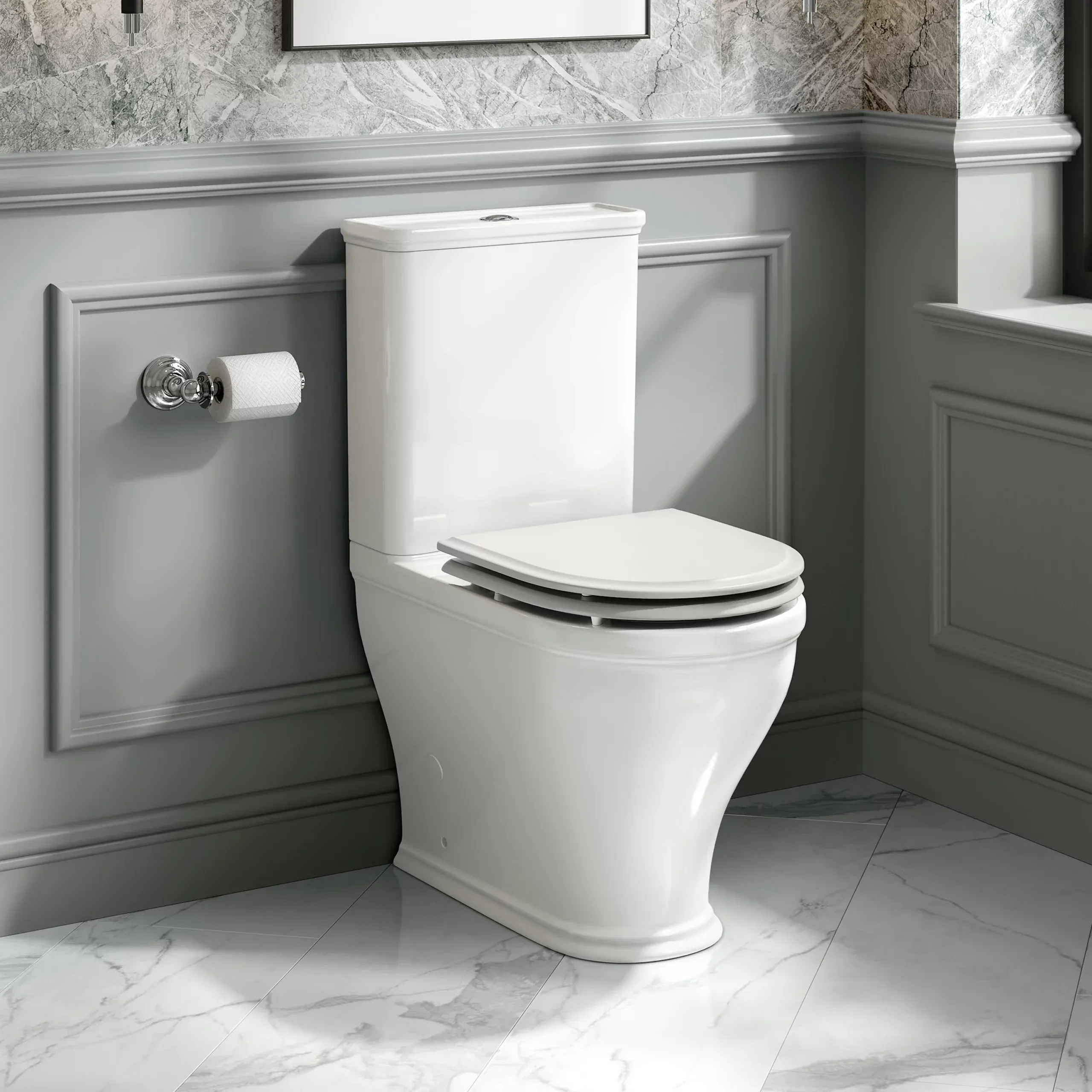
A rimless toilet is a ceramic toilet pan with an open-flow flushing channel that increases hygiene, improves cleaning efficiency and strengthens flush coverage because the design removes the concealed rim cavity found in traditional toilets. Full-surface water distribution reduces residue because every internal area receives continuous exposure during flushing. Smooth contours accelerate maintenance because unobstructed edges provide complete access. Rimless toilet formats, including close-coupled, wall-hung, back-to-wall and compact designs, deliver consistent performance because each type applies the same open-flow engineering. Installation accuracy, channel alignment and steady water entry determine flush effectiveness because rimless systems rely on uninterrupted flow. Cost ranges from £120.00 to £570.00 because material density, glazing quality and structural complexity vary across formats. Functional benefits include stronger hygiene, faster cleaning, wider coverage, reduced residue and increased reliability because rimless construction eliminates hidden trapping points. Upgrade suitability increases when hygiene priorities, spatial requirements and design preferences align with the operational advantages of rimless flushing.
What Is a Rimless Toilet?
A rimless toilet is a ceramic toilet pan without a closed rim that uses an open-flow channel to deliver full bowl coverage and higher hygiene performance. Removal of the traditional rim cavity eliminates the concealed zone where residue forms on standard toilet bowls. Open-flow distribution increases flush reach across the entire bowl circumference and increases cleanliness through continuous surface contact. Wider flush exposure decreases scrubbing frequency and decreases bacterial retention during routine maintenance. Structural compatibility with close-coupled toilets, wall-hung toilets and back-to-wall toilets supports consistent installation across varied bathroom layouts.
How Does a Rimless Toilet Work?
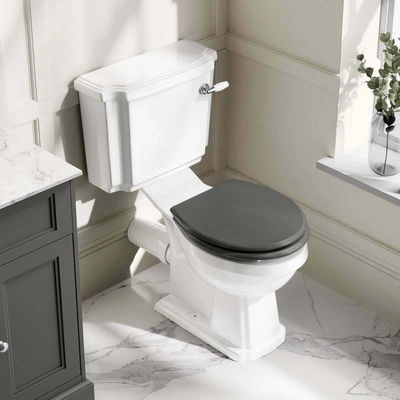
A rimless toilet works by directing flush water through an open-flow channel that distributes water across the full bowl circumference without a concealed rim cavity. The open channel guides water along a controlled path, and this guided movement increases surface contact because no overhanging rim blocks the flow. High-velocity dispersion strengthens waste removal because the water stream moves freely around the bowl. Continuous circulation enhances hygiene because every internal surface receives equal exposure during each flush cycle. Structural simplicity supports easier maintenance because unrestricted edges allow clear visibility and complete access during cleaning.
Flush Path and Water Distribution
Full-surface distribution develops from the open-flow channel that releases water evenly around the bowl. Uniform coverage improves cleansing because the flush stream maintains consistent force along all exposed areas. Targeted direction reduces missed zones because no enclosed rim interrupts the water path.
Hydraulic Action and Waste Removal
Efficient waste removal results from continuous, uninterrupted hydraulic action along the bowl interior. Stable flow increases removal strength because water maintains momentum from entry to exit. Complete circulation reduces residue formation because the motion covers all functional surfaces.
Structural Design and Maintenance Access
Simplified structural design increases accessibility because no rim overhang conceals internal areas. Clear sightlines support thorough maintenance because all surfaces remain visible during cleaning. Reduced hidden zones minimise long-term debris accumulation because routine flushing already reaches every section of the toilet pan.
Why Choose a Rimless Toilet?
A rimless toilet provides higher hygiene performance, faster cleaning and wider flush coverage because the design removes the concealed rim cavity found in traditional toilet pans. Open-flow distribution increases cleanliness because the flush stream reaches every internal surface during each cycle. Smooth internal geometry decreases residue formation because no sheltered zone exists underneath a rim overhang. Direct access around the bowl edge strengthens maintenance efficiency because manual wiping reaches the full circumference without obstruction. Continuous surface contact maintains consistent performance because uniform water movement supports reliable waste removal across varied bathroom layouts.
Hygiene Performance Benefits
Higher hygiene performance follows from unobstructed flush paths that expose all bowl surfaces to continuous water movement. Seamless interiors limit residue attachment because water contacts the entire circumference without blockage. Enhanced exposure disrupts bacterial settlement because no concealed cavity offers protection during daily use.
Cleaning and Maintenance Benefits
Faster cleaning efficiency develops from open bowl edges that provide unrestricted access to every internal surface. Clear visibility improves maintenance accuracy because cleaning tools reach all areas without resistance. Reduced scrubbing frequency results from the open-flow structure because routine flushing already covers the main sanitation zones.
Flush Coverage and Functional Benefits
Wider flush coverage results from the directed open-flow channel that circulates water uniformly around the bowl. Controlled flow supports consistent waste removal because uninterrupted movement preserves hydraulic force. Stable performance continues over time because simple internal geometry reduces mechanical resistance during flushing.
Are Rimless Toilets More Hygienic Than Traditional Toilets?
A rimless toilet is more hygienic than a traditional toilet because the open-flow channel removes the concealed rim cavity where residue accumulates. Continuous flush exposure reaches every internal surface and increases cleanliness because no hidden zone remains inside the toilet pan. Removal of the rim cavity decreases bacterial settlement because residue cannot anchor beneath an overhang. Direct bowl access strengthens maintenance efficiency because manual cleaning covers the full circumference without obstruction. Structural simplicity reduces long-term hygiene risks because smooth surfaces maintain consistent wash coverage during every flush cycle.
Hygiene Advantages of Rimless Toilets
Higher hygiene performance results from full-surface flush coverage during each use. Comprehensive water dispersion reduces residue accumulation because the open-flow channel directs water around the entire bowl circumference. Consistent movement across exposed surfaces disrupts bacterial retention because no sheltered zone forms inside the pan. Broader visibility improves sanitation because maintenance routines identify and address all surface changes without difficulty.
Cleaning Efficiency in Rimless Toilets
Faster cleaning efficiency develops from the unobstructed edge profile that allows full interior access. Smooth contours reduce cleaning time because wiping motions reach every surface without interruption. Clear visibility supports more precise maintenance because no concealed cavity prevents residue detection. Lower scrubbing frequency follows from this open configuration because flush action already covers the primary cleaning zones.
Hygiene Limitations of Traditional Toilets
Lower hygiene performance follows from enclosed rim channels that trap residue during repeated use. Restricted flush paths prevent water from reaching hidden rim sections and create stagnant pockets that promote bacterial persistence. Concealed overhangs obstruct manual wiping because cleaning tools cannot reach narrow recessed areas. Accumulated residue increases hygiene burdens because deep cleaning becomes necessary to offset reduced daily flush coverage.

Do Rimless Toilets Splash During Flushing?
A rimless toilet prevents splash during flushing because the open-flow channel controls water direction and stabilises the flush path. Guided release manages velocity across the bowl circumference and reduces outward movement because no rim obstruction redirects water unpredictably. Controlled dispersion maintains clean operation because the stream flows within the bowl boundary. Balanced flow patterns decrease droplet formation because forces remain consistent throughout the flush cycle. Structural engineering supports clean usage because bowl geometry and channel shaping regulate water movement from entry to exit.
Water Direction Control
Splash prevention begins with controlled water direction along the open-flow channel. Precision shaping stabilises the flush trajectory because the stream follows a defined route around the bowl. Consistent guidance reduces turbulence because no enclosed rim disrupts momentum.
Velocity and Flow Stability
Flow stability reduces splashing because uniform velocity prevents uneven pressure spikes. Balanced movement lowers splash likelihood because forces remain equal across the bowl surface. Even distribution contains water within the bowl because controlled circulation avoids upward deflection.
Bowl Geometry and Containment
Bowl geometry contributes to splash reduction because smooth contours absorb water movement without sharp transitions. Curved surfaces redirect energy downward because the design encourages inward flow. Wider coverage zones increase containment because water settles across the full bowl interior rather than striking confined areas.
How Do Rimless Toilets Compare with Traditional Rim Toilets?
A rimless toilet outperforms a traditional rim toilet in hygiene, cleaning efficiency, flush coverage and maintenance simplicity because the design removes the concealed rim cavity that restricts water distribution. Open-flow circulation increases surface contact because the stream reaches the full bowl circumference during each flush cycle. Smooth contours decrease residue formation because no recessed rim channel collects debris. Direct access strengthens cleaning efficiency because all surfaces remain exposed. Consistent dispersion improves flushing performance because uninterrupted water movement maintains stable hydraulic action.
Comparison of Rimless Toilets and Traditional Rim Toilets
The table below defines the key performance differences between rimless toilets and traditional rim toilets across hygiene, cleaning, flush behaviour and structural design.
| Performance Dimension | Rimless Toilet Characteristics | Traditional Rim Toilet Characteristics |
| Hygiene | Full-surface water coverage; no concealed rim cavity; reduced bacterial settlement | Hidden rim cavity traps residue; limited water reach increases bacterial formation |
| Cleaning | Easy access to all internal surfaces; no overhang; reduced scrubbing frequency | Obstructed access under rim; residue accumulation requires deep cleaning |
| Flush Coverage | Open-flow channel circulates water uniformly around bowl | Enclosed rim restricts water path and reduces bowl coverage |
| Splash Control | Controlled flow direction stabilises flushing and reduces splash | Irregular flow caused by rim geometry increases turbulence |
| Maintenance | Smooth structure decreases long-term build-up; easier inspection | Rim channels retain debris; higher maintenance workload |
| Usability | Consistent flush behaviour across varied installation types | Variable performance based on rim design and cavity shape |
What Are the Types of Rimless Toilets?
A rimless toilet range includes close-coupled rimless toilets, wall-hung rimless toilets, back-to-wall rimless toilets and compact rimless toilets because each format applies open-flow flushing without a concealed rim cavity. Structural variations support different spatial demands because every model maintains full-surface bowl coverage through continuous water distribution. Functional consistency remains stable across all types because rimless engineering removes hidden rim channels that restrict water movement.
Close-Coupled Rimless Toilets

Close-coupled rimless toilets combine the cistern and pan into a single vertical unit that delivers full-surface flushing through an open-flow channel. Integrated structure simplifies installation because the cistern sits directly above the pan. Compact proportions support varied floor plans because the unified profile reduces projection. Continuous surface contact increases hygiene because no rim cavity obstructs water movement inside the bowl.
Wall-Hung Rimless Toilets

Wall-hung rimless toilets mount the rimless pan on a concealed frame to maximise floor clearance and strengthen accessibility. Raised positioning accelerates cleaning because open floor space around and beneath the pan remains fully accessible. Streamlined geometry enhances modern interior layouts because the suspended form creates visual lightness. Full-coverage flushing maintains hygiene because the open-flow system distributes water uniformly across all internal surfaces.
Back-to-Wall Rimless Toilets

Back-to-wall rimless toilets position the rimless pan directly against a wall or furniture unit to conceal pipework and create a clean architectural line. Hidden connections improve visual uniformity because no external pipework remains exposed. Reduced projection strengthens layout efficiency because closer placement maximises usable space. Full-surface flush contact improves bowl cleanliness because the absence of rim cavities prevents residue retention.
Compact Rimless Toilets
Compact rimless toilets shorten overall projection to support reduced floor areas while retaining complete rimless flushing performance. Smaller dimensions accommodate cloakrooms and en-suites because the pan depth decreases without altering functional output. Continuous water exposure maintains hygiene because flush reach remains equal to standard-sized rimless formats.
How Much Does a Rimless Toilet Cost?
A rimless toilet cost ranges from £120.00 to £570.00 because material quality, installation format and design complexity determine overall pricing. Price variation reflects ceramic density, glazing performance and structural engineering while maintaining full-surface open-flow flushing across all rimless formats.
Budget Rimless Toilet Costs (£120.00–£220.00)
Budget rimless toilets occupy the £120.00–£220.00 range because simplified construction and standard glazing reduce manufacturing demand. Essential rimless performance remains constant because open-flow channels deliver full bowl coverage regardless of price. Compact models often appear in this band because reduced projection decreases material use.
Mid-Range Rimless Toilet Costs (£220.00–£400.00)
Mid-range rimless toilets fall within the £220.00–£400.00 range because improved ceramic density, refined contours and enhanced glazing increase production quality. Stronger structural composition increases durability because higher density resists long-term wear. Broader design availability supports varied layouts because close-coupled, back-to-wall and compact options dominate this category.
Premium Rimless Toilet Costs (£400.00–£570.00)
Premium rimless toilets reach the £400.00–£570.00 range because advanced materials, designer forms, soft-close components and concealed systems require greater engineering precision. Superior glazing maintains clarity because smooth finishes resist staining. Wall-hung formats sit in this tier because reinforced frames and concealed carriers increase installation complexity.
Factors Affecting Total Rimless Toilet Cost
Total cost depends on cistern configuration, seat specification and installation requirements. Concealed systems elevate costs because frames and carriers support structural loads. Seat quality influences pricing because reinforced hinges and soft-close mechanisms increase material strength. Labour complexity adjusts final expenditure because wall-hung and back-to-wall formats require additional preparation.
How Do You Choose the Right Rimless Toilet?
The right rimless toilet is chosen by evaluating bathroom space, installation format, flushing performance, maintenance requirements and design compatibility because these factors determine functional and structural suitability. Accurate selection ensures consistent hygiene performance because rimless technology depends on proper positioning, system pairing and bowl geometry.
Space and Layout Requirements
Space suitability depends on projection, width and available clearance around the rimless toilet. Smaller rooms benefit from compact or short-projection rimless pans because reduced depth increases movement space. Larger layouts support close-coupled or back-to-wall formats because extended projection fits without restricting circulation zones. Wall-hung formats optimise usable area because elevated mounting frees floor space for cleaning and access.
Installation Format and Structural Compatibility
Installation compatibility depends on the existing plumbing position, cistern type and wall structure. Close-coupled rimless models suit standard floor plumbing because the cistern and pan align vertically. Back-to-wall rimless designs integrate with concealed cisterns because pipework sits behind furniture or within a stud wall. Wall-hung rimless pans require reinforced frames because concealed carriers support load distribution. Correct installation alignment maintains full-surface flushing because the open-flow channel relies on stable water entry angles.
Flushing Performance and Water Efficiency
Performance suitability depends on flush volume, bowl geometry and open-flow channel design. Strong rimless performance relies on consistent water distribution because full-surface contact ensures thorough cleaning. Lower-volume flush systems remain efficient because channel engineering maximises surface coverage with reduced water use. Balanced flush dispersion strengthens hygiene because the flow reaches all internal surfaces without obstruction.
Cleaning and Maintenance Needs
Maintenance suitability depends on bowl access, surface smoothness and internal contour design. Rimless toilets with simplified profiles accelerate cleaning because every surface remains accessible without rim obstruction. Glazed interiors reduce residue formation because smoother surfaces resist build-up. Minimal joints improve sanitation because continuous contours prevent debris retention during daily use.
Design Style and Bathroom Integration
Design compatibility depends on shape, pan height, connection concealment and overall aesthetic direction. Modern interiors benefit from wall-hung rimless forms because clean lines enhance visual clarity. Traditional or transitional spaces pair effectively with close-coupled rimless toilets because the unified structure maintains familiar proportions. Back-to-wall formats support minimal visual schemes because concealed pipework creates a streamlined appearance.
Durability and Material Quality
Durability suitability depends on ceramic density, glaze performance and hinge construction. High-density ceramic increases longevity because structural strength resists wear. Anti-scratch glazing protects interior surfaces because smoother coatings reduce abrasion. Robust hinge systems enhance seat stability because movement remains controlled over long-term usage.
How Do You Install a Rimless Toilet?
A rimless toilet is installed by positioning the pan, securing the fixings, connecting the waste outlet, attaching the cistern or frame system and completing the water supply connection because each step ensures structural stability and correct flushing function. Accurate installation preserves rimless performance because the open-flow channel depends on precise alignment, steady water entry and secure anchoring.
Positioning and Marking the Rimless Toilet Pan
Pan positioning begins with aligning the rimless toilet over the waste outlet to confirm projection, height and structural clearance. Accurate marking defines fixing points because secure placement prevents movement during use. Correct alignment preserves flush efficiency because the open-flow system requires consistent entry angle and bowl orientation.
Securing Floor or Wall Fixings
Fixing installation strengthens stability because anchored bolts prevent pan displacement. Floor-mounted rimless toilets use base fixings because the pan transfers load directly to the floor surface. Wall-hung rimless toilets use concealed frames because load-bearing carriers distribute weight across reinforced structures. Stable anchoring preserves water path accuracy because misalignment disrupts rimless flow distribution.
Connecting the Waste Outlet
Waste connection attaches the rimless toilet pan to the soil pipe using a sealed coupling to maintain airtight waste removal. Secure engagement prevents leakage because compression seals maintain continuous pressure. Correct gradient supports waste clearance because aligned pipe angles maintain flow momentum.
Installing the Cistern or Concealed System
Cistern installation depends on the selected rimless toilet format. Close-coupled models attach the cistern directly to the pan because the system operates as a single vertical unit. Back-to-wall and wall-hung formats integrate with concealed cisterns because pipework sits within a frame or furniture unit. Accurate connection preserves flush volume because the rimless channel requires steady water delivery.
Attaching the Water Supply
Water supply connection completes the installation because the inlet valve regulates controlled flow into the cistern. Secure joints maintain pressure consistency because stable flow ensures correct rimless flushing. Leak testing protects long-term performance because early detection prevents structural damage.
Testing Flush Function and Stability
Flush testing verifies rimless performance because uniform water distribution confirms correct installation. Bowl inspection confirms full-surface coverage because complete exposure indicates proper channel alignment. Structural checks confirm stability because secured fixings prevent movement during operation.
How Do You Clean a Rimless Toilet Properly?
A rimless toilet is cleaned properly by applying a suitable cleaner, wiping all exposed surfaces, flushing the bowl and inspecting the interior because rimless construction provides full access without concealed rim cavities. Complete visibility strengthens hygiene maintenance because every bowl section remains reachable during routine cleaning.
Applying the Cleaning Solution
Cleaning starts with applying a toilet-safe cleaner across all internal surfaces because uniform distribution increases residue removal efficiency. Balanced formulas protect ceramic glazing because controlled pH levels prevent surface wear. Full exposure supports breakdown of deposits because no rim cavity restricts chemical contact.
Wiping All Internal and External Surfaces
Residue removal depends on wiping every accessible area because the rimless edge profile exposes the entire bowl circumference. Smooth contours accelerate cleaning because uninterrupted geometry allows direct cloth movement. Equal surface reach enhances sanitation because every internal zone receives consistent treatment.
Flushing to Remove Loosened Deposits
Flushing completes the cleaning cycle because water movement removes detached residue from the bowl surface. Continuous circulation reinforces hygiene because the open-flow channel distributes water along the full circumference. Unrestricted contact confirms effective cleaning because no concealed zones exist for debris retention.
Inspecting the Bowl After Flushing
Inspection verifies cleanliness because rimless design provides clear sightlines across all interior surfaces. Direct visibility increases accuracy because manual checks detect remaining residue immediately. Early identification strengthens long-term hygiene because prompt action prevents build-up.
Maintaining a Regular Cleaning Routine
Routine cleaning frequency preserves rimless performance because consistent maintenance limits residue formation. Durable glazing maintains cleanliness because reduced porosity resists staining. Scheduled care supports stable hygiene outcomes because ongoing upkeep sustains full-surface exposure during every flush.
How Water Efficient Are Rimless Toilets?
A rimless toilet is water efficient because the open-flow channel delivers full-surface coverage with reduced flush volumes while maintaining strong cleaning performance. Precision distribution strengthens efficiency because uniform contact across the bowl removes waste without requiring excess water. Optimised geometry preserves hydraulic momentum because uninterrupted flow clears the bowl with fewer litres per flush.
Flush Volume and Distribution Efficiency
Water efficiency increases when engineered channels maximise bowl coverage using controlled flush volumes. Dual-flush systems reduce consumption because lower-volume options manage liquid waste effectively. Full-circumference exposure improves cleaning accuracy because directed flow contacts all surfaces simultaneously. Stable dispersion prevents unnecessary repeat flushing because each cycle achieves complete removal.
Hydraulic Performance and Resource Reduction
Hydraulic efficiency strengthens conservation because high-velocity open-flow movement reduces the water required for thorough cleaning. Consistent flow paths maintain strength because uninterrupted trajectories prevent pressure loss during circulation. Reduced turbulence supports resource control because water remains fully directed along the intended route, increasing overall flushing precision.
Long-Term Consumption Stability
Long-term water efficiency remains consistent because rimless construction prevents residue accumulation in concealed areas. Clean surfaces reduce repeat flush demand because bowl visibility supports immediate waste removal. Predictable flow behaviour stabilises consumption because engineered channels maintain their effectiveness over extended use.
Which Rimless Toilet Is Best for Your Bathroom Type?
The best rimless toilet for a specific bathroom type is chosen by matching room size, layout constraints and design priorities with the structural format of the rimless toilet. Precise pairing strengthens functionality because each rimless format delivers different spatial, aesthetic and installation advantages while maintaining full-surface flushing performance.
Small Bathrooms and Cloakrooms
Compact rimless toilets suit small bathrooms and cloakrooms because reduced projection preserves movement space without sacrificing rimless flushing efficiency. Shorter pan depth improves accessibility because tighter layouts require minimal forward extension. Continuous bowl exposure maintains hygiene because reduced size does not limit open-flow performance.
En-Suites
Back-to-wall rimless toilets suit en-suites because concealed pipework creates a clean visual line that integrates with fitted furniture. Closer placement increases spatial efficiency because projection remains controlled. Full-surface flushing strengthens day-to-day cleanliness because rimless construction prevents hidden residue formation in compact private spaces.
Family Bathrooms
Close-coupled rimless toilets suit family bathrooms because integrated cistern-and-pan design provides reliable performance with simplified installation. Unified structure enhances stability because vertical alignment manages frequent daily use. Full-coverage flushing maintains hygiene because continuous water contact supports busy household routines.
Modern and Minimalist Bathrooms
Wall-hung rimless toilets suit modern and minimalist bathrooms because elevated mounting creates open floor space and a streamlined visual profile. Clear flooring strengthens usability because cleaning access improves beneath the suspended pan. Uniform bowl coverage maintains hygiene because rimless construction delivers complete internal reach regardless of mounting height.
Large Bathrooms and Premium Layouts
Back-to-wall and wall-hung rimless toilets suit large bathrooms because clean geometry enhances spacious design themes. Concealed systems refine visual flow because mechanical components remain hidden. Full bowl exposure supports consistent hygiene because engineered open-flow channels maintain strong performance across all installation scales.
What Are Common Rimless Toilet Problems and How Do You Fix Them?
Common rimless toilet problems include splash misalignment, weak flushing, noise during flushing, seat instability, limescale build-up and overflow irregularities because these issues relate to installation accuracy, water flow behaviour and maintenance consistency. Corrective actions strengthen rimless performance because precise adjustments restore open-flow distribution, stability and hygiene efficiency.
Splash Misalignment
Splash misalignment occurs when the flush stream enters the bowl at an incorrect angle because pan alignment or cistern positioning is inaccurate. Realigning the pan corrects trajectory because proper placement stabilises water movement. Adjusting the fill valve refines flow control because balanced pressure decreases turbulence. Restored directional consistency increases cleanliness because the stream remains contained within the bowl.
Weak Flushing
Weak flushing develops when restricted water volume, obstructed channels or incorrect valve height reduces hydraulic strength. Increasing flush volume improves waste removal because adequate water quantity reinforces flow momentum. Clearing inlet or outlet blockages strengthens distribution because unobstructed channels maintain continuous movement. Adjusting valve height restores optimal entry because rimless systems rely on precise water depth for full-surface reach.
Noise During Flushing
Flush noise arises when uneven water velocity or loose fittings disrupt smooth circulation. Regulating inlet pressure decreases noise because controlled flow prevents vibration. Securing internal components reduces sound because stable fittings eliminate rattling. Correcting flush timing improves flow harmony because uniform distribution supports quieter rimless operation.
Seat Instability
Seat instability results from worn or loose hinge fittings because repeated use weakens connection points. Tightening hinge screws restores firmness because secure anchoring prevents lateral movement. Replacing damaged hinge parts increases durability because reinforced components maintain alignment. Level seating enhances comfort because balanced support distributes weight evenly.
Limescale Build-Up
Limescale build-up forms when mineral deposits accumulate on exposed ceramic surfaces. Applying descaling solution removes deposits because acidic agents dissolve hardened mineral layers. Increasing cleaning frequency reduces recurrence because fresh surfaces restrict adhesion. Using glaze-compatible products protects bowl coatings because smooth finishes resist future build-up.
Overflow and Cistern Irregularities
Overflow irregularities occur when inlet valves fail to close because internal seals degrade or the float height is incorrect. Replacing worn seals restores controlled filling because tight barriers regulate water entry. Adjusting float height prevents overflow because accurate positioning stops excess water accumulation. Cleaning the fill valve improves responsiveness because sediment removal restores full operational movement.
Most Frequently Asked Questions About Rimless Toilets
Are Rimless Toilets More Hygienic?
A rimless toilet is more hygienic because full-surface flushing eliminates the concealed rim cavity where residue accumulates. Uniform water exposure disrupts bacterial settlement because every internal surface receives direct contact.
Do Rimless Toilets Splash?
A rimless toilet prevents splash because controlled channel design manages flow direction and stabilises water movement. Balanced dispersion maintains clean operation because the stream remains contained inside the bowl.
Are Rimless Toilets Easy to Clean?
A rimless toilet is easy to clean because open edges and smooth contours provide full access to all internal surfaces. Direct visibility accelerates maintenance because no rim overhang conceals residue.
Do Rimless Toilets Flush Better?
A rimless toilet flushes effectively because uninterrupted hydraulic flow circulates water around the entire bowl circumference. Consistent force improves waste removal because the flow path remains unobstructed.
Are Rimless Toilets Noisy?
A rimless toilet operates quietly because controlled water entry maintains stable velocity through the open-flow channel. Smooth circulation reduces vibration because no enclosed rim disrupts movement.
Do Rimless Toilets Work with All Cistern Types?
A rimless toilet works with standard close-coupled cisterns, concealed cisterns and wall-mounted frames because the open-flow channel depends on distribution, not cistern format. Correct alignment preserves flushing efficiency because entry angle consistency supports full-surface coverage.
Are Rimless Toilets Compatible with Small Bathrooms?
A rimless toilet suits small bathrooms because compact and short-projection models reduce forward extension while maintaining full flushing performance. Efficient dimensions improve layout flexibility because reduced projection increases usable space.
How Long Do Rimless Toilets Last?
A rimless toilet maintains long-term usability because high-density ceramic and durable glazing resist wear. Stable open-flow construction preserves performance because fewer hidden structures reduce points of failure.
Do Rimless Toilets Cost More?
A rimless toilet cost ranges from £120.00 to £570.00 because material quality, installation format and design complexity influence pricing. Performance remains consistent across price bands because rimless functionality depends on channel engineering.
Can Rimless Toilets Replace Traditional Toilets?
A rimless toilet replaces a traditional toilet because installation methods and waste connections align with standard plumbing systems. Correct fitting preserves structural integrity because anchoring and alignment maintain flushing behaviour.
Conclusion
A rimless toilet delivers higher hygiene performance, faster cleaning and wider flush coverage because the open-flow channel removes the concealed rim cavity that traps residue in traditional toilets. Full-surface water contact maintains internal cleanliness because every bowl section receives continuous exposure during flushing. Smooth contours simplify maintenance because unobstructed edges allow complete access during routine cleaning. Consistent performance remains across close-coupled, wall-hung, back-to-wall and compact formats because each design applies identical rimless engineering. Cost variation between £120.00 and £570.00 reflects material density, glazing quality and structural complexity. Functional reliability strengthens daily use because stable water entry, precise installation and reduced residue formation preserve long-term performance.