A corner toilet buying guide explains how angled toilet designs solve space constraints by repositioning the pan and cistern into wall junctions, outlining dimensional requirements, installation constraints, performance equivalence, and suitability factors to support accurate selection for compact bathrooms, cloakrooms, and en-suites.
Corner toilets address layout limitations where linear wall length restricts standard toilet placement. Selection accuracy depends on understanding dimensions, waste outlet alignment, installation tolerances, comfort metrics, and long-term maintenance implications rather than appearance alone.
What Is a Corner Toilet?
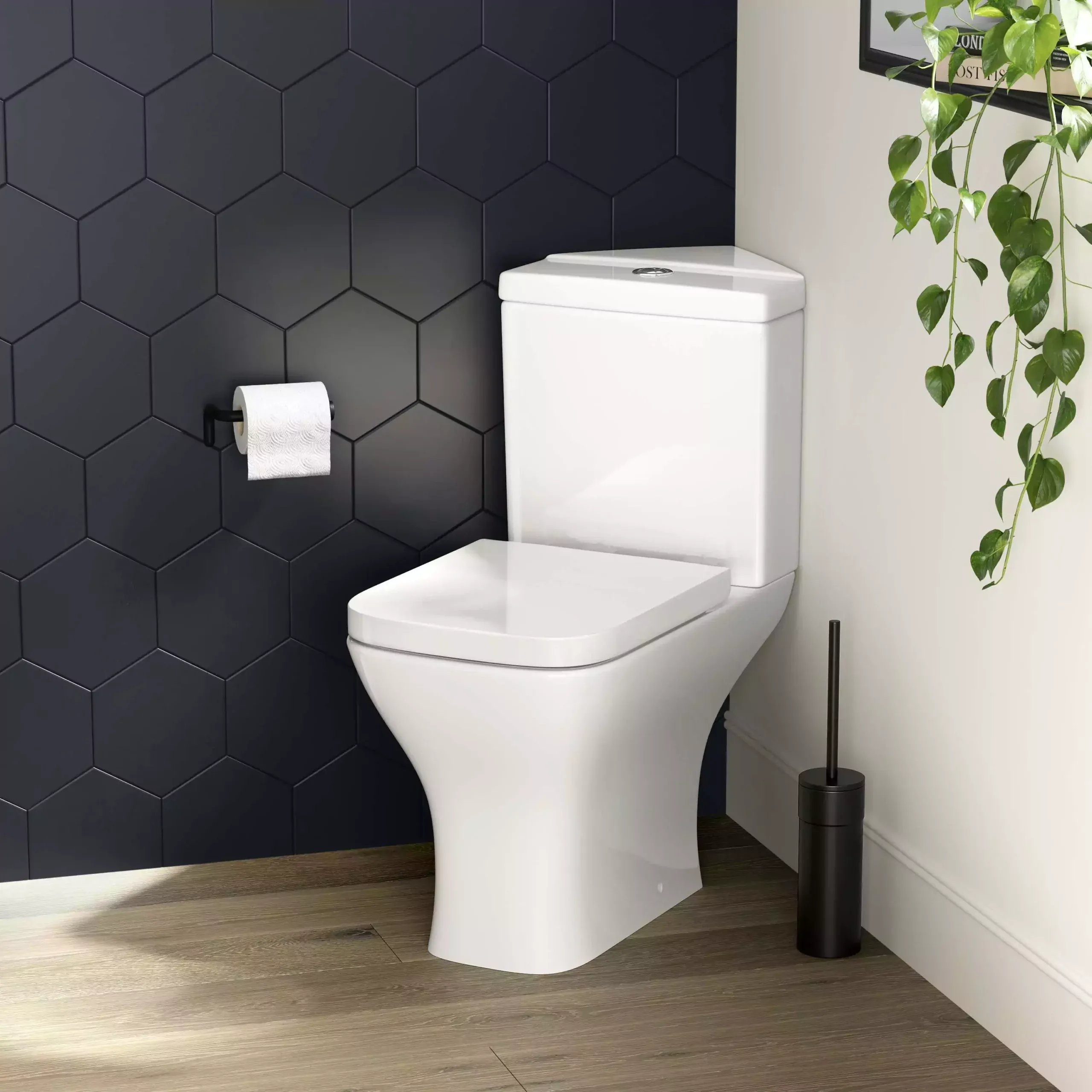
A corner toilet is a WC designed for installation at a 90-degree wall junction, using an angled pan and cistern to occupy unused corner space while maintaining standard flush performance, pan height, and compliance with UK sanitation and drainage regulations.
Corner toilets reposition the footprint away from straight walls.
Corner toilets improve layout efficiency in compact bathrooms and cloakrooms.
Key Features of Corner Toilets:
- Angled cistern geometry for wall junction alignment
- Standard seat height between 400–420 mm
- Compatibility with dual-flush systems
Why Are Corner Toilets Used in Small Bathrooms?
Corner toilets are used in small bathrooms because corner placement reduces forward projection by 80–140 mm, increases usable floor area, and improves circulation clearance around doors, basins, and walkways in rooms under 3.5 m².
Straight-wall toilets consume continuous wall length.
Corner installations convert unused junctions into functional space.
Reasons corner toilets improve small bathrooms:
- Reduced linear wall dependency
- Improved door swing clearance
- Increased flexibility for basin positioning
How Does a Corner Toilet Save Space?
A corner toilet saves space by shifting the pan and cistern footprint into unused wall junctions, reducing linear wall demand and increasing floor circulation clearance without compromising comfort, hygiene, or flushing efficiency.
Straight-wall toilets restrict layout flexibility.
Corner alignment improves spatial balance in tight layouts.
Steps:
- Identify unused wall junction zones
- Relocate cistern footprint into corner geometry
- Reduce forward projection depth
- Improve central floor circulation
What Types of Corner Toilets Are Available?
Corner toilets are available as close-coupled, back-to-wall, and wall-hung configurations, each offering different levels of pipework concealment, installation complexity, and aesthetic presentation while maintaining corner-specific geometry.
Each configuration suits different bathroom layouts.
Installation constraints influence suitability.
Types:
Close-coupled corner toilets
A close-coupled corner toilet combines pan and cistern into a single fixed unit designed for corner alignment, offering straightforward installation, visible pipework access, and compatibility with traditional and modern bathroom layouts.
Installation complexity remains low.
Maintenance access remains direct.
Back-to-wall corner toilets
A back-to-wall corner toilet positions the pan against a boxed or concealed cistern structure, hiding pipework while maintaining a corner footprint, supporting minimalist aesthetics and easier external cleaning.
Cistern access requires removable panels.
Pipework alignment requires planning.
Wall-hung corner toilets
A wall-hung corner toilet mounts the pan onto a concealed steel frame rated to 400 kg load capacity, freeing floor space, improving hygiene access, and requiring reinforced wall structures and professional installation.
Frame systems dictate positioning accuracy.
Maintenance access routes require planning.

What Dimensions Do Corner Toilets Have?
Corner toilets typically feature pan projections of 520–620 mm, pan heights of 400–420 mm, cistern depths of 380–450 mm, and require symmetrical wall junction angles within ±3 degrees to ensure correct alignment, sealing integrity, and waste outlet compatibility.
Corner toilet dimensions determine usability, comfort, and installation feasibility.
Incorrect dimensional assumptions create alignment, clearance, and compliance issues.
Key dimension checks:
- Pan projection from wall junction
Pan projection measures the distance from the corner wall junction to the front rim of the toilet pan.
Projections under 550 mm suit cloakrooms under 2.5 m².
Projections above 580 mm improve seated comfort but reduce circulation clearance. - Floor-to-seat height measurement
Floor-to-seat height defines seated ergonomics and accessibility compliance.
Standard heights range between 400–420 mm measured from finished floor level to seat top.
Comfort-height models reach 460–480 mm and suit reduced-mobility users. - Cistern clearance behind pan
Cistern clearance measures the rear depth required for flush mechanism housing and servicing access.
Minimum clearance ranges from 380–450 mm depending on cistern shape and flush valve type.
Insufficient clearance restricts maintenance access and causes installation failure.
How Do Corner Toilet Flush Systems Work?
Corner toilet flush systems operate using dual-flush valve mechanisms that release either a full or reduced volume of water from the cistern, directing controlled water flow into the bowl to remove waste efficiently while meeting modern water efficiency standards.
Flush performance depends on valve quality and water pressure.
Corner placement does not alter flushing mechanics compared with standard toilets.
Steps:
- Flush activation engages the valve mechanism
Pressing the flush button lifts the internal valve rather than pulling a siphon.
Dual-flush buttons activate different lift heights. - Measured water volume releases from the cistern
Full flush releases 6 litres or 4.5 litres.
Reduced flush releases 4 litres or 3 litres depending on specification. - Water enters the bowl through rim or rimless channels
Rimmed designs distribute water around the bowl perimeter.
Rimless designs direct water through shaped outlets for controlled flow. - Waste evacuation occurs through gravity-assisted flow
Water momentum pushes waste through the trapway.
Trapway geometry controls splash and noise. - Valve reseals and cistern refills automatically
The valve reseats once water reaches the cutoff level.
The fill valve restores cistern volume for the next flush.
What Waste Outlet Types Do Corner Toilets Use?
Corner toilets connect to horizontal P-trap or vertical S-trap waste outlets, requiring precise soil pipe positioning because corner alignment restricts lateral adjustment compared with straight-wall toilet installations.
Outlet alignment affects installation success.
Retrofit projects require careful measurement.
Waste outlet options:
- Horizontal rear outlets for upper floors
Horizontal outlets discharge waste through the rear of the pan into a wall-mounted soil pipe.
Upper-floor bathrooms typically route soil pipes laterally before vertical stacks.
Corner toilets with horizontal outlets require exact wall-to-outlet distance measurement because corner placement restricts sideways correction beyond 10–15 mm. - Vertical floor outlets for ground floors
Vertical outlets discharge waste directly downward into floor-mounted soil pipes.
Ground-floor installations commonly use vertical outlets due to direct access to drainage runs.
Corner toilets with vertical outlets require precise centring over the soil pipe because floor penetration points allow minimal adjustment once flooring is complete. - Offset connectors for minor alignment tolerance
Offset pan connectors compensate for small misalignments between toilet outlet and soil pipe.
Typical offset tolerance ranges between 10–30 mm depending on connector design.
Offset connectors correct minor positional errors but do not resolve incorrect outlet orientation or severe misalignment.
What Materials Are Corner Toilets Made From?
Corner toilets are manufactured from high-density vitreous china fired above 1,200 °C, producing low-porosity ceramic surfaces with improved strength, hygiene performance, and resistance to staining and limescale accumulation.
Glaze quality influences durability.
Rimless designs reduce bacterial retention.
Material and finish considerations:
- Vitreous china density
- Glaze thickness and smoothness
- Rimless bowl construction
Are Corner Toilets Comfortable to Use?
Corner toilets provide equivalent seated comfort to standard toilets when pan height measures between 400–420 mm, bowl depth supports even weight distribution, and internal geometry aligns with residential ergonomic benchmarks used in modern bathroom design.
Comfort derives from dimensional accuracy rather than placement location.
Corner alignment does not affect seating posture or stability.
Comfort factors:
- Pan height and seating ergonomics
Standard pan heights between 400–420 mm support natural knee and hip alignment.
Comfort-height variants between 460–480 mm suit reduced-mobility requirements. - Bowl depth and internal geometry
Adequate bowl depth prevents forward weight concentration.
Optimised curvature supports balanced seated posture. - Seat construction and stability
Rigid seat hinges reduce lateral movement.
Soft-close mechanisms improve user experience and longevity.

How Are Corner Toilets Installed?
Corner toilet installation requires accurate wall angle verification, confirmed waste outlet alignment, level flooring within ±2 mm tolerance, and compliance with Building Regulations Part G and Part H.
Incorrect alignment causes sealing failure.
Wall-hung models require reinforced structures.
Installation steps:
- Verify wall junction angle accuracy
Measure the internal corner angle using a digital angle finder or framing square.
Acceptable tolerance remains within ±3 degrees of a true 90-degree junction.
Out-of-square corners require packing, boxing, or correction before installation. - Confirm finished floor level and datum height
Check finished floor level using a spirit level across the installation zone.
Floor variation above ±2 mm causes pan rocking and seal failure.
Floor levelling compound corrects minor deviations before fixing. - Identify and measure soil outlet position
Locate the soil pipe centreline relative to the wall junction.
Measure horizontal and vertical offsets precisely in millimetres.
Compare measurements against manufacturer outlet specifications before purchase. - Dry-fit the pan to confirm alignment
Position the pan without fixings to verify wall contact and outlet alignment.
Confirm pan projection clearance and door swing clearance.
Adjust connector type if minor misalignment appears. - Secure the waste connection
Fit the pan connector ensuring full engagement and airtight sealing.
Avoid excessive force that distorts rubber seals.
Confirm gradient and alignment prevent backflow. - Fix the pan to the floor or frame
Drill fixing points through ceramic mounting holes using a masonry bit.
Insert wall plugs or anchors suited to subfloor material.
Tighten fixings evenly to prevent ceramic stress cracking. - Install and connect the cistern
Position the cistern squarely into the corner alignment.
Connect flush pipe and inlet valve according to manufacturer torque limits.
Verify isolation valve accessibility. - Seal perimeter joints
Apply sanitary-grade silicone along pan-to-floor and pan-to-wall joints.
Leave a rear gap where required for leak detection.
Allow full cure time before use. - Test flushing and drainage performance
Perform multiple full and reduced flush tests.
Check for leaks at inlet, outlet, and seal points.
Confirm refill volume and shut-off accuracy. - Complete final alignment and finish checks
Verify pan stability under seated load.
Recheck clearances and visual alignment.
Clean surfaces and remove protective materials.
What Maintenance Do Corner Toilets Require?
Corner toilets require routine cleaning and periodic internal servicing, with rimless designs reducing cleaning time by approximately 25% and concealed cistern models requiring access panels for valve maintenance.
Maintenance complexity varies by design.
Spare parts access affects long-term upkeep.
Maintenance considerations:
- Access to flush valves
- Rimless bowl cleaning efficiency
- Seat and hinge replacement
What Are Common Corner Toilet Buying Mistakes?
Common corner toilet buying mistakes include misjudging projection depth, overlooking soil pipe position, assuming universal corner angles, and neglecting cistern access requirements during planning.
Measurement errors cause installation delays.
Early verification prevents rework costs.
Mistakes to avoid:
- Incorrect room measurements
- Incompatible waste outlet selection
- Ignoring access clearance needs

How Does a Corner Toilet Compare With a Standard Toilet?
Corner toilets differ from standard toilets by using wall junction placement to improve space efficiency while maintaining equivalent comfort, flushing performance, and regulatory compliance.
Standard toilets suit linear walls.
Corner toilets suit constrained layouts.
Comparison factors:
- Floor space efficiency
Corner toilets reposition the pan and cistern into wall junctions, reducing forward projection by 80–140 mm compared with standard straight-wall toilets.
Reduced projection increases central floor clearance and improves circulation in rooms under 3.5 m².
Standard toilets require uninterrupted linear wall length, limiting layout flexibility in compact spaces. - Installation complexity
Corner toilets require precise wall-angle verification within ±3 degrees and stricter soil outlet alignment due to limited lateral adjustment tolerance.
Standard toilets allow greater horizontal correction during installation.
Wall-hung corner toilets add structural frame requirements and increase installation complexity further. - Plumbing compatibility
Corner toilets demand accurate matching of P-trap or S-trap orientation because corner geometry restricts corrective offsets beyond 10–30 mm.
Standard toilets accommodate wider connector tolerances.
Retrofit projects face higher risk with corner toilets when soil pipe positions remain fixed. - Maintenance accessibility
Close-coupled corner toilets provide direct cistern access comparable to standard toilets.
Back-to-wall and wall-hung corner toilets rely on access panels, increasing servicing time.
Standard toilets generally allow faster component replacement due to exposed cistern layouts. - Design and layout flexibility
Corner toilets enable basin and door repositioning by freeing linear wall space.
Standard toilets integrate more easily into symmetrical layouts and larger bathrooms.
Corner toilets suit irregular or constrained room geometries. - Cost implications
Corner toilets typically cost 10–25% more than equivalent standard toilets due to specialised cistern geometry.
Installation costs increase when wall correction or concealed frames are required.
Standard toilets maintain lower average purchase and installation costs. - Comfort and usability
Comfort levels remain equivalent when pan height, bowl depth, and seat geometry match ergonomic standards.
Placement location does not affect seated posture.
User comfort depends on dimensions rather than toilet type.
Are Corner Toilets Suitable for Small Bathrooms?
Corner toilets suit small bathrooms, cloakrooms, and en-suites by improving circulation clearance, reducing layout congestion, and enabling better fixture placement in rooms under 3 m².
Room geometry determines suitability.
Door clearance improves.
Suitability indicators:
- Limited wall length
- Restricted floor area
- Tight circulation zones
How Should a Corner Toilet Be Chosen?
Corner toilet selection requires evaluation of room dimensions, wall angle accuracy, soil outlet position, pan height preference, flush efficiency, and design compatibility with surrounding fixtures.
Measurement precedes product selection.
Compatibility outweighs appearance.
Corner toilet selection steps
- Measure room and wall angles
- Identify waste outlet type
- Confirm pan projection limits
- Select flush efficiency level
- Match design style
Conclusion
Corner toilets provide a space-efficient toilet solution for compact bathrooms by repositioning the pan and cistern into wall junctions while maintaining standard comfort, flushing performance, and regulatory compliance, provided dimensional accuracy, waste outlet compatibility, and installation tolerances receive careful evaluation before selection. Successful outcomes depend on precise measurement rather than visual preference.
Corner toilet suitability increases where linear wall length restricts conventional layouts.