Walk-in shower installation forms a level-access shower area through structural floor integration, engineered drainage gradients, continuous waterproof tanking, and controlled splash containment, delivering step-free access, efficient water management, and long-term durability within residential bathrooms. Effective installation depends on floor construction depth, drainage alignment, waterproofing continuity, suitable wall and floor finishes, correct enclosure strategy, regulatory compliance, and precise sequencing of preparation, construction, testing, and commissioning stages. Cost variation reflects structural alteration, drainage relocation, and waterproofing scope rather than surface appearance alone, while long-term performance relies on accurate installation, material compatibility, and routine maintenance that preserves drainage flow and moisture protection over a typical 20–30 year lifespan.
What Is Walk-In Shower Installation?
Walk-in shower installation is the fixed bathroom construction process that forms a level-access shower area through engineered floor gradients, continuous waterproof tanking, integrated drainage placement, and enclosure sealing to manage water flow, prevent leakage, and enable step-free showering within a defined wet zone.
How Does Walk-In Shower Installation Differ From Standard Shower Installation?

The difference between walk-in shower installation and standard shower installation is defined by floor level integration, water control strategy, access design, and construction sequencing, with walk-in systems using level-access wet-zone engineering and standard systems using raised trays with surface containment.
Floor Construction Differences
Floor construction differs through integrated gradient floors instead of raised tray placement. Walk-in shower installation forms drainage slopes directly within the subfloor build-up to guide water flow, while standard shower installation positions a pre-formed tray above the finished floor without structural gradient formation.
Drainage Design Differences
Drainage design differs through distributed floor drainage rather than single-point tray outlets. Walk-in shower installation uses linear or central drains embedded within the floor plane to manage surface water, while standard shower installation directs water toward one outlet fixed to the tray base.
Waterproofing Scope Differences
Waterproofing scope differs through full wet-zone coverage rather than localized sealing. Walk-in shower installation applies continuous waterproof membranes across floors and surrounding wall areas, while standard shower installation limits sealing to tray junctions and immediate splash zones.
Accessibility Differences
Accessibility differs through flush floor entry rather than stepped thresholds. Walk-in shower installation removes vertical level changes at entry points, while standard shower installation introduces raised access created by tray height and enclosure framing.
Installation Process Differences
Installation process differs through structural preparation instead of modular assembly. Walk-in shower installation concentrates complexity during subfloor preparation and waterproof integration, while standard shower installation focuses on surface fitting of trays, screens, and waste components.
Who Is Walk-In Shower Installation Suitable For?
Walk-in shower installation suits users requiring level-access bathing, spatial flexibility, hygiene efficiency, and long-term adaptability, with suitability determined by mobility capability, bathroom size, household structure, usage intensity, and future access requirements. Walk-in shower installation supports diverse residential and lifestyle conditions without functional limitation.
Older Adults
Older adults benefit from walk-in shower installation due to step-free access that removes entry thresholds and reduces balance-related bathing risk. Level-access shower zones support independent use as joint flexibility, reaction speed, and lower-limb strength decline with age-related mobility changes.
Users With Limited Mobility
Users with limited mobility benefit from walk-in shower installation through uninterrupted floor planes that support walking aids, seated showering, and assisted access. Level-access layouts allow forward, lateral, and rotational movement without vertical obstruction during entry and exit phases.
Wheelchair and Seated Users
Wheelchair and seated users benefit from walk-in shower installation because flush floor construction enables direct roll-in access and stable transfer positioning. Open wet zones support fixed or fold-down seating arrangements and lateral transfer movement without tray height interference.
Small Bathroom Households
Small bathroom households benefit from walk-in shower installation through improved spatial efficiency created by open wet-zone layouts. Removal of trays, door swings, and enclosure overlaps increases usable floor area and circulation clearance within compact bathroom footprints.
Multi-User Households
Multi-user households benefit from walk-in shower installation due to adaptable access that accommodates varied height, reach, and movement ranges. Step-free shower areas reduce usage restrictions caused by fixed thresholds and confined enclosure geometry.
Family Homes With Children
Family homes with children benefit from walk-in shower installation through easier supervision, safer entry, and simplified cleaning routines. Open access shower zones allow assisted bathing without lifting over tray edges or navigating narrow enclosure doors.
Long-Term Property Adaptability
Long-term property adaptability benefits from walk-in shower installation by supporting future mobility changes without structural replacement. Level-access shower construction maintains functional relevance across ageing, injury recovery, and changing household needs.
High-Use Bathrooms
High-use bathrooms benefit from walk-in shower installation through simplified maintenance and reduced wear points. Absence of tray seals, sliding doors, and raised joints lowers failure risk in bathrooms with frequent daily usage.
Hygiene-Focused Users
Hygiene-focused users benefit from walk-in shower installation due to continuous waterproof surfaces and reduced dirt-trapping junctions. Open wet zones simplify cleaning and limit mould-prone seal accumulation compared to enclosed tray systems.
Design-Led Renovations
Design-led renovations benefit from walk-in shower installation through minimal visual obstruction and flexible layout integration. Flush floors and open enclosures create uninterrupted sightlines that support contemporary bathroom layouts without functional compromise.
Is My Bathroom Suitable for a Walk-In Shower Installation?

Bathroom suitability for walk-in shower installation depends on floor construction depth, drainage positioning, available floor area, waterproofing feasibility, and plumbing access, with suitability confirmed when level-access gradients, continuous tanking, and compliant waste connections can be formed within the existing bathroom structure.
Floor Construction and Depth
Floor construction suitability depends on available build-up depth for gradient formation. Walk-in shower installation requires sufficient floor depth to form controlled slopes toward drainage outlets, while suspended floors and solid floors present different construction tolerances and preparation methods.
Drainage Location and Waste Fall
Drainage suitability depends on waste outlet position and achievable gravity fall. Walk-in shower installation performs best when drainage points align closely with existing soil connections, as longer waste runs reduce achievable fall efficiency within limited floor depths.
Bathroom Size and Layout
Bathroom size suitability depends on maintaining a defined wet zone without splash overlap. Walk-in shower installation requires adequate clearance to contain water within the shower area while preserving dry circulation space for safe movement and daily use.
Waterproofing Compatibility
Waterproofing suitability depends on surface continuity across floors and walls. Walk-in shower installation requires uninterrupted tanking coverage across all wet-zone surfaces, including floor junctions and wall penetrations, to prevent moisture migration beyond the shower boundary.
Plumbing and Pipe Access
Plumbing suitability depends on access to supply and waste pipework within floors or walls. Walk-in shower installation benefits from accessible pipe routes that allow concealed connections without extensive structural alteration to supporting elements.
Structural and Property Constraints
Structural suitability depends on load capacity and alteration permissions. Walk-in shower installation suitability reduces in bathrooms with restricted joist modification allowances or limited floor reinforcement capacity, particularly in upper-floor installations.
What Are the Different Types of Walk-In Showers Available?
Walk-in showers are available in defined layout and enclosure types based on access design, water containment method, drainage configuration, and spatial positioning, with each type serving distinct bathroom sizes, usage patterns, and installation constraints. Walk-in shower type selection determines water control efficiency and spatial performance.
Open Wet Room Walk-In Shower
An open wet room walk-in shower is a fully level-access shower area without fixed enclosures that relies on floor gradients and full-surface waterproofing for water control. Open wet room layouts suit larger bathrooms and prioritise unrestricted movement and visual continuity.
Framed Glass Walk-In Shower
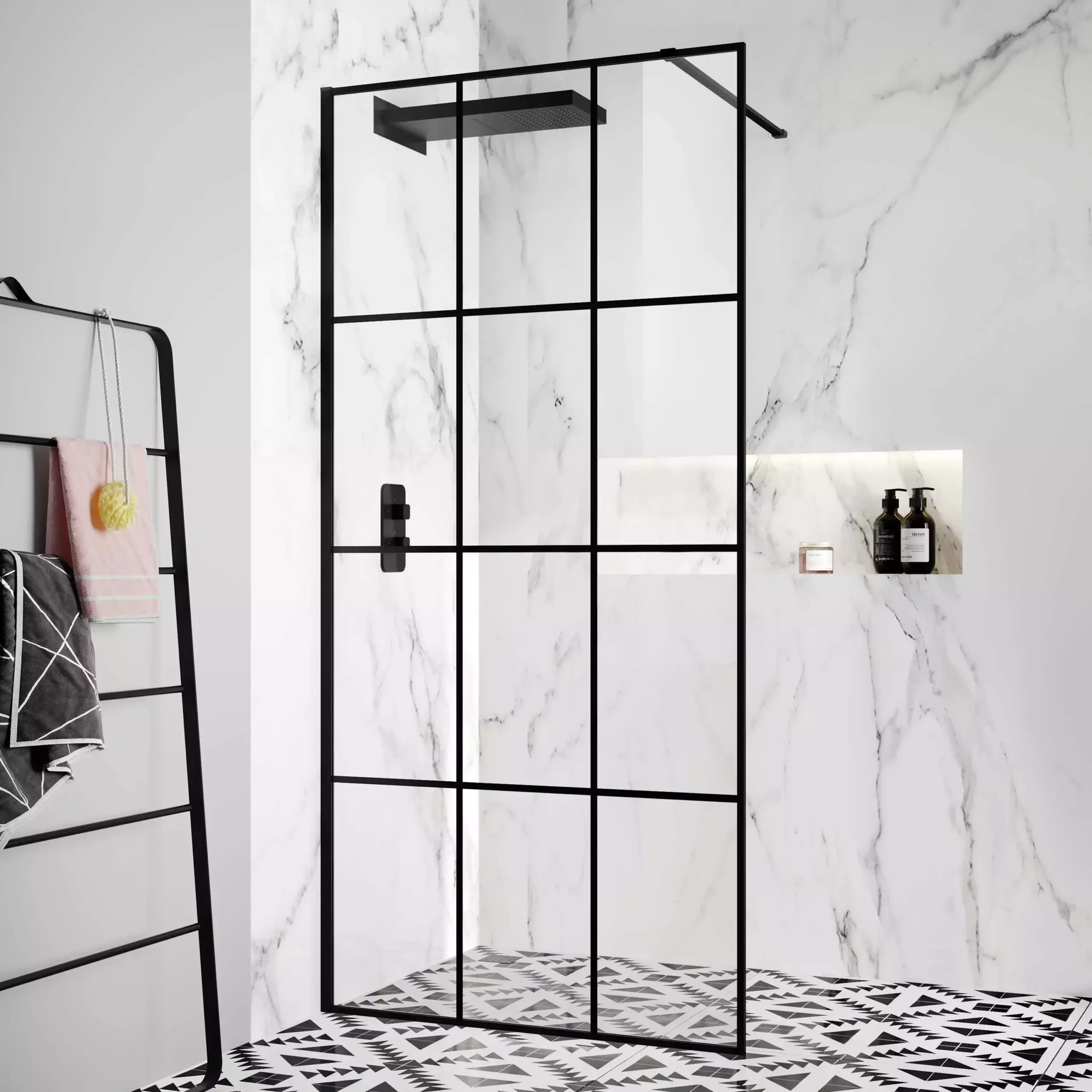
A framed glass walk-in shower uses fixed glass panels supported by metal framing to define the wet zone while maintaining step-free access. Framed systems improve splash containment and structural rigidity in medium-sized bathrooms.
Frameless Glass Walk-In Shower
A frameless glass walk-in shower uses minimal hardware and thick safety glass to create a defined shower zone with unobstructed sightlines. Frameless designs support contemporary layouts and maximise perceived space without visual interruption.
Corner Walk-In Shower
A corner walk-in shower positions the shower zone across two adjoining walls to optimise floor space and drainage alignment. Corner configurations suit compact bathrooms by reducing splash spread while preserving open entry access.
Alcove Walk-In Shower
An alcove walk-in shower installs the shower area between three walls to create a contained wet zone with a single open entry side. Alcove layouts improve water containment and simplify waterproofing coverage.
Linear Drain Walk-In Shower
A linear drain walk-in shower uses elongated drainage channels positioned along one edge of the shower floor to manage surface water efficiently. Linear drainage supports uniform floor gradients and modern aesthetic alignment.
Centre Drain Walk-In Shower
A centre drain walk-in shower places the waste outlet centrally within the shower floor to collect water from multiple gradient directions. Centre drain layouts suit square or compact shower zones with balanced water distribution.
Walk-In Shower With Fixed Screen
A walk-in shower with a fixed screen uses a single glass panel to block splash zones while maintaining open access. Fixed screen layouts balance accessibility and water containment in shared or family bathrooms.
Walk-In Shower With Hinged Panel
A walk-in shower with a hinged panel combines partial enclosure with flexible access control through inward or outward opening glass panels. Hinged designs increase splash protection while preserving level-entry functionality.
What Are the Essential Components Needed for Walk-In Shower Installation?
Walk-in shower installation requires a coordinated set of structural, waterproofing, drainage, enclosure, and plumbing components that function together to create a level-access wet zone with controlled water flow, leakage prevention, and safe daily use. Component integration determines long-term performance.
Floor Former or Gradient-Created Subfloor
A floor former or gradient-created subfloor forms the foundation for walk-in shower installation by directing surface water toward drainage outlets. Floor formers provide pre-engineered slopes, while screed-formed gradients achieve equivalent falls when sufficient floor depth exists.
Drainage System
A drainage system removes surface water efficiently during walk-in shower installation through linear or central waste outlets integrated at floor level. Drain placement, outlet capacity, and achievable fall collectively control water evacuation speed and splash containment.
Waterproof Tanking System
A waterproof tanking system protects the building structure during walk-in shower installation by sealing floors and walls within the wet zone. Continuous membranes cover floor surfaces, wall elevations, joints, corners, and penetrations to prevent moisture migration beyond the shower area.
Shower Enclosure or Screen
A shower enclosure or screen controls splash spread during walk-in shower installation without restricting level access. Fixed glass panels define the wet zone boundary while maintaining open entry and visual continuity across the bathroom space.
Shower Valve and Outlet Assembly
A shower valve and outlet assembly delivers controlled water supply during walk-in shower installation through concealed or exposed plumbing configurations. Valve positioning, outlet height, and flow rate selection influence usability, comfort, and water distribution across the shower area.
Plumbing Pipework
Plumbing pipework supports walk-in shower installation by supplying hot and cold water and removing waste through concealed routes. Pipe sizing, routing length, and connection points affect pressure balance and drainage efficiency within the shower system.
Wall Substrates and Finishes
Wall substrates and finishes complete walk-in shower installation by providing stable, water-resistant surfaces for tiling or panel systems. Cement boards, tile backer boards, and bonded finishes support long-term adhesion and moisture resistance within the wet zone.
Flooring Surface Material
A flooring surface material completes walk-in shower installation by providing slip resistance and water compatibility. Textured tiles, stone, or specialist wet-room surfaces improve grip under wet conditions while maintaining drainage flow across gradients.
Sealants and Junction Treatments
Sealants and junction treatments finalise walk-in shower installation by reinforcing critical transition points. Flexible sealants protect movement joints between floors, walls, drains, and glazing where structural expansion and contraction occur.
How Do You Prepare Your Bathroom for Walk-In Shower Installation?
Bathroom preparation for walk-in shower installation requires structural assessment, drainage planning, surface strip-out, waterproofing readiness, and plumbing isolation to enable level-access construction, controlled water flow, and long-term moisture protection. Preparation quality determines installation accuracy and durability.
Structural Assessment and Floor Build-Up
Structural assessment confirms floor depth and load capacity for gradient formation. Walk-in shower installation preparation measures available build-up to achieve drainage falls between 1:40 and 1:60 within screed or former systems across solid and suspended floors.
Drainage Planning and Waste Alignment
Drainage planning aligns waste outlet position with achievable gravity fall. Bathroom preparation maps existing soil connections, pipe diameters, and run lengths to position linear or centre drains close to vertical drops and reduce flow resistance.
Removal of Existing Fixtures and Finishes
Removal of existing fixtures clears the wet zone for structural work. Bathroom preparation includes strip-out of shower trays, baths, screens, tiles, adhesives, and sealants to expose subfloor and wall substrates for inspection and modification.
Subfloor Levelling and Repair
Subfloor levelling stabilises the base for gradient construction. Bathroom preparation repairs cracks, deflection points, and uneven surfaces to maintain consistent falls and prevent membrane stress under daily use.
Wall Substrate Preparation
Wall substrate preparation creates stable, water-resistant backing surfaces. Bathroom preparation replaces moisture-sensitive boards with cement-based or tile backer boards across the defined wet zone to support waterproof tanking and finish adhesion.
Plumbing Isolation and Rerouting
Plumbing isolation protects supply lines during construction. Bathroom preparation shuts down hot and cold feeds, caps outlets, and reroutes concealed pipework to align valve positions and outlet heights with walk-in shower layouts.
Waterproofing Readiness Checks
Waterproofing readiness confirms continuous surface connectivity. Bathroom preparation seals penetrations, corners, and junctions to allow uninterrupted tanking coverage across floors and walls within the shower area.
Spatial Zoning and Clearance Setting
Spatial zoning defines wet and dry areas before installation begins. Bathroom preparation marks splash boundaries, screen positions, and circulation clearances to maintain water containment without restricting movement.
What Is the Step-by-Step Walk-In Shower Installation Process?

The step-by-step walk-in shower installation process is a fixed construction sequence that prepares structure, engineers drainage gradients, applies waterproof protection, installs plumbing systems, and completes surface and enclosure elements to create a level-access wet zone with controlled water flow and long-term durability.
Step 1: Initial Feasibility Assessment
Initial feasibility assessment confirms whether the bathroom structure supports walk-in shower installation. The assessment evaluates floor type, available build-up depth, joist direction or slab thickness, waste route proximity, and load tolerance to enable level-access gradient formation.
Step 2: Detailed Measurement and Layout Planning
Detailed measurement and layout planning define the shower footprint and wet-zone boundaries. The planning stage sets drain position, screen alignment, circulation clearance, and splash containment zones to prevent water escape during daily use.
Step 3: Isolation of Plumbing and Electrical Services
Service isolation protects supply systems during construction. Water feeds are shut off, electrical circuits serving the bathroom are isolated, and exposed pipework is secured to prevent accidental discharge or damage.
Step 4: Full Strip-Out of Existing Fixtures and Finishes
Full strip-out exposes structural substrates for modification. The process removes shower trays, baths, tiles, floor coverings, adhesives, sealants, and sanitaryware to allow direct access to floors and walls.
Step 5: Structural Floor Alteration
Structural floor alteration creates space for level-access construction. Floor recessing, joist adjustment, or slab chasing is carried out where permitted to accommodate drainage components and gradient build-up without raising surrounding floor levels.
Step 6: Subfloor Repair and Stabilisation
Subfloor repair stabilises the base for gradient formation. Cracks, voids, deflection points, and weakened sections are corrected to prevent membrane stress and surface movement under load.
Step 7: Drain Body Installation and Waste Alignment
Drain body installation establishes the primary water evacuation point. Linear or centre drains are fixed in position, aligned with gravity fall, and mechanically secured to prevent movement during subsequent stages.
Step 8: Gradient Formation and Floor Former Setting
Gradient formation directs surface water toward the drainage outlet. Controlled falls, typically between 1:40 and 1:60, are formed using screed shaping or pre-formed floor formers bonded to the subfloor.
Step 9: First Fix Plumbing Installation
First fix plumbing installs concealed water supply routes. Valve bodies, pipework, and outlet feeds are positioned at defined depths and heights to ensure accurate alignment during final fitting.
Step 10: Wall Substrate Replacement
Wall substrate replacement creates water-resistant backing surfaces. Moisture-sensitive boards are replaced with cement-based or tile backer boards across all wet-zone wall elevations.
Step 11: Waterproof Tanking System Application
Waterproof tanking system application seals the entire wet zone. Continuous membranes are applied to floors, walls, internal corners, junctions, drains, and penetrations to prevent moisture migration into structural elements.
Step 12: Flood Testing and Membrane Curing
Flood testing verifies waterproof system integrity. The shower base is temporarily filled to confirm leak-free performance, followed by a curing period to stabilise the waterproof membrane.
Step 13: Floor and Wall Surface Installation
Surface installation completes functional finishes. Tiles or wall panels compatible with wet zones are bonded onto tanked substrates while maintaining drainage gradients and slip-resistance performance.
Step 14: Screen or Enclosure Installation
Screen installation defines splash boundaries without restricting access. Fixed or hinged glass panels are secured using pre-set anchors to control water spread while preserving level entry.
Step 15: Second Fix Plumbing Installation
Second fix plumbing completes water delivery components. Shower controls, outlets, thermostatic valves, and accessories are fitted, followed by flow and temperature stability checks.
Step 16: Sealant Application and Movement Joint Treatment
Sealant application protects flexible transition points. Elastic sealants are applied at wall-floor junctions, glazing interfaces, and penetrations to accommodate structural movement.
Step 17: Final Testing and Commissioning
Final testing confirms operational performance. Drainage speed, water containment, pressure balance, and temperature control are tested under active shower conditions.
Step 18: Handover and Maintenance Guidance
Handover completes the installation lifecycle. The completed walk-in shower installation is reviewed, cleaning requirements are explained, and maintenance guidance is provided to preserve long-term performance.
Can I Install a Walk-In Shower Myself or Should I Hire a Professional?
Walk-in shower installation requires professional involvement because structural floor modification, drainage gradient engineering, waterproof tanking continuity, and concealed plumbing accuracy exceed typical DIY capability and directly affect long-term water containment, safety performance, and structural integrity. Installation risk increases when any stage lacks technical precision.
DIY Walk-In Shower Installation Suitability
DIY installation suits only surface-level tasks rather than full walk-in shower construction. Tasks such as tile removal, basic strip-out, or cosmetic finishing fall within DIY scope, while gradient formation, drain integration, and waterproof tanking demand specialist execution to prevent leakage and floor failure.
Structural and Drainage Complexity
Structural and drainage complexity limits DIY feasibility. Walk-in shower installation requires precise floor recessing, controlled falls between 1:40 and 1:60, and gravity-aligned waste routing, where small errors cause standing water, backflow, or subfloor saturation.
Waterproofing Risk and Failure Impact
Waterproofing failure risk outweighs DIY cost savings. Walk-in shower installation depends on continuous membrane coverage across floors, walls, corners, drains, and penetrations, where incomplete sealing results in concealed moisture damage and long-term structural degradation.
Plumbing Accuracy and System Integration
Plumbing accuracy determines functional performance. Walk-in shower installation involves concealed valve positioning, pressure balancing, and outlet alignment, where incorrect placement causes temperature instability, poor flow distribution, and invasive rework.
Professional Installation Advantages
Professional installation ensures technical compliance and durability. Experienced installers manage structural preparation, drainage alignment, tanking systems, and staged testing to deliver predictable water control and long-term performance across daily use cycles.
What UK Building Regulations Apply to Walk-In Shower Installation?
Walk-in shower installation is governed by building regulations covering drainage performance, waterproofing integrity, electrical safety, structural alteration, and accessibility standards, with compliance required to ensure safe water evacuation, moisture control, and lawful modification of residential bathrooms. Regulatory alignment determines installation validity.
Building Regulations Part H: Drainage and Waste Disposal
Part H regulates drainage capacity, pipe gradients, and waste connection integrity. Walk-in shower installation must achieve effective gravity flow, secure trap seals, and correctly vented waste systems to prevent backflow, odour release, and standing water within level-access shower zones.
Building Regulations Part C: Resistance to Moisture
Part C governs moisture resistance and damp prevention. Walk-in shower installation requires continuous waterproof tanking across floors, walls, junctions, and penetrations to prevent water ingress into structural elements and adjoining rooms.
Building Regulations Part P: Electrical Safety
Part P regulates electrical installations within bathrooms. Walk-in shower installation restricts electrical components to defined bathroom zones and requires appropriate IP-rated fittings, safe cable routing, and certified electrical work where modifications occur near wet areas.
Building Regulations Part A: Structural Safety
Part A applies when structural alterations affect load-bearing elements. Walk-in shower installation involving floor recessing, joist modification, or slab alteration must preserve structural integrity and load distribution to prevent long-term floor deflection or failure.
Building Regulations Part M: Access and Use of Buildings
Part M informs accessibility considerations for level-access bathing. Walk-in shower installation aligns with guidance on step-free access, clear movement space, and safe entry design, particularly in dwellings adapted for reduced mobility.
Water Supply Regulations and Backflow Prevention
Water Supply Regulations govern potable water protection. Walk-in shower installation must prevent contamination through correct valve selection, backflow prevention, and compliant connection of thermostatic mixing valves.
Local Authority Notification and Certification
Certain installation works require notification or certification. Walk-in shower installation involving drainage alteration, structural change, or electrical modification may require approval or certification from qualified professionals to confirm regulatory compliance.
How Much Does Walk-In Shower Installation Cost in the UK?

Walk-in shower installation cost ranges from £3,000 to £12,500 based on construction complexity, drainage modification, waterproofing scope, material specification, and labour intensity, with higher costs linked to full wet-room conversion and structural floor alteration. Cost formation depends on build depth and finish grade.
Entry-Level Walk-In Shower Installation Cost
Entry-level walk-in shower installation costs between £3,000 and £5,000 for straightforward replacements without major structural change. Cost coverage typically includes tray or former installation, standard drainage alignment, basic waterproofing, fixed glass screen, and standard surface finishes.
Mid-Range Walk-In Shower Installation Cost
Mid-range walk-in shower installation costs between £5,000 and £9,000 where drainage relocation, enhanced waterproofing, and upgraded finishes are required. Cost increases reflect extended labour time, higher-grade membranes, larger glass panels, and improved surface materials.
Wet Room and Level-Access Conversion Cost
Full wet room or true level-access walk-in shower installation costs between £8,500 and £12,500 due to structural floor modification and complete tanking coverage. Cost drivers include floor recessing, joist adjustment or slab alteration, linear drainage systems, and extended testing stages.
Bath-to-Walk-In-Shower Conversion Cost
Bath-to-walk-in-shower conversion costs range from £3,500 to £7,500 depending on plumbing adaptation and waste repositioning. Cost variation depends on bath removal, wall repair, pipe rerouting, and floor preparation requirements.
Cost Factors That Influence Final Price
Final installation cost is influenced by five primary factors.
The cost factors are listed below:
- Drainage modification: Relocation or replacement increases labour and material cost.
- Waterproofing scope: Full wet-zone tanking costs more than junction-only sealing.
- Floor construction type: Suspended floors and concrete slabs differ in alteration cost.
- Surface finishes: Tile size, material density, and slip rating affect labour time.
- Glass specification: Frameless and oversized panels increase material and fitting cost.
What Are the Most Common Walk-In Shower Installation Mistakes?
The most common walk-in shower installation mistakes occur in drainage gradient formation, waterproofing continuity, floor preparation, splash containment design, and sequencing control, with each error increasing long-term water damage risk, usability failure, and premature system breakdown. Installation errors usually originate below surface finishes.
Incorrect Floor Gradient Formation
Incorrect floor gradient formation causes standing water and slow drainage. Walk-in shower installation requires controlled falls, typically between 1:40 and 1:60, where insufficient slope leads to pooling and excessive slope creates unstable footing and uneven surface wear.
Inadequate Waterproof Tanking Coverage
Inadequate waterproof tanking coverage allows moisture penetration into structural elements. Walk-in shower installation fails when membranes omit wall-to-floor junctions, internal corners, drain interfaces, or penetrations, resulting in concealed leaks beneath finished surfaces.
Poor Drain Positioning
Poor drain positioning reduces water evacuation efficiency. Walk-in shower installation mistakes occur when drains sit too far from main water impact zones or lack sufficient gravity fall, causing splash-back, surface flooding, and overflow beyond the wet zone.
Insufficient Subfloor Preparation
Insufficient subfloor preparation leads to membrane stress and surface cracking. Walk-in shower installation requires stable, level, and reinforced substrates, where deflection, voids, or cracks transfer movement into finishes and compromise waterproof layers.
Incorrect Drain-to-Floor Integration
Incorrect drain-to-floor integration creates leakage paths at critical junctions. Walk-in shower installation fails when drain flanges are not mechanically bonded or correctly tanked, allowing water to bypass the drainage system and enter subfloor layers.
Inadequate Splash Containment Planning
Inadequate splash containment planning causes water escape into dry zones. Walk-in shower installation mistakes arise when screen placement, shower head orientation, and floor gradients fail to align with water dispersion patterns.
Skipping Flood Testing
Skipping flood testing prevents early detection of waterproofing failures. Walk-in shower installation requires controlled water testing before surface finishes, where omission allows hidden leaks to remain undetected until structural damage occurs.
Incorrect Sequencing of Installation Stages
Incorrect sequencing of installation stages compromises system integrity. Walk-in shower installation errors occur when waterproofing precedes structural stabilisation or surface finishes begin before membrane curing completion.
Using Incompatible Materials
Using incompatible materials reduces long-term durability. Walk-in shower installation fails when adhesives, membranes, sealants, and substrates lack chemical or mechanical compatibility, leading to delamination and joint failure.
Over-Reliance on Sealants
Over-reliance on sealants replaces structural waterproofing with temporary fixes. Walk-in shower installation errors arise when sealants substitute continuous tanking systems, despite sealants degrading faster under heat, moisture, and movement cycles.
What Flooring and Wall Finishes Work Best for Walk-In Showers?
Flooring and wall finishes for walk-in showers perform best when surfaces provide slip resistance, water impermeability, strong adhesion to tanked substrates, and dimensional stability under constant moisture exposure, with finish suitability defined by material density, surface texture, joint volume, and maintenance behaviour. Finish selection directly affects safety and durability.
Flooring Finishes That Perform Best in Walk-In Showers
Flooring finishes perform best when surfaces maintain grip, support drainage gradients, and resist water absorption. Walk-in shower flooring must balance traction and cleanability without disrupting water flow.
Textured Porcelain Tiles
Textured porcelain tiles provide high slip resistance and low water absorption. Dense porcelain construction resists moisture ingress below 0.5%, while textured surfaces maintain grip under wet conditions and support precise gradient formation.
Mosaic Tiles
Mosaic tiles improve drainage control through increased grout distribution. Smaller tile formats conform easily to floor gradients and reduce pooling risk, making mosaic tiles effective for linear and centre-drain configurations.
Natural Stone With Honed Finish
Honed natural stone provides controlled grip with reduced surface polish. Stone finishes require sealing due to porosity, yet perform effectively when treated and installed over continuous waterproof membranes.
Specialist Wet-Room Flooring Systems
Specialist wet-room flooring systems offer seamless water control. Resin-based or vinyl wet-room finishes create joint-free surfaces that simplify maintenance and maintain consistent slip resistance across the wet zone.
Wall Finishes That Perform Best in Walk-In Showers
Wall finishes perform best when materials resist saturation, support strong bonding, and limit joint failure. Walk-in shower walls remain exposed to direct spray and condensation cycles.
Porcelain and Ceramic Wall Tiles
Porcelain and ceramic tiles provide durable, water-resistant wall coverage. Low porosity and high compressive strength support long-term adhesion over tanked substrates with predictable maintenance requirements.
Large-Format Wall Panels
Large-format wall panels reduce joint volume and maintenance demand. Fewer seams limit moisture entry points and simplify cleaning while maintaining full surface waterproof protection beneath bonded systems.
Natural Stone Wall Finishes
Natural stone wall finishes deliver high durability when sealed correctly. Stone walls require periodic sealing yet offer strong impact resistance and long-term structural stability in walk-in shower environments.
Waterproof Wall Panels
Waterproof wall panels provide rapid installation and uniform coverage. Factory-sealed panels create consistent moisture barriers and reduce reliance on grout lines within high-splash zones.
Finish Selection Considerations for Walk-In Showers
Finish performance depends on four critical criteria.
The criteria are given below:
- Slip resistance: Flooring must maintain grip under flowing water.
- Water absorption: Materials must resist saturation and swelling.
- Joint volume: Reduced joints lower leak and maintenance risk.
- Substrate compatibility: Finishes must bond securely to tanked surfaces.
Flooring and wall finishes succeed in walk-in showers when material properties align with drainage design, waterproofing systems, and daily exposure intensity rather than visual preference alone.
How Do You Maintain and Clean a Walk-In Shower?
Walk-in shower maintenance and cleaning involve regular surface rinsing, residue removal, joint inspection, and drainage care to preserve waterproof integrity, hygiene performance, and surface safety under constant moisture exposure. Maintenance effectiveness depends on routine frequency and material compatibility.
Daily Rinsing and Surface Drying
Daily rinsing removes soap residue and mineral deposits from exposed surfaces. Walk-in shower maintenance includes rinsing floors, walls, screens, and fittings with clean water after use, followed by surface drying to limit limescale accumulation and streak formation.
Weekly Floor and Wall Cleaning
Weekly cleaning controls biofilm and surface contamination. Walk-in shower cleaning uses non-abrasive cleaners compatible with tiles, stone, or panels to remove body oils, shampoo residue, and environmental particles without degrading surface finishes or waterproof layers.
Drain and Waste Maintenance
Drain maintenance ensures consistent water evacuation. Walk-in shower maintenance includes weekly removal of hair and debris from drain covers and channels to prevent flow restriction, surface pooling, and odour development within waste systems.
Grout and Joint Inspection
Grout and joint inspection prevents moisture ingress. Walk-in shower maintenance checks grout lines, sealant joints, and movement interfaces for cracking, separation, or erosion, with prompt repair maintaining waterproof continuity beneath surface finishes.
Glass Screen and Panel Care
Glass care maintains clarity and splash control. Walk-in shower cleaning removes mineral spotting from glass screens using pH-neutral solutions, while regular drying reduces scale formation and preserves transparency without surface etching.
Periodic Deep Cleaning
Periodic deep cleaning restores surface performance. Walk-in shower maintenance schedules monthly or quarterly deep cleans targeting grout lines, textured flooring, and concealed corners where residue accumulates beyond routine cleaning reach.
Ventilation and Moisture Control
Ventilation control reduces condensation and mould risk. Walk-in shower maintenance includes ensuring effective airflow during and after use to accelerate surface drying and stabilise humidity levels within the bathroom environment.
Material-Specific Care Requirements
Material-specific care preserves finish longevity. Walk-in shower maintenance adapts cleaning methods based on surface type, with natural stone requiring sealing checks, textured tiles requiring grout attention, and panel systems requiring seam inspection.
What Are the Pros and Cons of Walk-In Shower Installation?
Walk-in shower installation presents defined advantages and limitations related to accessibility, space efficiency, water control, construction complexity, and long-term maintenance, with suitability determined by bathroom structure, usage patterns, and installation precision. Evaluation requires balanced assessment of functional gains and technical constraints.
Pros of Walk-In Shower Installation
The advantages of walk-in shower installation relate to access continuity, spatial optimisation, and long-term usability.
The primary benefits are explained below.
Improved Accessibility
Improved accessibility results from level-access floor construction. Walk-in shower installation removes raised thresholds, supporting step-free entry, reduced trip risk, and easier movement for users with varied mobility ranges.
Increased Spatial Efficiency
Increased spatial efficiency occurs through open wet-zone layouts. Walk-in shower installation removes trays and door swing zones, increasing usable bathroom floor area and improving circulation within compact layouts.
Long-Term Adaptability
Long-term adaptability supports changing household needs. Walk-in shower installation maintains functional relevance across ageing, injury recovery, and multi-user households without requiring structural replacement.
Simplified Cleaning and Hygiene
Simplified cleaning results from reduced joints and open layouts. Walk-in shower installation limits dirt-trapping corners, enclosure tracks, and tray seals, supporting easier surface maintenance and hygiene control.
Contemporary Design Flexibility
Design flexibility improves through minimal visual obstruction. Walk-in shower installation supports flush floors, large-format surfaces, and open sightlines that integrate with modern bathroom layouts.
Cons of Walk-In Shower Installation
The limitations of walk-in shower installation relate to water containment, installation complexity, and cost sensitivity.
The primary drawbacks are outlined below.
Higher Installation Complexity
Higher installation complexity arises from structural floor modification and waterproofing requirements. Walk-in shower installation demands precise gradient formation, drainage alignment, and full-surface tanking, increasing technical dependency.
Increased Installation Cost
Increased installation cost reflects structural and waterproofing scope. Walk-in shower installation costs exceed standard tray-based showers where floor recessing, drainage relocation, or full wet-zone tanking is required.
Water Splash Management Challenges
Water splash management requires careful design. Walk-in shower installation performs poorly when screen placement, drainage position, or shower outlet orientation fails to control water dispersion beyond the wet zone.
Dependency on Accurate Waterproofing
Waterproofing dependency increases failure risk if poorly executed. Walk-in shower installation relies on continuous membrane integrity, where defects remain concealed and cause long-term structural moisture damage.
Reduced Thermal Containment
Reduced thermal containment occurs due to open layouts. Walk-in shower installation retains less heat than fully enclosed cubicles, affecting comfort during longer shower use.
How Do Walk-In Showers Compare to Wet Rooms and Shower Enclosures?
Walk-in showers differ from wet rooms and shower enclosures by combining level-access entry with partial water containment, whereas wet rooms convert the entire bathroom into a waterproofed wet zone and shower enclosures rely on raised trays and fully enclosed cubicles for water control. Comparison depends on waterproofing scope, access design, and spatial impact.
Walk-In Showers Compared to Wet Rooms
Walk-in showers differ from wet rooms through limited wet-zone coverage rather than full-room waterproofing. Walk-in shower installation tanks and gradients only the shower area, while wet room construction applies continuous waterproofing across the entire bathroom floor and wall perimeter.
Walk-in showers reduce construction scope compared to wet rooms. Wet rooms require whole-room gradient engineering and universal drainage planning, while walk-in showers concentrate gradients and drainage within a defined zone, reducing structural intervention.
Walk-in showers provide greater splash containment than open wet rooms. Fixed screens and partial enclosures limit water spread, whereas wet rooms rely entirely on floor gradients and drainage capacity to manage splash across the full space.
Walk-In Showers Compared to Shower Enclosures
Walk-in showers differ from shower enclosures through level-access floors rather than raised trays. Shower enclosures use pre-formed trays and framed cubicles to contain water, while walk-in showers integrate drainage directly into the floor structure.
Walk-in showers offer improved accessibility compared to shower enclosures. Step-free entry removes vertical thresholds present in tray-based enclosures, supporting easier access and reduced trip risk.
Walk-in showers reduce mechanical components compared to shower enclosures. Enclosures depend on doors, rollers, and seals, while walk-in showers use fixed panels or open access, reducing wear points and maintenance demand.
Spatial and Design Comparison
Spatial impact differs across all three shower types. Walk-in showers balance openness and containment, wet rooms maximise open space but increase splash exposure, and shower enclosures prioritise containment at the cost of visual and physical openness.
Installation and Cost Comparison
Installation complexity increases from shower enclosures to walk-in showers to wet rooms. Shower enclosures involve surface fitting, walk-in showers require subfloor engineering and tanking, and wet rooms demand full-room structural and waterproof integration.
How Long Do Walk-In Showers Last?
Walk-in showers last between 20 and 30 years when floor gradients, waterproof tanking systems, drainage components, and surface finishes are correctly installed and maintained, with service life determined by waterproof integrity, material density, joint stability, and daily usage intensity.
Structural Lifespan
Structural lifespan depends on subfloor stability and waterproof system performance. Walk-in shower installation that includes full-surface tanking and stable substrates preserves structural elements for 25 years or longer without moisture-related degradation.
Waterproofing System Longevity
Waterproofing systems last 20 to 25 years when membranes remain continuous and undisturbed. Walk-in shower installation failure typically originates from damaged membranes rather than surface finishes, making tanking quality the primary lifespan determinant.
Drainage Component Durability
Drainage components last 15 to 25 years based on material grade and maintenance frequency. Stainless steel drains and correctly aligned waste systems retain functional performance longer than plastic assemblies exposed to frequent debris accumulation.
Surface Finish Lifespan
Surface finishes last 10 to 20 years depending on material type and cleaning practices. Porcelain tiles, stone finishes, and bonded panels maintain performance when grout integrity and surface sealing remain intact.
Glass and Enclosure Longevity
Glass panels and screens last 20 years or more due to low mechanical wear. Fixed glass components experience minimal stress compared to hinged or sliding enclosure systems.
Maintenance Influence on Service Life
Maintenance frequency directly affects walk-in shower lifespan. Regular drain cleaning, joint inspection, and sealant renewal extend functional performance by preventing secondary moisture ingress and surface deterioration.
Is a Walk-In Shower Worth Installing in Your Home?
Walk-in shower installation is worth undertaking when level-access design, improved spatial efficiency, reduced trip risk, simplified cleaning, and long-term adaptability align with homeowner priorities and bathroom structure, with value determined by functional performance rather than visual preference. Worth assessment depends on usage patterns, accessibility needs, and durability expectations.
Accessibility Value
Walk-in showers deliver accessibility value by eliminating raised thresholds and supporting uninterrupted movement. Homes with occupants experiencing reduced mobility, balance limitations, or assistive device use benefit from step-free access that lowers trip risk and enhances daily bathing independence.
Spatial Efficiency Value
Walk-in showers provide spatial efficiency value through open wet-zone layouts. Removing trays, enclosure doors, and surface barriers maximises usable floor area and improves circulation in both compact and large bathrooms without sacrificing water control.
Maintenance and Hygiene Value
Walk-in showers increase hygiene value by reducing dirt-trapping junctions. Fewer seals, edges, and enclosure tracks reduce areas where soap residue and limescale accumulate, simplifying cleaning routines and improving surface sanitation over time.
Long-Term Adaptability Value
Walk-in showers support long-term adaptability through future-ready access design. Homes anticipating ageing occupants, changing mobility ranges, or multi-generational use maintain functional relevance without structural redesign.
Cost-Benefit Consideration
Walk-in shower cost-benefit depends on budget alignment with installation complexity and long-term performance expectations. Higher initial investment often yields improved daily usability, reduced maintenance effort, and enhanced property appeal.
Aesthetic and Design Value
Walk-in showers deliver aesthetic value through minimalist layouts and uninterrupted sightlines. Flush floors and open enclosures integrate with contemporary bathroom schemes and contribute to perceived space without functional compromise.
Final Considerations
Walk-in shower installation achieves durable bathroom performance through precise floor gradient engineering, integrated drainage alignment, continuous waterproof tanking, and controlled splash containment that together deliver level-access use, reliable water evacuation, and long-term structural protection. Successful outcomes depend on structural suitability, drainage feasibility, material compatibility, regulatory compliance, and correct installation sequencing rather than visual preference.
Long-term walk-in shower installation performance, typically spanning 20–30 years, depends on accurate construction, compatible flooring and wall finishes, and routine maintenance that preserves drainage flow, joint integrity, and waterproof continuity. Walk-in shower installation remains functional and adaptable when planning, execution, and upkeep operate as a single integrated system aligned with access needs and daily usage demands.