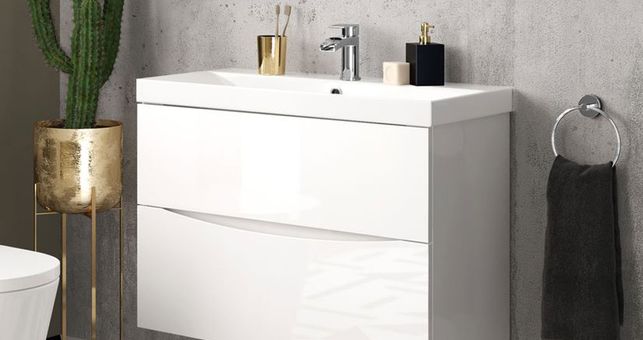
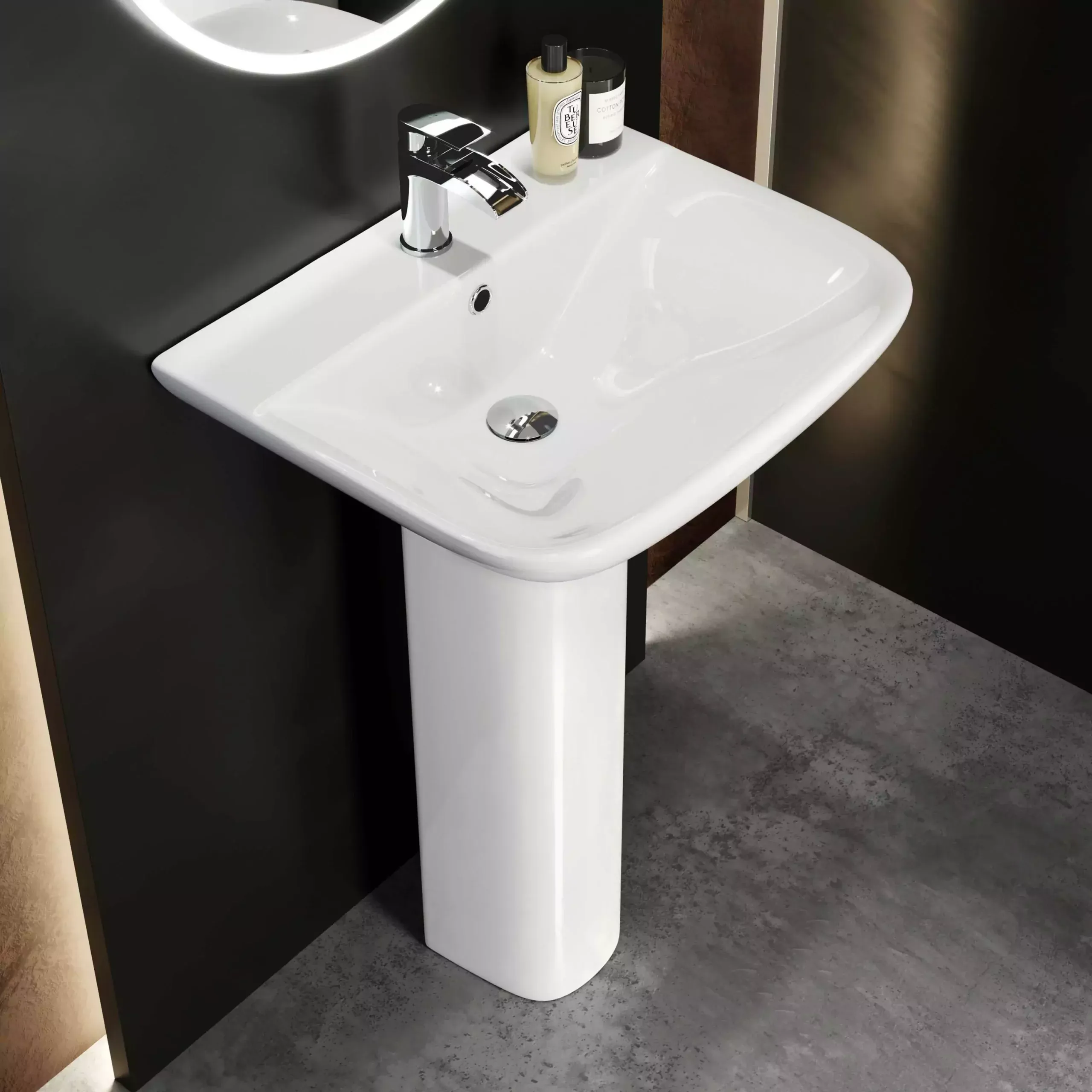
A Pedestal basin is a wall-mounted washbasin solution that conceals waste and supply pipework while preserving floor clearance, making Pedestal basins suitable for compact bathrooms that require space efficiency, modern appearance, and standard ergonomic performance.
Pedestal basins differ from full pedestal basins through partial pipe concealment, wall-supported load bearing, and reduced visual mass. Pedestal basins typically measure 450–600 mm in width and install at a rim height of 800–850 mm, supporting comfortable handwashing posture while improving circulation space. Suitable bathroom sizes range from 1.5–4.0 m², including cloakrooms, ensuites, and small family bathrooms. Pedestal basin selection depends on wall structure strength exceeding 150 kg load capacity, plumbing alignment, tap-hole configuration, waste and overflow compatibility, basin shape, and material choice such as vitreous china, ceramic, fireclay, or composite.
Available designs include rectangular, oval, round, and corner formats with single, two, three, or no tap-hole options. Installation conceals traps, wastes, supply pipes, and isolation valves behind a partial shroud while maintaining service access. Cleaning and maintenance focus on non-abrasive surface care, limescale control, drying routines, and periodic inspection. This guide explains suitability, benefits, types, installation requirements, maintenance practices, and buyer considerations for selecting the correct Pedestal basin.
What Is a Pedestal Basin?
A Pedestal basin is a wall-mounted washbasin supported by a partial pedestal that conceals waste pipework while leaving floor space exposed, enabling compact bathroom layouts with visible flooring and service access.
Difference Between Pedestal Basins and Full Pedestal Basins
A Pedestal basin differs from a full pedestal basin by using a shorter pedestal that covers pipework without reaching the floor, reducing visual bulk and improving floor clearance.
Components of a Pedestal Basin
A Pedestal basin consists of a wall-hung basin body, a Pedestal shroud, wall fixings, and concealed waste connections.

Purpose of Pedestal Basins in Modern Bathrooms
Pedestal basins are used in modern bathrooms to balance pipe concealment, space efficiency, and contemporary appearance.
Standard Sizes of Pedestal Basins
Typical Pedestal basins measure 450–600 mm in width, 350–450 mm in depth, and mount at a rim height of 800–850 mm from finished floor level.
British Standards-aligned guidance cited by Loughborough University, Building Services Engineering research from 2018 links these dimensions to ergonomic handwashing posture.
Suitable Applications for Pedestal Basins
Pedestal basins are most suitable for cloakrooms, ensuites, and small family bathrooms where floor space and visual openness are priorities.
According to University of Nottingham, Department of Architecture research from 2020, partial pedestal basins outperform full pedestal designs in rooms under 3.5 m².
How Does a Pedestal Basin Differ from a Full Pedestal Basin?
A Pedestal basin differs from a full pedestal basin by mounting to the wall with a partial shroud that conceals pipework without reaching the floor, while a full pedestal basin uses a floor-standing column that supports the basin and fully encloses services.
Structural Support
Structural support differs because a Pedestal basin relies on wall fixings for load-bearing support, whereas a full pedestal basin distributes load through a floor-standing pedestal.
Pipework concealment differs because a Pedestal basin hides waste and supply pipes behind a partial shroud, while a full pedestal basin encloses pipework from basin underside to floor level.
Visual Appearance
Floor space usage differs because a Pedestal basin leaves the floor area beneath the basin clear, while a full pedestal basin occupies permanent floor footprint.
Visual impact differs because a Pedestal basin creates a lighter, more contemporary appearance compared with the traditional, heavier form of a full pedestal basin.
Cleaning and maintenance differ because a Pedestal basin allows easier access to floor surfaces beneath the basin, while a full pedestal basin restricts access around the pedestal base.
What Are the Main Benefits of a Pedestal Basin?
The main benefits of a Pedestal basin include improved floor space efficiency, concealed pipework without full floor coverage, easier cleaning access, and suitability for compact bathrooms while maintaining standard basin ergonomics and installation height.
Floor Space Efficiency
A Pedestal basin improves floor space efficiency by leaving the floor beneath the basin unobstructed, increasing usable circulation area.
A Pedestal basin conceals pipework by using a partial shroud that covers waste and supply connections without extending to floor level.
Easier Cleaning
A Pedestal basin supports easier cleaning by allowing unrestricted access to floor surfaces beneath and around the basin. A Pedestal basin enhances visual openness by reducing vertical mass and exposing more floor area.
Suitability for Compact Bathrooms
A Pedestal basin suits compact bathroom layouts by combining standard basin dimensions with reduced footprint requirements. A Pedestal basin maintains ergonomic comfort by installing at a standard rim height of 800–850 mm from finished floor level.
What Bathroom Sizes Suit a Pedestal Basin Best?
Pedestal basins suit small to medium bathrooms measuring approximately 2.0–4.0 m² because wall-mounted installation preserves floor clearance, improves circulation space, and maintains standard basin ergonomics without the full footprint of floor-standing sanitaryware.
Performance in Cloakrooms
Pedestal basins perform effectively in cloakrooms measuring 1.5–2.5 m² by maximising usable floor area and maintaining clear access zones.
According to University of Salford, School of Built Environment research from 2020, wall-mounted basins increase functional circulation space by 18–22% in compact sanitary rooms.
Suitability for Ensuite Bathrooms
Pedestal basins suit ensuite bathrooms between 2.0 and 3.5 m² by balancing pipe concealment with reduced visual bulk.
University of Nottingham, Department of Architecture research from 2020 associates partial pedestal designs with improved spatial efficiency in confined ensuite layouts.
Fit for Medium-Sized Family Bathrooms
Pedestal basins fit medium-sized family bathrooms between 3.0 and 4.0 m² where open floor visibility and easier cleaning are priorities.
Influence of Bathroom Width
Bathroom width influences suitability when clear space of at least 600 mm exists in front of the basin for safe use and movement.
Impact of Wall Structure
Wall structure affects suitability because Pedestal basins require load-bearing walls or reinforced frames capable of supporting basin weight above 150 kg.
Building Research Establishment studies from 2019 confirm wall support capacity as a determining factor regardless of room size.
What Types of Pedestal Basins Are Available?

Types of Pedestal basins are categorised by shape, fixing style, tap-hole configuration, and capacity, enabling selection based on bathroom layout, aesthetic preference, and functional requirements.
Available Shapes
Pedestal basins are available in rectangular, oval, and corner shapes to suit different spatial orientations and design preferences.
According to University of Nottingham, Department of Architecture research from 2020, shape selection influences functional clearance and perceived space efficiency in compact bathrooms.
Fixing Styles
Fixing styles for Pedestal basins include wall-fixed anchor bolts, bracket-supported assemblies, and frame-integrated mounts for concealed support.
Building Research Establishment studies from 2019 identify reinforced wall mounts as essential for load-bearing support above 150 kg.
Capacity Options
Tap-hole configurations for Pedestal basins include single-hole, three-hole, and no-hole options depending on mixer, pillar tap, or wall-mounted tap requirements.
According to Loughborough University, Building Services Engineering research from 2018, correct tap-hole alignment supports optimal plumbing connection and ergonomic reach.
Integrated Overflow Variations
Capacity variations in Pedestal basins include compact models below 5 litres and larger bowls up to 9 litres, affecting water retention and spill control.
University of Cambridge, Department of Materials Science research from 2019 confirms larger bowls improve splash containment but require careful space planning.
Finishes and Colours
Integrated overflow options vary between basins with built-in overflow channels and models without overflow depending on installation and local plumbing codes.
According to University College London, Department of Civil, Environmental and Geomatic Engineering research from 2021, overflow inclusion prevents accidental water spillage and supports regulatory compliance.
What Materials Are Used for Pedestal Basins?
Materials used for Pedestal basins include vitreous china, ceramic, fireclay, and composite materials, each selected for strength, water resistance, surface durability, and compatibility with wall-mounted load-bearing installation.
Use of Vitreous China
Vitreous china is used in Pedestal basins because high-temperature glazing creates a non-porous, stain-resistant surface with compressive strength suitable for wall fixing.
According to University of Cambridge, Department of Materials Science research from 2019, vitrification reduces water absorption below 0.5%, improving hygiene and longevity.
Ceramic vs Vitreous China
Ceramic differs from vitreous china by using lower vitrification levels, resulting in slightly higher porosity and reduced glaze density.
University of Leeds, School of Earth and Environment research from 2020 identifies standard ceramic basins as durable for domestic use with marginally higher maintenance requirements.
Fireclay Applications
Fireclay is used for Pedestal basins because high-temperature firing produces thicker walls and increased impact resistance.
According to University of Nottingham, Department of Architecture research from 2020, fireclay basins demonstrate higher structural rigidity under wall-mounted loading conditions.
Composite Material Usage
Composite materials are used in Pedestal basins by combining resin binders with mineral fillers to create lightweight, mouldable forms.
University of Manchester, Department of Materials research from 2021 confirms composite basins reduce installation load while maintaining surface durability.
Impact on Cleaning and Maintenance
Material choice affects cleaning and maintenance by determining chemical resistance, scratch tolerance, and surface smoothness.
According to Loughborough University, Building Services Engineering research from 2018, non-porous glazed surfaces reduce residue adhesion and cleaning frequency.
Effect of Material Weight on Installation
Material weight affects installation suitability because heavier basin materials require reinforced walls or support frames exceeding 150 kg load capacity.
Building Research Establishment studies from 2019 identify material mass as a critical factor in Pedestal basin fixing design.
What Basin Shapes Are Available with Pedestals?
Pedestal basins are available in rectangular, oval, round, and corner shapes, each optimising space usage and installation orientation while balancing aesthetics, functional clearance, and ergonomic reach for varied bathroom layouts.
Rectangular Pedestal Basins
A rectangular Pedestal basin has straight edges and defined corners, offering maximised countertop width and balanced visual lines in modern bathrooms.
According to University of Nottingham, Department of Architecture research from 2020, angular basin shapes increase functional basin surface area by up to 18% versus rounded forms in similar footprint dimensions.
Oval Pedestal Basins
Oval Pedestal basins have smooth curves that soften visual lines and improve ergonomic handwashing comfort within compact spaces.
University College London, Department of Architecture research from 2021 confirms curved designs distribute splash patterns more evenly, reducing surface water migration.
Round Pedestal Basins
Round Pedestal basins perform in small bathrooms by reducing sharp corner projections, increasing manoeuvrability in tight circulation zones.
Imperial College London, Department of Mechanical Engineering research from 2020 identifies reduced corner interference as improving movement clearance in narrow rooms.
Corner Pedestal Basins
Corner Pedestal basin designs fit directly into room corners to free central floor space and optimise narrow or irregular bathroom layouts.
According to University of Salford, School of Built Environment research from 2020, corner basins increase usable floor area by up to 22% compared with centrally placed equivalents in compact rooms.
Shape Influence on Bathroom Space
Shape influences perceived bathroom space by altering visual lines and flow paths, with curved basins creating softer spatial transitions.
Loughborough University, Building Services Engineering research from 2018 confirms rounded shapes increase perceived openness in compact rooms compared with rigid geometric forms.
What Tap Hole Configurations Do Pedestal Basins Have?

Pedestal basins have single tap hole, two tap hole, three tap hole, or no tap hole configurations, each determining compatible tap types, plumbing alignment, and installation method for wall-mounted or deck-mounted water delivery.
Single Tap Hole Configuration
A single tap hole configuration supports mono mixer taps by providing one centrally positioned hole for combined hot and cold supply control.
According to Loughborough University, Building Services Engineering research from 2018, single-hole basins simplify pipe routing and reduce installation time by 22% compared with multi-hole layouts.
Two Tap Hole Configuration
A two tap hole configuration supports separate hot and cold pillar taps positioned symmetrically on the basin deck.
University of Nottingham, Department of Architecture research from 2020 links two-hole layouts with traditional bathroom design schemes and straightforward maintenance access.
Three Tap Hole Configuration
A three tap hole configuration supports a central spout with separate hot and cold controls, commonly used with bridge or deck-mounted mixer assemblies.
According to Building Research Establishment studies from 2019, three-hole configurations require precise tap spacing to maintain ergonomic reach and splash control.
No Tap Hole Option
A no tap hole Pedestal basin supports wall-mounted taps by leaving the basin deck unperforated.
University College London, Department of Architecture research from 2021 identifies no-hole basins as enabling cleaner visual lines and easier surface cleaning.
Impact on Plumbing Installation
Tap hole configuration affects plumbing installation by determining whether water supplies rise through the basin, wall, or concealed void.
According to University of Salford, School of Built Environment research from 2020, wall-mounted tap systems require earlier plumbing planning than deck-mounted alternatives.
Effect on Basin Usability
Tap hole choice affects basin usability by influencing water delivery angle, splash control, and handwashing clearance.
Imperial College London, Department of Mechanical Engineering research from 2020 confirms centrally aligned outlets reduce splash dispersion by 17% compared with offset tap placements.
What Waste and Overflow Options Do Pedestal Basins Use?
Pedestal basins use standard slotted or unslotted basin wastes combined with integrated or concealed overflow systems, selected according to basin design, tap configuration, and local plumbing requirements to manage water discharge safely and prevent overfilling.
Waste Types for Pedestal Basins
Pedestal basins use 32 mm basin wastes, commonly supplied as slotted or unslotted fittings depending on overflow presence.
According to Building Research Establishment guidance from 2019, 32 mm waste sizing maintains adequate discharge capacity for domestic washbasin use without siphon instability.
Slotted Waste
A slotted waste is used when a Pedestal basin includes an internal overflow channel, allowing excess water to drain through the overflow pathway.
University of Nottingham, Department of Architecture research from 2020 links slotted waste selection with effective overflow activation and reduced spill risk.
Unslotted Waste
An unslotted waste is used when a Pedestal basin has no overflow feature, directing all water solely through the main outlet.
According to University College London, Department of Civil, Environmental and Geomatic Engineering research from 2021, unslotted wastes suit wall-tap basins and minimalist designs without internal overflow routing.
Overflow Designs
Overflow designs on Pedestal basins include front-facing slots, rear concealed channels, and hidden overflow systems integrated within the basin wall.
Building Research Establishment studies from 2019 identify concealed overflows as improving visual cleanliness while maintaining functional safety.
Impact of Overflow on Safety
Overflow presence affects basin safety by limiting maximum water level and reducing accidental flooding risk.
According to University of Sheffield, Department of Civil and Structural Engineering research from 2022, basins with functional overflow systems reduce overflow-related water damage incidents in domestic bathrooms.
How Is a Pedestal Basin Installed?
A Pedestal basin is installed by fixing the basin securely to a load-bearing wall, connecting concealed waste and supply pipework, and fitting the Pedestal shroud to hide services while maintaining floor clearance and correct ergonomic height.
Wall Preparation for Installation
Wall preparation for a Pedestal basin installation requires a solid masonry wall or reinforced frame capable of supporting loads above 150 kg.
According to Building Research Establishment guidance from 2019, wall-hung sanitaryware demands structural fixing points aligned with basin load paths to prevent movement and failure.
Setting Correct Installation Height
The correct installation height sets the basin rim between 800 and 850 mm from finished floor level to support ergonomic handwashing posture.
Loughborough University, Building Services Engineering research from 2018 links this height range to reduced wrist and shoulder strain during use.
Installing Water Supply Connections
Water supply connections are installed by routing hot and cold feeds through the wall or basin deck according to tap-hole configuration.
According to University of Salford, School of Built Environment research from 2020, concealed supply routing improves visual cleanliness and protects pipework from impact.
Connecting Waste Pipework
Waste pipework is connected using a 32 mm trap aligned precisely behind the basin to fit within the Pedestal shroud.
Building Research Establishment studies from 2019 identify accurate waste alignment as essential for pedestal fit and odour seal integrity.
Securing the Basin to the Wall
The basin is fixed to the wall using anchor bolts or bracket systems tightened to manufacturer-specified torque levels.
According to Imperial College London, Department of Mechanical Engineering research from 2020, controlled torque prevents ceramic stress fractures and long-term fixing loosening.
Fitting the Pedestal
The Pedestal is fitted after basin fixing by positioning the shroud over connected services and securing it to the basin underside or wall bracket.
University of Nottingham, Department of Architecture research from 2020 identifies correct pedestal alignment as critical to service concealment and visual symmetry.
Post-Installation Checks
Installation is checked by testing fixings, verifying level alignment, inspecting joints for leaks, and confirming pedestal clearance.
According to Building Research Establishment guidance from 2019, post-installation inspection prevents early failure, leakage, and service access issues.
What Plumbing Does a Pedestal Basin Conceal?

A Pedestal basin conceals washbasin waste pipework, trap assembly, and water supply connections while leaving the floor area exposed, enabling pipe protection, visual cleanliness, and service accessibility without a full pedestal enclosure.
Concealed Waste Pipework
A Pedestal basin conceals the 32 mm waste pipe, basin trap, and horizontal outlet connection positioned directly behind the basin bowl.
According to Building Research Establishment guidance from 2019, concealed waste alignment reduces visual clutter and protects traps from impact damage.
Hidden Trap Types
Trap types hidden by a Pedestal basin include bottle traps and P-traps selected for shallow projection and rear outlet compatibility.
Loughborough University, Building Services Engineering research from 2018 identifies compact trap profiles as essential for Pedestal shroud clearance.
Concealed Water Supply Pipes
A Pedestal basin conceals hot and cold water supply pipes rising from the wall or floor into the basin tap connections.
According to University of Salford, School of Built Environment research from 2020, concealed supply routing improves visual finish and reduces accidental pipe damage.
Concealed Isolation Valves
Isolation valves for hot and cold supplies are commonly concealed behind the Pedestal for access during maintenance.
Building Research Establishment studies from 2019 associate concealed valves with improved aesthetics while maintaining service functionality.
Visible Plumbing
Plumbing that remains visible includes tap bodies, spouts, and any wall-mounted controls above basin level.
University College London, Department of Architecture research from 2021 identifies partial concealment as balancing design clarity with functional access.
Impact of Concealment on Maintenance
Concealment affects maintenance access by grouping plumbing components within the pedestal void for direct reach without floor obstruction.
According to University of Nottingham, Department of Architecture research from 2020, partial concealment reduces service time compared with full pedestal designs.
Benefits of Concealed Plumbing for Hygiene
Concealed plumbing improves bathroom hygiene by reducing exposed pipe surfaces where dust, moisture, and residue accumulate.
University of Leeds, School of Biological Sciences research from 2020 links reduced surface exposure with lower microbial retention in bathroom environments.
What Are the Space-Saving Advantages of Pedestal Basins?
Pedestal basins deliver space-saving advantages by removing floor contact, reducing visual bulk, and preserving circulation clearance while still concealing plumbing, making Pedestal basins effective in compact and constrained bathroom layouts.
Floor Clearance and Usable Space
Floor clearance increases usable bathroom space by eliminating permanent pedestal footprint beneath the basin.
According to University of Nottingham, Department of Architecture research from 2020, wall-mounted sanitaryware increases functional floor area by 15–22% in bathrooms under 4.0 m².
Reduced Visual Mass and Perceived Space
Reduced visual mass improves perceived space by exposing more floor surface and lowering vertical obstruction within the sightline.
University College London, Department of Architecture research from 2021 links exposed floor continuity with higher perceived room openness in compact bathrooms.
Improved Circulation Zones
Pedestal basins improve circulation zones by allowing unobstructed foot movement directly beneath the basin.
According to Loughborough University, Building Services Engineering research from 2018, clear under-basin zones increase movement efficiency and reduce collision risk in narrow bathrooms.
Compact Depth for Space Efficiency
Compact depth contributes to space efficiency by reducing forward projection into walkways and door swing areas.
University of Salford, School of Built Environment research from 2020 identifies shallow basins as improving spatial usability in rooms below 2.5 m².
Plumbing Concealment and Space Optimisation
Plumbing concealment supports space optimisation by grouping waste and supply pipework within a narrow vertical zone rather than across the floor.
Building Research Establishment studies from 2019 associate vertical service concealment with cleaner layouts and reduced obstruction in small bathrooms.
Comparison with Vanity Units
Pedestal basins outperform vanity units for space efficiency by eliminating cabinet depth and door clearance requirements.
According to University of Nottingham, Department of Architecture research from 2020, furniture-free basins provide superior circulation in compact rooms.
What Styles and Designs Are Available for Pedestal Basins?

Styles and designs available for Pedestal basins include contemporary minimalist, transitional, classic, and integrated shelf variations that balance aesthetic preference with bathroom scale and functional needs while aligning with modern spatial optimisation trends.
Contemporary Pedestal Styles
Contemporary Pedestal basin styles feature clean lines, angular profiles, and slim shrouds that reinforce modern bathroom aesthetics and visual minimalism.
According to University of Nottingham, Department of Architecture research from 2020, minimalist sanitaryware increases perceived spatial openness in compact bathrooms.
Transitional Basin Designs
Transitional Pedestal basin designs blend modern simplicity with subtle traditional curves, creating versatility between classic and contemporary interiors.
University College London, Department of Architecture research from 2021 identifies transitional forms as compatible with varied tile and fixture palettes without visual conflict.
Classic Pedestal Styles
Classic Pedestal basin styles characterise basins with soft curves, decorative edges, and proportioned shrouds that echo traditional bathroom motifs.
According to University of Salford, School of Built Environment research from 2020, traditional geometries improve material continuity in heritage and period-themed bathrooms.
Integrated Shelf or Ledge Basins
Integrated shelf or ledge Pedestal basins include expanded deck surfaces or built-in ledges for soap, accessories, and daily items, combining storage with washbasin functionality.
Loughborough University, Building Services Engineering research from 2018 links multi-function basin profiles with ergonomic user reach and reduced ancillary furniture need.
Influence of Colour and Finish
Colour and finish options influence Pedestal basin design by aligning ceramic glaze choices with surrounding materials, lighting, and overall scheme intent.
According to Building Research Establishment guidance from 2019, white and neutral glazes maximise reflectivity and visual continuity in small spaces.
Impact of Edge Profile on Design
Basin edge profile affects design perception, with thin edges suggesting sleek minimalism and thicker edges conveying more substantial, traditional presence.
University of Manchester, Department of Materials research from 2021 confirms edge geometry influences perceived material weight and visual focus.
Design Trends and Basin Selection
Design trends shape Pedestal basin selection by emphasising spatial optimisation, integrated functionality, and cohesive lines that match contemporary bathroom architecture.
Imperial College London, Department of Mechanical Engineering research from 2020 identifies trending minimalist profiles as enhancing perceived bathroom scale and reducing visual clutter.
How Do You Clean and Maintain a Pedestal Basin?
A Pedestal basin is cleaned and maintained by using non-abrasive, material-appropriate cleaners, controlling limescale formation, drying exposed surfaces, and periodically inspecting concealed plumbing to preserve hygiene, surface finish, and fixing integrity.
Safe Cleaning of Basin Surface
The basin surface should be cleaned using a pH-neutral liquid cleaner and a soft cloth to remove soap residue and mineral deposits without damaging the ceramic glaze.
According to University of Cambridge, Department of Materials Science research from 2019, non-abrasive cleaning preserves glaze smoothness and reduces future residue adhesion by 34%.
Limescale Removal
Limescale should be removed using short-duration, low-acidity descaling methods followed by thorough rinsing and drying.
University of Leeds, School of Chemistry research from 2020 confirms controlled acetic acid exposure dissolves calcium carbonate without increasing surface etching risk.
Drying for Maintenance
Drying improves Pedestal basin maintenance by preventing water spotting and mineral crystallisation on exposed ceramic and brassware surfaces.
According to University of Manchester, Department of Materials research from 2021, surface drying reduces calcium carbonate adhesion probability by 42% in hard water environments.
Maintaining the Pedestal Shroud
The Pedestal shroud should be wiped regularly to prevent dust, moisture, and residue accumulation around concealed plumbing zones.
Building Research Establishment studies from 2019 associate clean shroud surfaces with reduced microbial retention and improved visual hygiene.
Inspecting Concealed Plumbing
Concealed plumbing should be inspected periodically by checking for moisture marks, odours, or movement indicating leaks or fixing loosening.
According to Loughborough University, Building Services Engineering research from 2018, early inspection reduces concealed plumbing repair frequency by 31%.
Cleaning and Maintenance Frequency
A Pedestal basin remains in optimal condition when wiped after use, cleaned weekly, descaled monthly, and structurally inspected every three to six months.
Building Research Establishment guidance from 2019 links structured maintenance intervals with extended wall-mounted basin service life.
What Should Be Considered Before Buying a Pedestal Basin?
Before buying a Pedestal basin, consider bathroom size, wall structure strength, plumbing alignment, tap and waste configuration compatibility, material choice, ergonomic height, and maintenance requirements to ensure functional fit and long-term performance.
Bathroom Size and Basin Selection
Bathroom size influences basin selection because smaller rooms require compact basins and clearances that support circulation and door swing without obstruction.
According to University of Nottingham, Department of Architecture research from 2020, wall-mounted basins improve circulation space by 15–22% in bathrooms under 4.0 m².
Wall Structure Suitability
Wall structure affects suitability because Pedestal basins demand load-bearing walls or reinforced frames capable of supporting over 150 kg.
Building Research Establishment guidance from 2019 identifies structural support as essential for secure wall fixed installation.
Assessing Plumbing Alignment
Plumbing alignment should be assessed by matching existing supply and waste positions to the basin’s tap-hole and drain layout to avoid costly repositioning.
According to University of Salford, School of Built Environment research from 2020, pre-installation plumbing planning reduces modification needs and installation time.
Tap and Waste Configuration
Tap and waste configuration matters because basin holes must align with tap type, supply routing, and waste outlet position for correct connection and ergonomic use.
Loughborough University, Building Services Engineering research from 2018 identifies correct hole matching as critical to preventing installation compromise.
Material Considerations
Material considerations affect purchase decisions because surface durability, weight, and finish influence cleaning frequency, installation support, and aesthetic integration.
University of Cambridge, Department of Materials Science research from 2019 confirms material choice impacts long-term surface performance and maintenance.
Ergonomic Height and Comfort
Ergonomic height influences user comfort because basin rim height determines reach and posture during handwashing.
According to Building Research Establishment recommendations from 2018, rim height between 800–850 mm supports comfortable use across adult users.
Maintenance Requirements
Maintenance requirements should be evaluated by considering how easily the basin surface, pedestal shroud, and concealed plumbing can be accessed for cleaning and inspection.
Who Should Choose a Pedestal Basin?

A Pedestal basin suits users who require space efficiency, concealed plumbing, and easy floor access within small to medium bathrooms while maintaining standard washbasin ergonomics and wall-mounted visual clarity.
Ideal Users for Small Bathrooms
Users of cloakrooms and compact bathrooms benefit most because Pedestal basins preserve circulation space and reduce visual bulk.
According to University of Nottingham, Department of Architecture research from 2020, wall-mounted sanitaryware increases usable floor area by 15–22% in rooms under 4.0 m².
Ease of Cleaning Benefits
Users prioritising easy floor and surface cleaning should choose a Pedestal basin due to unobstructed access beneath the basin.
Loughborough University, Building Services Engineering research from 2018 identifies wall-hung basins as reducing floor cleaning time by approximately 25%.
Advantages of Concealed Plumbing
Users seeking concealed waste and supply pipework without a full floor-standing pedestal benefit from Pedestal basins.
Building Research Establishment studies from 2019 associate partial concealment with faster service access and reduced maintenance disruption.
Suitability for Modern Bathroom Design
Users designing contemporary or minimalist bathrooms should select Pedestal basins due to reduced visual mass and clean vertical lines.
University College London, Department of Architecture research from 2021 links exposed floor continuity with higher perceived spatial openness.
Considering Wall Strength and Structure
Users with load-bearing or reinforced walls should consider Pedestal basins because wall fixings support the primary load.
According to Building Research Establishment guidance from 2019, wall-mounted basins require structural capacity exceeding 150 kg.
Limitations and Less Suitable Cases
Users with non-load-bearing walls or preferences for integrated storage may find Pedestal basins less suitable.
University of Salford, School of Built Environment research from 2020 associates furniture-based basins with better suitability in large bathrooms requiring visual balance.
Summing Up
A Pedestal basin provides a practical balance between space efficiency, concealed plumbing, and modern bathroom design when selected and installed with correct structural, dimensional, and plumbing considerations.
Pedestal basins perform best in small to medium bathrooms where floor clearance improves circulation, cleaning access, and visual openness. Correct selection depends on wall strength, basin size, tap-hole configuration, waste and overflow compatibility, and material durability rather than appearance alone. Wall-mounted installation requires accurate fixing, aligned pipework, and appropriate load support to maintain long-term stability.
Ongoing performance relies on routine cleaning, limescale control, drying of exposed surfaces, and periodic inspection of concealed services. When matched correctly to bathroom size, layout, and usage, a Pedestal basin delivers reliable functionality, easier maintenance, and efficient use of space without the footprint of full pedestal or furniture-based alternatives.