

If you have just purchased a brand-new bathtub, you may be wondering where to install the faucets. Not all tubs come with predrilled holes, which means they require some preparation before you can fit any deck-mounted taps.
Naturally, if you plan to use a floor-mounted filler, a wall-mounted faucet, or an integrated overflow filler, you won’t need to pierce the tub itself. However, if your choice is separate pillar taps or a single-unit blending faucet, you will need to start drilling.
Can I Drill Bath Tap Holes Myself?
Absolutely! While the idea of puncturing precise circles into solid acrylic may seem intimidating, you don’t need to be an expert DIY professional to succeed. Many suppliers or manufacturers offer to drill the holes for you at the time of purchase, and you can always hire a plumber afterward. However, both options will involve a considerable extra expense. Why not tackle the job yourself and save some money?

What Equipment is Necessary for Drilling Tap Holes?
As with any project, success depends on the tools you use. The list of necessary equipment is quite short, and you may already own some of it if you’ve done DIY work before. Here is what you will need:
- A power drill
- A small pilot drill bit (e.g., 1/8-inch)
- A hole saw drill bit (The size is determined by your chosen faucet’s diameter; consult the tap’s instructions first, but it is sometimes recommended to choose a bit a few millimeters larger than the tap’s base for a good fit.)
- Masking tape
- A pen or pencil
- A tape measure
- A straight edge or ruler
- Safety goggles
- Safety gloves
Most of these items are reasonably inexpensive and can be reused for future home improvement tasks.
How Many Tap Holes Do I Need to Drill?
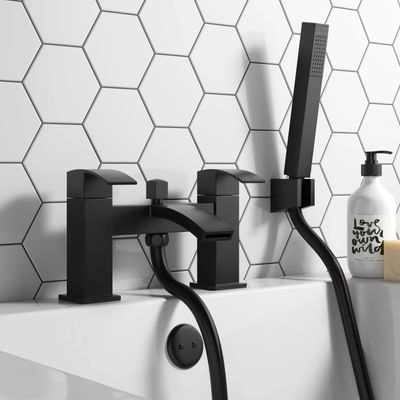
This depends entirely on the type of faucet you plan to install. Tub faucets come in a variety of styles that require either two or three holes.
- The majority of faucets, including separate pillar taps, blending faucets, and most tub/handheld shower blenders, require only two tap holes.
- Certain models use a three-hole design. This may include individual hot and cold handles separated from the central spout, or a deck-mounted handheld shower spray that requires an extra hole.
What Size Hole Cutter Do I Need?
The hole size is determined by your specific faucet model. The hole must be large enough to accommodate the tap’s body and the piping that secures it. The standard pipe thread for many fixtures is a specific size (often around 3/4 inch), but the required hole diameter typically ranges from 22mm to 35mm.
You must carefully check the technical specifications provided with your faucet to find the exact hole size needed. If unsure, contact the manufacturer. Once you confirm the size, you can purchase the corresponding hole saw drill bit.
How Far Apart Should the Tap Holes Be Spaced?
The distance between the holes depends on the faucet model, whether you are installing a blending faucet or separate pillar taps. Always, always check the technical documentation supplied with your fixtures to determine the precise spacing. Getting the spacing wrong means the tub will likely be unusable.
How to Drill Tap Holes in a Bath
Now that the preparation is complete, it’s time to begin. The following instructions apply to both common polymer (acrylic) and fiberglass-coated tubs.
Step 1: Read the Instructions (Again!)
We cannot overstate the importance of knowing your precise measurements: the exact diameter of the holes and the exact distance between them. There is no reversing the action once you start drilling, so verify your measurements multiple times. Remember the professional rule: “Measure twice, cut once.”
Step 2: Measuring and Marking
First, identify the edge of the tub where the faucets will be placed. Cover this edge with masking tape (this prevents the drill from slipping and allows for easy marking). Using a tape measure, find and mark the center point of the tub edge.
Next, measure where the faucet holes will go, relative to the center point. Double-check your faucet’s instructions for the precise spacing, then use a ruler or tape measure to mark these locations. Draw circles with a small cross at the center to indicate the exact drilling points. The circle should match the diameter of the hole saw bit you will use.
Tip: If your faucet came with washers, you can place a washer on the tub and trace its internal edge to create your guiding circle.
Step 3: Create Your Pilot Holes
It’s time to drill! Put on your safety goggles and gloves. Attach the small pilot drill bit (e.g., 1/8-inch) to your power drill. Pilot holes only need to be shallow incisions. They serve as an accurate starting point, preventing the larger hole saw from wandering when you begin the main drilling.
Step 4: Drilling the Tap Holes
Replace the small bit with the appropriately sized hole saw drill bit. Place the saw over the marked circle, ensuring the center point of the saw fits snugly into the pilot hole. Now, drill slowly and steadily straight down through the tub material. Take your time and work carefully until you have cut all the way through.
Once finished, clean up the debris, and your tub is ready for the faucets to be fitted.

Material-Specific Notes
Drilling Polymer Tubs
Polymer (acrylic) is the most common tub material today. It is relatively easy to drill through, making it ideal for both beginners and experienced DIYers.
Drilling Fiberglass Tubs
Sometimes, polymer tubs are finished with a fiberglass coating to enhance durability. The drilling process remains the same. The only difference is that fiberglass can sometimes splinter slightly more than pure polymer, which is why eye protection is mandatory.
Drilling Metal Tubs
We strongly advise against attempting to drill tap holes into a steel or cast-iron bathtub at home. This task requires specialized equipment and expertise to prevent damaging the enamel coating (which can shatter if incorrectly drilled) and to apply a sealant that protects the exposed metal edges from inevitable rust and degradation. If you have an undrilled metal tub, choosing wall-mounted or floor-mounted faucets is the recommended approach.
What If the Holes Are Too Big or Spacing Is Wrong?
Unfortunately, you only get one chance to drill a hole correctly. You cannot easily undo a wrongly placed or oversized hole. Your only options are:
- Find an alternative set of faucets that happens to fit the hole sizes and spacing you have created.
- Attempt to use large stainless steel washers to bridge the gap. However, this often results in a visually awkward, temporary fix.
The key lesson is to ensure meticulous planning and careful execution to avoid needing a replacement tub.


