

A vanity unit is a bathroom cabinet with a sink on top and a cupboard underneath, available in widths from 400mm to 2500mm across the UK. Choosing the correct size determines how functional, comfortable, and practical your bathroom is on a daily basis.
Vanity units in the UK come in 4 core size categories: compact (400mm–550mm) for cloakrooms, standard (600mm–750mm) for single bathrooms, large (800mm–900mm) for family bathrooms, and double (1000mm–2500mm) for master and luxury bathrooms. Height runs from 820mm to 860mm and depth from 380mm to 500mm across all categories.
Size selection of vanity units depends on factors like available wall width, floor clearance, basin type, number of daily users, and room type. British Standard BS 6465-1:2006 requires a minimum 700mm of clear floor space in front of any basin, making accurate measurement essential before purchasing.
Vanity unit prices in the UK range from £45 for a compact 400mm unit to £1,500 for a premium large double unit. Getting the size right from the start avoids the cost and disruption of a bathroom refit later.
This guide covers every standard vanity unit size available in the UK, the best size for every room type and user need, how to measure correctly, and what to avoid when choosing a vanity unit size.
What Is a Vanity Unit, and Why Does Size Matter?
A vanity unit is a bathroom cabinet with a sink on top and a cupboard underneath. Vanity units perform 3 functions in a bathroom: hand-washing, pipe concealment, and storage. The correct vanity unit size keeps a bathroom functional, safe, and comfortable to use daily.
Vanity unit size matters because an incorrectly sized unit reduces usable bathroom space. British Standard BS 6465-1:2006 requires 700mm of clear floor space in front of any sink. A vanity unit that is too wide removes that clearance. A vanity unit that is too narrow reduces storage capacity. Choosing the correct size from the start avoids the cost and disruption of a bathroom refit.
What Are the Standard Vanity Unit Sizes in the UK?

In the United Kingdom vanity units come in widths from 400mm to 2500mm, with a depth of 380mm–500mm and a height of 820mm–860mm including the basin. The standard vanity unit sizes available in the UK are listed below:
- 400mm Vanity Unit: The smallest UK vanity unit size, designed for cloakrooms and downstairs toilets with limited wall space. Accommodates a compact basin with basic under-sink storage.
- 450mm Vanity Unit: A 50mm wider alternative to 400mm, suited to narrow cloakrooms requiring a slightly more comfortable basin width.
- 500mm Vanity Unit: A widely chosen cloakroom vanity unit size, providing a functional basin and under-sink cupboard without reducing floor space.
- 550mm Vanity Unit: Designed for small en-suites where a 600mm vanity unit exceeds the available wall width. Delivers more basin space than 500mm while remaining compact.
- 600mm Vanity Unit: The most installed vanity unit size in UK homes, providing a full-sized basin and a practical storage cupboard in standard single bathrooms.
- 650mm Vanity Unit: A 50mm wider alternative to 600mm, providing additional counter space in compact family bathrooms without stepping up to 700mm.
- 700mm Vanity Unit: A generous single-basin vanity unit with greater under-sink storage than 600mm, suited to single and small family bathrooms.
- 750mm Vanity Unit: A mid-range vanity unit size between standard and large categories, commonly specified in modern UK bathroom designs.
- 800mm Vanity Unit: A large vanity unit providing a wider basin and increased storage capacity, suited to busy family bathrooms with heavier daily use.
- 900mm Vanity Unit: A spacious single-basin vanity unit with substantial storage, suited to larger family bathrooms shared by 2 or more users daily.
- 1000mm Vanity Unit: The entry-level double vanity unit size, accommodating 2 basins side by side in master bathrooms requiring simultaneous use.
- 1100mm Vanity Unit: A double vanity unit providing 100mm more counter space between 2 basins than the 1000mm, suited to master bathrooms with moderate wall width.
- 1200mm Vanity Unit: The most popular double vanity unit size in UK master bathrooms, fitting 2 full-sized basins with comfortable counter space between them.
- 1500mm Vanity Unit: A wide double vanity unit providing generous counter space, 2 basins, and substantial under-sink storage in large master bathrooms.
- 1600mm Vanity Unit: A large double vanity unit designed for luxury bathrooms, giving 2 users ample personal space at the basin.
- 1800mm Vanity Unit: A premium double vanity unit suited to high-end en-suites and boutique hotel-style bathroom designs with significant wall space.
- 2500mm Vanity Unit: The largest standard vanity unit size in the UK, designed for bespoke and luxury bathroom installations with long wall runs and maximum storage requirements.
What Are the Standard Vanity Unit Widths Available?
Standard vanity unit widths range from 400mm to 2500mm, covering 4 categories: compact, standard, large, and double. The available widths are listed below:
- 400mm–550mm (Compact): Built for cloakrooms and small en-suites with restricted wall width.
- 600mm–750mm (Standard): The most common width range in UK single bathrooms, balancing basin size with storage.
- 800mm–900mm (Large): Wider basins and greater storage for family bathrooms with heavier daily use.
- 1000mm–1200mm (Double): Accommodates 2 basins side by side, suited to master bathrooms.
- 1500mm–2500mm (Premium Double): Maximum width range for luxury and bespoke bathroom installations.
What Are the Standard Vanity Unit Depths (Front to Back) in the UK?
Standard vanity unit depths in the UK range from 380mm to 500mm front to back, with 450mm–500mm being the most commonly installed depth across single and family bathrooms. The available depth options are listed below:
- 380mm (Shallow): The slimmest standard depth, designed for narrow bathrooms where every millimetre of floor space counts.
- 400mm (Compact): A slim-profile vanity unit depth suited to small en-suites and cloakrooms with restricted floor space.
- 450mm (Standard): The most widely available vanity unit depth in the UK, fitting the majority of UK bathroom layouts comfortably.
- 500mm (Full Depth): The deepest standard vanity unit option, providing a wider basin and more generous under-sink storage capacity.
Depth directly affects 2 things: how much floor space the vanity unit occupies and how much usable basin space you get at the sink. A 380mm deep vanity unit preserves more floor clearance in tight bathrooms, while a 500mm deep unit provides a more comfortable washing experience with greater storage underneath.
What Are the Standard Vanity Unit Heights in the UK?
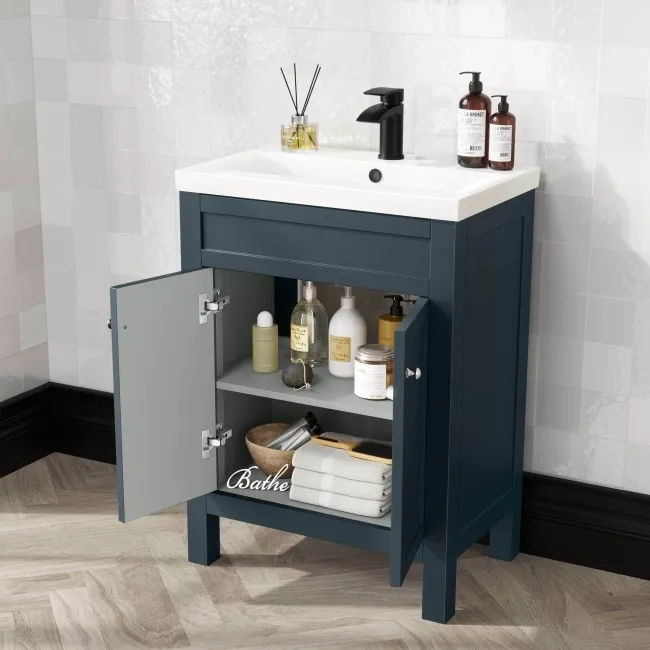
Standard vanity unit heights in the UK range from 820mm to 860mm including the basin, with 850mm being the most common height found in UK bathrooms. The available height options are listed below:
- 820mm (Low): The shortest standard height, great for children’s bathrooms or accessible bathrooms where a lower sink is needed.
- 830mm (Compact): A touch taller than 820mm, works well for shorter users who find 820mm a little too low.
- 845mm (Mid): Sits nicely between compact and standard, a popular choice in modern UK bathrooms.
- 850mm (Standard): The most popular vanity unit height in UK homes, comfortable for most adults to wash their hands without bending or stretching.
- 860mm (Tall): The tallest standard option, perfect for taller users and modern bathrooms going for a sleek, counter-height look.
What Vanity Unit Sizes Are Best for Different Room Types?

The best vanity unit size depends on the room type, with each bathroom type having a recommended width range based on available space and daily use.
- Cloakroom: 400mm–500mm. Cloakrooms are the smallest bathroom type in UK homes, typically measuring 900mm x 1500mm. A compact vanity unit keeps the room functional without blocking movement.
- Small En-Suite: 500mm–600mm. Small en-suites serve 1 person daily and have limited wall space. A 500mm–600mm vanity unit provides a comfortable basin and basic storage without crowding the room.
- Standard Single Bathroom: 600mm–700mm. The most common bathroom type in UK homes, shared by 2–4 users daily. A 600mm–700mm vanity unit delivers a full-sized basin and practical storage within the available wall width.
- Family Bathroom: 700mm–900mm. Family bathrooms serve 4 or more users daily and require a wider basin and greater storage capacity. A 700mm–900mm vanity unit handles heavier daily use comfortably.
- Guest Bathroom: 600mm–700mm. Guest bathrooms receive lighter daily use than family bathrooms. A 600mm–700mm vanity unit provides a comfortable basin and tidy storage for occasional users.
- Children’s Bathroom: 600mm–700mm. Children’s bathrooms require a lower basin height alongside a practical width. A 600mm–700mm vanity unit at 820mm height suits younger users comfortably.
- Jack and Jill Bathroom: 800mm–1000mm. Jack and Jill bathrooms are shared between 2 adjacent bedrooms, serving 2 users simultaneously. An 800mm–1000mm vanity unit accommodates 2 users without overcrowding the shared space.
- Accessible Bathroom: 600mm–700mm. Accessible bathrooms are designed for wheelchair users and those with limited mobility. A 600mm–700mm vanity unit at a reduced height of 720mm–750mm meets accessibility requirements while maintaining practical storage.
- Wet Room: 600mm–800mm. Wet rooms combine the shower and bathroom into a single open-plan space. A 600mm–800mm wall-hung vanity unit suits wet room layouts by keeping the floor clear and maintaining an open feel.
- Loft Conversion Bathroom: 500mm–700mm. Loft conversion bathrooms frequently have restricted ceiling heights and angled walls that reduce usable wall width. A 500mm–700mm vanity unit fits within the available straight wall space comfortably.
- Basement Bathroom: 600mm–900mm. Basement bathrooms often have more generous floor space than upper-floor bathrooms but limited natural light. A 600mm–900mm vanity unit with integrated storage reduces surface clutter and keeps the space feeling open.
- Master Bathroom: 1000mm–1200mm. Master bathrooms are the largest private bathroom in a UK home, typically shared by 2 adults. A double vanity unit of 1000mm–1200mm fits 2 basins side by side for simultaneous use.
- Luxury Bathroom: 1500mm–2500mm. Luxury and bespoke bathrooms have generous wall runs and prioritise comfort and aesthetics. A 1500mm–2500mm vanity unit delivers maximum storage, counter space, and a premium look.
How Do Vanity Unit Sizes Differ by Type?
Vanity unit sizes differ by type because each type is designed for a different installation method, which directly affects the available width, depth, and height dimensions.
- Freestanding Vanity Units: Available in widths from 400mm to 1200mm. Freestanding units sit directly on the floor with exposed legs or a solid base, requiring additional floor clearance around the unit on 3 sides.
- Wall-Hung Vanity Units: Available in widths from 400mm to 1200mm. Wall-hung units are fixed directly to the wall with no floor contact, making the floor space beneath the unit fully visible and the bathroom feel larger.
- Floor-Standing Vanity Units: Available in widths from 400mm to 2500mm. Floor-standing units run from floor to basin with a fully enclosed base, providing the greatest under-sink storage capacity of any vanity unit type.
- Corner Vanity Units: Available in widths from 400mm to 600mm. Corner units fit diagonally into a bathroom corner, making use of otherwise wasted space in small cloakrooms and compact en-suites.
- Double Vanity Units: Available in widths from 1000mm to 2500mm. Double units accommodate 2 basins side by side and are designed exclusively for master bathrooms and luxury bathroom installations.
- Countertop Vanity Units: Available in widths from 500mm to 1200mm. Countertop units feature a flat worktop surface with a vessel basin sitting on top, adding 100mm–150mm to the overall unit height.
- Combination Vanity Units: Available in widths from 600mm to 1200mm. Combination units integrate a mirrored cabinet above the basin unit, providing storage at 2 levels within the same wall footprint.
How Do Basin Types Affect Vanity Unit Sizing?

Basin type directly affects vanity unit sizing because each basin type occupies a different amount of counter space, depth, and height, changing the minimum unit dimensions required.
- Inset Basin: Sits inside a cut-out in the vanity unit countertop. Requires a minimum unit width of 500mm and a depth of 450mm to accommodate the basin recess without compromising counter space on either side.
- Semi-Recessed Basin: Sits partially inside and partially outside the vanity unit. Reduces the required unit depth to 350mm–400mm, making semi-recessed basins a practical choice for shallow vanity units in compact bathrooms.
- Countertop Basin: Sits fully on top of the vanity unit surface. Adds 100mm–150mm to the overall unit height and requires a minimum unit width of 500mm and depth of 450mm to support the basin base securely.
- Undermount Basin: Fixed underneath the countertop from below. Requires a solid countertop material such as stone or solid surface and a minimum unit depth of 450mm to provide adequate basin bowl depth beneath the worktop.
- Integrated Basin: Moulded directly into the vanity unit countertop as a single piece. Eliminates the gap between basin and countertop, reducing cleaning effort, and is available in unit widths from 400mm upwards.
- Vessel Basin: Sits entirely on top of the vanity unit as a standalone bowl. Adds 120mm–150mm to the overall height and requires a minimum unit width of 500mm with a flat, unobstructed countertop surface.
- Double Basin: Two basins fitted within a single vanity unit. Requires a minimum unit width of 1000mm to accommodate 2 full-sized basins with comfortable counter space between them.
How Do You Measure Your Bathroom to Find the Right Vanity Unit Size?

Measure the available wall width, floor depth, and ceiling height of your bathroom to find the right vanity unit size. Take the following measurements before selecting a vanity unit:
- Wall Width: Measure the full width of the wall where the vanity unit will sit. Subtract any obstructions such as door frames, radiators, and pipework from the total wall width to get the maximum available unit width.
- Floor Depth: Measure the distance from the wall to the nearest obstruction directly in front of the installation point. Subtract the vanity unit depth of 380mm–500mm from this measurement to confirm the remaining floor clearance is at least 700mm.
- Ceiling Height: Measure the floor-to-ceiling height above the installation point. Standard UK ceiling heights of 2400mm leave sufficient clearance above an 850mm vanity unit for mirror cabinets and overhead lighting.
- Pipework Position: Locate the existing waste pipe and water supply positions on the wall. The vanity unit width and depth must align with existing pipework to avoid costly plumbing alterations.
- Door Swing Clearance: Measure the full arc of any door that opens into the bathroom. The vanity unit must sit outside the door swing arc to allow full unrestricted entry and exit.
- Adjacent Fixture Clearance: Measure the distance between the intended vanity unit position and adjacent fixtures such as the toilet, bath, and shower enclosure. A minimum clearance of 200mm between the vanity unit and any adjacent fixture keeps the bathroom layout comfortable.
- Window and Sill Position: Measure the position and sill depth of any window on or near the installation wall. A vanity unit that sits below a window must clear the sill depth without blocking ventilation or natural light.
- Skirting Board Depth: Measure the depth of the skirting board along the installation wall. Floor-standing vanity units require skirting boards to be removed or cut back to sit flush against the wall, reducing the effective floor depth available.
- Wall Stud Position: Locate the wall studs or noggins behind the installation wall. Wall-hung vanity units require fixing directly into studs or a reinforced backing board to carry the weight of the unit and basin safely.
- Soil Stack Position: Identify the position of the soil stack relative to the installation wall. A vanity unit installed far from the soil stack requires a longer waste pipe run, which affects the unit depth and floor clearance available.
- Corner Angles: Check whether the bathroom corners are square using a spirit level. Walls that are out of square by more than 5mm affect how flush a vanity unit sits against the wall, particularly for wider units of 900mm and above.
- Existing Tile Depth: Measure the depth of any existing wall tiles on the installation wall. Wall tiles of 8mm–12mm reduce the effective floor depth available and affect how flush a wall-hung vanity unit sits against the tiled surface.
What Vanity Unit Sizes Are Best for Specific User Needs?

The best vanity unit size for a specific user need is determined by the user’s height, mobility, daily usage frequency, and storage requirements.
- Tall Users (over 6ft): A vanity unit height of 860mm suits tall users, bringing the basin rim to a comfortable washing height without requiring the user to bend forward at the waist.
- Short Users (under 5ft 4in): A vanity unit height of 820mm–830mm suits shorter users, reducing the reach distance to the basin and making daily use more comfortable.
- Children: A vanity unit height of 820mm with a width of 500mm–600mm suits children’s bathrooms, providing a low, accessible basin with sufficient storage for bathroom essentials.
- Wheelchair Users: A wall-hung vanity unit at a height of 720mm–750mm with a width of 600mm–700mm meets Part M of the UK Building Regulations for accessible bathroom design, allowing knee clearance beneath the unit for wheelchair access.
- Elderly Users: A wall-hung vanity unit at 820mm with a width of 600mm–700mm suits elderly users, providing a comfortable basin height with open floor space beneath for walking aid clearance.
- Single Occupant: A vanity unit width of 500mm–700mm provides sufficient basin space and storage for 1 daily user without occupying unnecessary wall width.
- Two Occupants Sharing: A double vanity unit of 1000mm–1200mm accommodates 2 users simultaneously, reducing morning congestion in shared master bathrooms.
- Large Families: A vanity unit width of 800mm–900mm with deep under-sink storage of 500mm suits families of 4 or more, providing a wide basin and maximum storage for multiple users’ bathroom essentials.
- Users With Limited Storage: A vanity unit width of 800mm–1200mm with a full-height door cabinet provides the greatest under-sink storage volume, accommodating cleaning products, toiletries, and spare towels within a single unit.
- Users Prioritising Counter Space: A countertop vanity unit of 900mm–1200mm provides the widest usable surface area alongside the basin for toiletries, grooming products, and decorative items.
- Users With Accessibility Requirements: A corner vanity unit of 400mm–500mm at a height of 720mm–750mm suits accessible bathrooms with restricted floor space, keeping the central floor area clear for mobility aid use.
- Hotel and Commercial Use: A vanity unit width of 1200mm–1800mm with an integrated countertop basin suits hotel and commercial bathroom installations, providing a premium appearance and durable surface for high-frequency daily use.
Does a Bigger Vanity Unit Always Mean More Storage?
A bigger vanity unit does not always mean more storage. Internal storage capacity depends on 4 factors: unit width, internal configuration, basin type, and plumbing layout.
- Internal Configuration: A 600mm vanity unit with 2 internal shelves delivers more usable storage than an 800mm unit with a single open cavity. Shelf count, drawer dividers, and door configuration determine how efficiently the internal space is used.
- Basin Type: An undermount or integrated basin preserves the full internal cabinet height for storage. A semi-recessed basin reduces the internal cabinet depth by 80mm–100mm, cutting available storage volume regardless of unit width.
- Pipework Intrusion: Waste pipes and water supply connections occupy internal cabinet space. A poorly positioned soil pipe can reduce usable storage in a 900mm vanity unit to less than that of a well-configured 600mm unit.
- Drawer vs Door Configuration: Drawer units provide easier access to stored items than door-and-shelf configurations. A 700mm wide drawer unit delivers more accessible storage than an 800mm door unit with a single fixed shelf.
- Wall-Hung vs Floor-Standing: A floor-standing vanity unit encloses the full height from floor to basin, providing greater total storage volume than a wall-hung unit of the same width, which leaves the lower section open.
- Double Basin Impact: A double vanity unit of 1000mm–1200mm dedicates a significant portion of internal width to 2 basin wastes and supply pipes, reducing the usable storage area compared to a single basin unit of the same width.
- Corner Units: A 500mm corner vanity unit uses a diagonal internal layout, reducing the usable rectangular storage space inside the cabinet compared to a straight 500mm unit of the same external width.
How Much Should You Expect to Pay for Different Vanity Unit Sizes in the UK?

Vanity unit prices in the UK range from £45 to £1,500, with unit size being the primary cost factor.
- 400mm–500mm (Compact): £45–£250. Entry-level compact vanity units start at £45 for basic white gloss finishes. Premium cloakroom units with matt finishes and soft-close doors reach £250.
- 550mm–600mm (Standard Small): £100–£450. The most widely available price bracket in UK bathroom retail. Mid-range 600mm units with soft-close doors and ceramic basins sit between £150–£300.
- 650mm–700mm (Standard Large): £150–£550. A 700mm vanity unit with an integrated basin and quality finish sits comfortably between £200–£400 in the mid-market range.
- 750mm–800mm (Large): £200–£700. Larger single-basin units with premium finishes, solid timber carcasses, and undermount basins reach £500–£700.
- 900mm (Extra Large Single): £300–£900. A 900mm vanity unit with full-height doors, an integrated worktop, and a quality basin sits between £400–£700 in the mid-to-premium range.
- 1000mm–1200mm (Double): £450–£1,200. Entry-level double vanity units start at £450. Premium 1200mm units with 2 integrated basins, soft-close drawers, and matt finishes reach £900–£1,200.
- 1500mm–1600mm (Large Double): £800–£1,500. Large double vanity units in this width range are positioned firmly in the premium market, with solid wood and stone countertop options reaching £1,500.
What Are the Most Common Mistakes People Make When Choosing a Vanity Unit Size?
The most common mistake people make when choosing a vanity unit size is measuring the wall width only, without accounting for door swing, pipework, and adjacent fixture clearances.
- Measuring Wall Width Only: The available wall width and the usable installation width are 2 different measurements. Door frames, radiators, and adjacent fixtures reduce the usable wall width significantly.
- Ignoring Door Swing Clearance: A bathroom door swinging into the room can obstruct a vanity unit that fits the wall perfectly. A vanity unit sitting within the door swing arc makes the bathroom unusable.
- Choosing Width Without Checking Depth: A wide vanity unit with a depth of 500mm in a narrow bathroom reduces floor clearance below the 700mm minimum required by British Standard BS 6465-1:2006.
- Overlooking Pipework Positions: Existing waste pipes and water supply points on the wall determine where a vanity unit can realistically sit. Repositioning pipework adds significant plumbing costs to an installation.
- Prioritising Storage Over Space: A larger vanity unit delivers more storage but reduces floor clearance, making a small bathroom feel tight and difficult to use daily.
- Selecting Height Without Considering Users: A standard 850mm vanity unit height is uncomfortable for children, shorter adults, and wheelchair users. User height and mobility needs determine the correct unit height.
- Forgetting Adjacent Fixture Clearances: A vanity unit positioned too close to a toilet or shower enclosure creates an uncomfortable and non-compliant bathroom layout. Maintain a minimum 200mm clearance between the vanity unit and any adjacent fixture.
- Choosing Basin Type After Buying the Unit: Different basin types require different minimum unit dimensions. Selecting a countertop or vessel basin after purchasing a vanity unit often results in an incompatible combination.
- Overlooking Plumbing Waste Direction: Vanity units are manufactured with waste outlets positioned at the back or side of the cabinet. A mismatched waste outlet direction requires additional pipework alterations during installation.
- Buying Without Checking the Room Layout: A vanity unit that looks correct in isolation can disrupt the entire bathroom layout. Always plan the full bathroom layout before confirming the vanity unit size.
How Do You Install a Vanity Unit and Does Size Affect Installation?

Vanity unit installation involves fixing the unit to the wall or floor, connecting the basin waste, and linking the water supply — and yes, size directly affects the complexity and cost of installation.
- Mark the Installation Position: Mark the vanity unit position on the wall using a spirit level and pencil. Larger units of 1000mm and above require a longer level line across a greater wall span, increasing the risk of an uneven installation on walls that are not perfectly flat.
- Locate Wall Studs or Noggins: Use a stud finder to identify fixing points within the wall. Wall-hung vanity units of 800mm and above carry a greater weight of 30kg–50kg and require fixing into a minimum of 2 wall studs or a reinforced noggin for safe support.
- Fix the Wall Brackets or Cabinet: Drill fixing holes and secure wall brackets or the cabinet directly to the wall. Larger vanity units require a minimum of 4 fixing points to distribute the unit weight evenly across the wall surface.
- Connect the Water Supply: Attach the hot and cold water supply pipes to the basin tap connections. Double vanity units of 1000mm–1200mm require 4 supply connections for 2 taps, increasing plumbing time and material costs.
- Fit the Basin: Place and secure the basin onto or into the vanity unit. Countertop and vessel basins add 120mm–150mm to the overall unit height and require a watertight sealant bead around the full basin perimeter.
- Connect the Waste Pipe: Attach the basin waste to the existing soil stack or waste outlet. Vanity units positioned more than 3 metres from the soil stack require a pumped waste system regardless of unit size.
- Seal the Perimeter: Apply a continuous silicone sealant bead along all edges where the vanity unit meets the wall and floor. Larger units of 1200mm and above have a greater perimeter length, requiring more sealant and a longer sealing time to achieve a watertight finish.
- Check Level and Stability: Confirm the installed unit is level and fully stable before use. Floor-standing units of 1500mm and above require checking across the full width with a spirit level, as minor floor undulations across a long unit base produce visible tilt at the far end.
How Do You Choose the Best Vanity Unit Size?

Choose the best vanity unit size by measuring your available wall width, confirming floor clearance, identifying your basin type, and matching the unit dimensions to the number of daily users.
- Measure Wall Width First: Measure the full wall width and subtract door frames, radiators, and pipework to get the maximum usable unit width.
- Confirm Floor Clearance: Subtract the vanity unit depth from the available floor space and confirm at least 700mm of clearance remains in front of the unit.
- Match Size to Room Type: Cloakrooms suit 400mm–500mm, single bathrooms suit 600mm–700mm, family bathrooms suit 800mm–900mm, and master bathrooms suit 1000mm–1200mm.
- Match Size to Daily Users: 1 daily user requires 500mm–600mm. 2 simultaneous users require a double unit of 1000mm–1200mm.
- Choose the Right Height: 850mm suits most UK adults. Children and wheelchair users require 720mm–820mm.
- Select Basin Type Before the Unit: Countertop and vessel basins add 120mm–150mm to overall height. Semi-recessed basins reduce required depth to 350mm–400mm.
- Check Pipework Positions: Confirm existing waste and supply pipes align with the chosen unit to avoid additional plumbing costs.
- Assess Storage Needs: A 700mm drawer unit with 3 drawers delivers more accessible storage than a 900mm door unit with a single shelf.
- Check Door Swing: Confirm the unit sits fully outside the bathroom door swing arc before purchasing.
- Check Adjacent Fixture Clearances: Maintain a minimum 200mm gap between the vanity unit and any toilet, bath, or shower enclosure.
- Consider Wall Type: Stud walls require noggin reinforcement before fitting a wall-hung vanity unit. Solid walls accept standard fixings without additional preparation.
- Check Weight Capacity: Wall-hung vanity units of 800mm and above weigh 30kg–50kg fully loaded. Confirm the wall fixing method supports the full loaded weight before installation.
- Factor in Ventilation: A vanity unit installed directly beneath or adjacent to an extractor fan position reduces airflow efficiency. Maintain a minimum 300mm clearance between the unit top and any extractor fan.
- Plan for Future Use: A bathroom shared by a growing family benefits from a larger unit of 800mm–900mm from the outset, avoiding a costly refit within 3–5 years.
- Set a Budget Before Sizing: Vanity unit prices increase proportionally with width. Set a clear budget before selecting a size to avoid compromising on quality for the sake of extra width.
Why Choose Bathroom Mountain for Vanity Units?
Bathroom Mountain stocks vanity units from 400mm to 2500mm, covering every UK bathroom type, size, and budget in a single destination.
- Widest Size Range: Bathroom Mountain stocks vanity units from 400mm compact cloakroom units to 2500mm bespoke luxury installations, covering every standard UK bathroom size.
- All Budget Ranges Covered: Vanity units at Bathroom Mountain are priced from £45 to £1,500, giving every customer a quality option at every price point.
- All Types Available: Freestanding, wall-hung, floor-standing, corner, double, countertop, and combination vanity units are all stocked in one place.
- All Finishes Stocked: White gloss, matt black, anthracite, oak, walnut, and grey finishes are available across the full size range.
- Expert Sizing Guidance: Bathroom Mountain provides dedicated vanity unit sizing guidance to help customers select the correct width, depth, and height for their specific bathroom layout.
- UK Standard Compliance: Every vanity unit stocked by Bathroom Mountain meets UK building and sanitary installation standards, including British Standard BS 6465-1:2006.
- Fast UK Delivery: Bathroom Mountain delivers vanity units across the UK, with tracked delivery and a clear lead time on every product.
- Easy Returns: Bathroom Mountain offers a straightforward returns process on vanity units that do not fit or meet expectations after delivery.


