

Mirrors are defined by technical construction, functional purpose, and visual control, with classification based on shape, size, room use, mounting method, frame style and material, glass type, edge treatment, backing and coating systems, special features, control technology, thickness, colour and finish, portability, durability, budget level, and privacy regulation, each factor directly influencing reflection accuracy, moisture resistance, safety performance, lighting interaction, and spatial perception.
Mirror selection depends on environmental exposure, installation permanence, visibility requirements, and maintenance expectations, with material quality, coating protection, and feature integration determining long-term performance under bathroom humidity, temperature variation, and daily use conditions.
What Is A Mirror?
A mirror is a reflective surface that produces a visible image by returning incident light at equal angles according to the law of reflection, enabling precise visual perception for grooming, spatial alignment, and interior bathroom design.
Mirror manufacturing uses glass substrates with silver or aluminium coatings, delivering measured reflectance between 90% and 95% across the visible light spectrum, supporting consistent image accuracy in domestic bathroom environments.
What Are The Main Types Of Mirrors?

The main types of mirrors are classified by reflective surface geometry and optical image behaviour, including plane mirrors, concave mirrors, convex mirrors, and specialised bathroom mirrors designed for functional performance in residential interiors.
Plane Mirrors
Plane mirrors use flat reflective surfaces to create upright images with equal object and image distance, preserving true scale, proportional accuracy, and spatial alignment. Plane mirror installations dominate bathroom environments due to predictable reflection behaviour, full viewing coverage, and compatibility with wall-mounted configurations.
Concave Mirrors
Concave mirrors use inward-curved reflective surfaces to enlarge close-range images by converging reflected light rays toward a focal point. Concave mirror geometry supports precision grooming activities such as shaving and facial detailing, where controlled magnification improves visual accuracy.
Convex Mirrors
Convex mirrors use outward-curved reflective surfaces to generate reduced images while expanding the viewing angle through light ray divergence. Convex mirror behaviour prioritises peripheral visibility and spatial awareness rather than fine-detail representation in domestic settings.
Specialised Bathroom Mirrors
Specialised bathroom mirrors combine reflective surfaces with functional enhancements including integrated lighting systems, demisting elements, magnification zones, and electronic controls. Specialised bathroom mirror designs address humidity exposure, task-specific usage, and controlled bathroom operating conditions.
What Are The Types Of Mirrors By Shape?

The types of mirrors by shape are defined by external geometric outline rather than optical behaviour, including rectangular mirrors, square mirrors, round mirrors, oval mirrors, arched mirrors, pill-shaped mirrors, asymmetrical mirrors, corner mirrors, and full-length mirrors, each influencing spatial perception, wall proportion, and visual balance in bathroom environments.
Rectangular Mirrors
Rectangular mirrors use straight horizontal and vertical edges to maximise reflective surface area and maintain proportional alignment with vanity units and linear wall layouts. Rectangular geometry creates stable reflection zones, supports precise wall fitting, and delivers high surface efficiency within standard bathroom configurations.
Square Mirrors
Square mirrors present equal height and width dimensions that create balanced reflection fields within compact wall spaces. Equal-sided geometry reinforces centred alignment, proportional symmetry, and visual equilibrium above single-basin installations.
Round Mirrors

Round mirrors apply circular geometry to distribute reflection evenly across the viewing field while reducing angular visual rigidity. Continuous curvature softens edge perception and improves visual flow where linear fittings dominate wall composition.
Oval Mirrors

Oval mirrors combine vertical elongation with curved lateral edges to increase perceived wall height while preserving smooth reflective continuity. Elongated curvature adjusts vertical proportion perception without introducing abrupt boundary transitions.
Arched Mirrors

Arched mirrors integrate a straight lower edge with a curved upper profile to introduce architectural emphasis and controlled vertical focus. Partial curvature establishes a visual anchor that strengthens hierarchy without enclosing the reflective perimeter.
Pill-Shaped Mirrors

Pill or oval shaped mirrors use elongated rounded outlines that merge vertical extension with softened curvature. This geometry balances linear alignment with continuous edge transition across reflective surfaces.
Asymmetrical Mirrors
Asymmetrical mirrors feature intentionally irregular outlines that disrupt geometric uniformity to establish visual focal points. Non-uniform contours shift emphasis from symmetry toward decorative prominence within bathroom interiors.
Corner Mirrors

Corner mirrors use angled or triangular profiles designed for junction placement to extend reflective coverage across intersecting wall planes. This configuration improves spatial efficiency where uninterrupted wall width remains limited.
Full-Length Mirrors

Full-length mirrors employ extended vertical proportions to provide head-to-toe reflection while increasing perceived spatial depth. Vertical continuity enhances height perception and functional visibility within larger bathroom layouts.
What Are The Types Of Mirrors By Use Or Room?
The types of mirrors by use or room are classified by functional purpose and environmental conditions, including bathroom mirrors, bedroom mirrors, dressing room mirrors, hallway mirrors, living room mirrors, cloakroom mirrors, utility room mirrors, home gym mirrors, and commercial washroom mirrors, each addressing specific visibility, lighting, moisture, and spatial requirements.
Bathroom Mirrors
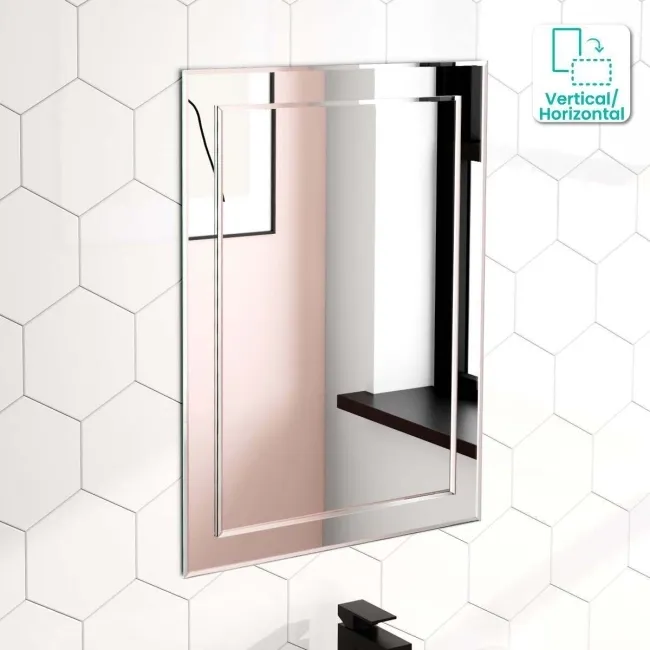
Bathroom mirrors support daily grooming tasks within high-humidity environments while maintaining clear reflection and surface stability. Bathroom mirrors represent over 70% of installed household mirror placements due to repeated daily use and proximity to water sources.
Bedroom Mirrors
Bedroom mirrors provide personal grooming visibility and outfit assessment within low-moisture, ambient-light environments. Placement emphasises vertical reflection and spatial depth rather than task-focused illumination.
Dressing Room Mirrors
Dressing room mirrors deliver full-length reflective coverage for complete body visibility and proportion evaluation. Extended vertical formats improve accuracy during clothing selection and posture assessment.
Hallway Mirrors
Hallway mirrors increase perceived space and improve light distribution within narrow or enclosed transitional areas. Reflective positioning enhances brightness and visual openness near entry points.
Living Room Mirrors
Living room mirrors act as decorative reflective surfaces that amplify natural and artificial light while increasing perceived room depth. Installation prioritises visual balance and feature-wall emphasis over functional grooming use.
Cloakroom Mirrors
Cloakroom mirrors provide compact reflective functionality within small guest washrooms and secondary toilet spaces. Size and placement focus on efficiency, wall clearance, and visibility near handwashing areas.
Utility Room Mirrors
Utility room mirrors support practical visibility within laundry rooms and secondary household spaces. Installation prioritises durability and functional placement rather than aesthetic prominence.
Home Gym Mirrors
Home gym mirrors enable posture monitoring, movement alignment, and exercise form assessment. Large reflective surfaces improve spatial awareness and movement accuracy during physical activity.
Commercial And Public Washroom Mirrors
Commercial washroom mirrors are designed for high-traffic environments requiring durability, impact resistance, and consistent visibility. Installation standards prioritise safety compliance, surface longevity, and frequent user interaction across shared facilities.
What Are The Types Of Mirrors By Mounting And Installation?
The types of mirrors by mounting and installation are classified by fixing method, structural integration, and adjustability, including wall-mounted mirrors, recessed mirrors, surface-mounted mirrors, freestanding mirrors, floor-standing mirrors, cabinet-mounted mirrors, hinged mirrors, pivot mirrors, extendable arm mirrors, ceiling-suspended mirrors, and integrated furniture mirrors, each defining installation permanence, load distribution, and spatial interaction within bathroom and residential environments.
Wall-Mounted Mirrors

Wall-mounted mirrors fix directly onto vertical wall surfaces using brackets, screws, adhesives, or concealed fixings to provide stable and space-efficient reflective coverage. This mounting type accounts for the majority of residential bathroom installations due to structural simplicity and compatibility with masonry and stud walls.
Surface-Mounted Mirrors
Surface-mounted mirrors sit directly on the wall face without recessing, projecting forward from the wall plane. This installation allows simplified fitting, accommodates thicker frames, and avoids wall cavity modification.
Recessed Mirrors

Recessed mirrors install flush within wall cavities, aligning the reflective surface with surrounding wall finishes. Recessed mounting reduces projection depth, protects mirror edges, and improves spatial efficiency in compact bathrooms.
Freestanding Mirrors
Freestanding mirrors rely on self-supporting frames or rear stands without permanent wall attachment. Structural stability depends on weighted bases or angled supports rather than fixed wall anchors.
Floor-Standing Mirrors
Floor-standing mirrors use full-height frames resting directly on the floor surface to provide extended vertical reflection. Installation requires no wall penetration and supports flexible repositioning within larger rooms.
Cabinet-Mounted Mirrors
Cabinet-mounted mirrors integrate reflective surfaces with wall-fixed storage units positioned above vanity areas. This installation combines visibility and concealed storage within a single structural assembly.
Hinged Mirrors
Hinged mirrors attach to walls or cabinets using pivot hinges that allow lateral opening movement. Hinged installation supports access to concealed storage or secondary reflective surfaces behind the primary panel.
Pivot Mirrors
Pivot mirrors rotate on central or side-mounted pivot points to allow angle adjustment without relocation. Mechanical pivots control movement range while maintaining fixed anchoring points.
Extendable Arm Mirrors
Extendable arm mirrors mount to walls using articulated arms that extend and retract for variable viewing distance. Mechanical joints support controlled movement while maintaining fixed structural anchors.
Ceiling-Suspended Mirrors
Ceiling-suspended mirrors hang vertically from overhead structures using cables, rods, or rigid fixings. Load-bearing requirements transfer weight to ceiling joists rather than wall surfaces.
Integrated Furniture Mirrors
Integrated furniture mirrors form part of wardrobes, vanity units, or dressing furniture rather than standalone fixtures. Installation aligns reflective surfaces with furniture structure, reducing separate wall mounting requirements.
What Are The Types Of Mirrors By Frame Style?
The types of mirrors by frame style are classified by edge treatment, frame material, and profile depth, including frameless mirrors, thin-frame mirrors, thick-frame mirrors, metal-framed mirrors, wooden-framed mirrors, composite-framed mirrors, decorative moulded mirrors, industrial-style mirrors, and minimalist profile mirrors, each affecting boundary definition and visual weight in bathroom environments.
Frameless Mirrors

Frameless mirrors use polished or bevelled glass edges without an external border to create uninterrupted reflective boundaries and minimal visual weight. Edge finishing replaces structural framing while maintaining clean alignment with tiled and painted wall surfaces.
Thin-Frame Mirrors
Thin-frame mirrors apply narrow perimeter borders that define mirror edges while preserving reflection dominance. Reduced frame width maintains visual clarity and controlled contrast against surrounding wall finishes.
Thick-Frame Mirrors
Thick-frame mirrors use wide perimeter borders to create strong boundary separation and increased visual presence. Greater frame depth establishes focal emphasis and structural definition around the reflective surface.
Metal-Framed Mirrors
Metal-framed mirrors use aluminium, steel, brass, or alloy borders to provide rigid edge definition and material contrast. Metallic construction supports dimensional stability and consistent geometry under bathroom humidity conditions.
Wooden-Framed Mirrors
Wooden-framed mirrors use solid wood or engineered timber borders to introduce texture and material warmth. Timber framing adds depth variation and contrasts with ceramic, porcelain, and stone bathroom finishes.
Composite-Framed Mirrors
Composite-framed mirrors use engineered materials such as resin or MDF to achieve uniform profiles and controlled surface finishes. Layered construction supports repeatable production and moisture-resistant coatings.
Decorative Moulded Mirrors
Decorative moulded mirrors feature sculpted or patterned frames that add ornamental definition around reflective surfaces. Moulded detailing increases visual complexity and stylistic prominence within bathroom interiors.
Industrial-Style Mirrors
Industrial-style mirrors use exposed metal frames, riveted detailing, or matte finishes to emphasise utilitarian structure. Structural visibility positions the frame as a dominant design element rather than a concealed boundary.
Minimalist Profile Mirrors
Minimalist profile mirrors use ultra-slim frames or recessed edge detailing to minimise boundary visibility. Reduced profile depth preserves spatial clarity and uninterrupted wall composition across bathroom layouts.
What Are The Types Of Mirrors By Frame Material?
The types of mirrors by frame material are classified by structural composition and surface properties, including metal-framed mirrors, wooden-framed mirrors, composite-framed mirrors, plastic-framed mirrors, glass-framed mirrors, and stone-framed mirrors, each influencing durability, moisture resistance, visual weight, and material compatibility in bathroom environments.
Metal-Framed Mirrors
Metal-framed mirrors use aluminium, stainless steel, brass, or coated steel to provide rigid edge definition and high dimensional stability. Metal frames maintain structural integrity under humidity exposure and represent a dominant material choice in moisture-prone bathroom conditions.
Wooden-Framed Mirrors
Wooden-framed mirrors use solid timber or engineered wood to introduce organic texture and material contrast. Timber construction relies on sealed or treated surfaces to maintain stability in controlled bathroom environments.
Composite-Framed Mirrors
Composite-framed mirrors use engineered materials such as MDF, resin, or layered composites to achieve uniform profiles and controlled finishes. Composite construction supports repeatable manufacturing and moisture-resistant surface coatings.
Plastic-Framed Mirrors
Plastic-framed mirrors use moulded polymers or acrylic materials to deliver lightweight construction and high moisture tolerance. Polymer frames resist corrosion and support flexible profile shaping with reduced structural load.
Glass-Framed Mirrors
Glass-framed mirrors use secondary glass borders, often bevelled or frosted, to create reflective continuity and minimal material contrast. Glass framing maintains visual cohesion while increasing edge thickness and surface refinement.
Stone-Framed Mirrors
Stone-framed mirrors use natural or engineered stone materials such as marble, slate, or composite stone to add mass and textural definition. Stone construction increases visual weight and requires reinforced wall mounting due to higher material density.
What Are The Types Of Mirrors By Glass Type?
The types of mirrors by glass type are classified by glass composition, treatment, and safety performance, including float glass mirrors, silvered glass mirrors, aluminium mirrors, low-iron mirrors, tempered glass mirrors, laminated glass mirrors, tinted mirrors, frosted mirrors, antiqued mirrors, and safety-backed mirrors, each affecting reflectance, colour accuracy, durability, and breakage behaviour in bathroom environments.
Float Glass Mirrors
Float glass mirrors use soda-lime silica glass produced by the float process to create flat, distortion-free reflective surfaces. Uniform thickness supports consistent image accuracy and represents the base substrate for most residential bathroom mirrors.
Silvered Glass Mirrors
Silvered glass mirrors use a metallic silver coating applied to the rear surface to achieve high reflectance and colour fidelity. Measured visible-light reflectance typically exceeds 90%, supporting accurate facial and spatial perception.
Aluminium Mirrors
Aluminium mirrors use aluminium coatings instead of silver to improve corrosion resistance under moisture exposure. Aluminium coatings provide lower reflectance than silver while increasing longevity in high-humidity conditions.
Low-Iron Glass Mirrors
Low-iron glass mirrors use reduced iron content to minimise green tint and improve colour neutrality. Enhanced clarity increases true colour representation compared with standard float glass substrates.
Tempered Glass Mirrors
Tempered glass mirrors use heat-treated safety glass that increases impact resistance and alters breakage into small granular fragments. Strength levels exceed annealed glass by approximately four to five times, improving safety in bathroom installations.
Laminated Glass Mirrors
Laminated glass mirrors bond multiple glass layers with an interlayer to retain fragments after breakage. Laminated construction improves user safety and structural stability in public and residential bathroom environments.
Tinted Glass Mirrors
Tinted glass mirrors incorporate coloured glass substrates such as grey, bronze, or black to alter light transmission and visual tone. Reduced light reflectance creates softer visual contrast within bathroom interiors.
Frosted Glass Mirrors
Frosted glass mirrors use etched or sandblasted surfaces to diffuse reflection and reduce image sharpness. Surface diffusion supports privacy applications while maintaining general light reflection.
Antiqued Glass Mirrors
Antiqued glass mirrors apply controlled oxidation or distressing to silver layers to create aged reflective patterns. Variable reflectance produces decorative visual texture rather than uniform image clarity.
Safety-Backed Mirrors
Safety-backed mirrors apply adhesive films to the rear glass surface to retain shards after impact. Backing systems reduce injury risk and support compliance with bathroom safety standards.
What Are The Types Of Mirrors By Function?
The types of mirrors by function are classified by operational purpose, performance enhancement, and user interaction, including standard reflective mirrors, illuminated mirrors, magnifying mirrors, anti-fog mirrors, smart mirrors, storage mirrors, safety mirrors, shaving mirrors, cosmetic mirrors, full-vision mirrors, two-way mirrors, and decorative mirrors, each engineered to address specific visual, environmental, and usability requirements within bathroom environments.
Standard Reflective Mirrors
Standard reflective mirrors provide undistorted image formation for general visibility, grooming, and spatial orientation. Reflective efficiency typically exceeds 90% visible-light return when silvered glass substrates are used, supporting accurate daily use.
Illuminated Mirrors

Illuminated mirrors integrate built-in lighting systems to improve facial visibility and shadow control during grooming. Light placement focuses on frontal illumination to reduce contrast imbalance in bathrooms with limited ambient light.
Magnifying Mirrors
Magnifying mirrors increase image scale using optical curvature or integrated lenses to support precision grooming. Common magnification ranges between 2× and 10×, improving visibility for skincare, shaving, and cosmetic application.
Anti-Fog Mirrors
Anti-fog mirrors prevent condensation build-up through integrated heating elements or conductive coatings. Surface temperature regulation maintains clear reflection during high-humidity conditions caused by hot water use.
Smart Mirrors

Smart mirrors incorporate digital interfaces such as displays, sensors, and connectivity modules alongside reflective surfaces. Functional integration supports information display, lighting adjustment, and environmental feedback without compromising mirror clarity.
Storage Mirrors

Storage mirrors combine reflective surfaces with concealed cabinets or shelving to provide visibility and organised storage. Functional integration reduces wall clutter while maintaining consistent mirror positioning above vanity areas.
Safety Mirrors
Safety mirrors use laminated glass, safety backing films, or impact-resistant substrates to minimise injury risk after breakage. Safety construction aligns with residential and commercial bathroom compliance requirements.
Shaving Mirrors
Shaving mirrors provide targeted magnification and adjustable positioning to support close-range facial grooming tasks. Installation often includes extendable arms or pivot mechanisms for controlled viewing distance.
Cosmetic Mirrors
Cosmetic mirrors support detailed makeup application through enhanced magnification and controlled illumination. Functional design prioritises facial detail visibility and colour accuracy.
Full-Vision Mirrors
Full-vision mirrors provide extended reflective coverage to display the entire body within a single vertical field. Vertical proportion supports posture assessment and overall appearance evaluation.
Two-Way Mirrors
Two-way mirrors allow partial transparency under controlled lighting conditions while maintaining reflective visibility on one side. Functional use supports observation or concealed viewing applications rather than standard domestic grooming.
Decorative Mirrors
Decorative mirrors emphasise visual enhancement through surface treatments, patterning, or intentional distortion. Functional priority shifts from reflection accuracy toward interior design expression.
What Are The Types Of Mirrors By Design And Style?
The types of mirrors by design and style are classified by visual language, historical reference, material expression, and aesthetic intent, including modern mirrors, contemporary mirrors, traditional mirrors, classic mirrors, minimalist mirrors, industrial mirrors, vintage mirrors, retro mirrors, Scandinavian mirrors, rustic mirrors, luxury mirrors, art-deco mirrors, mid-century mirrors, bohemian mirrors, and statement mirrors, each shaping stylistic consistency and visual hierarchy within bathroom environments.
Modern Mirrors
Modern mirrors use simplified geometry, smooth surfaces, and restrained detailing to create visual clarity and functional balance. Design structure prioritises straight lines, neutral tones, and reduced ornamentation aligned with present-day interior standards.
Contemporary Mirrors
Contemporary mirrors reflect current design movements through adaptable forms, mixed materials, and evolving stylistic expression. Visual identity changes in response to prevailing interior trends rather than fixed historical references.
Traditional Mirrors

Traditional mirrors incorporate classic proportions, symmetrical layouts, and decorative frame detailing derived from established interior styles. Design language emphasises ornamental presence and long-standing visual conventions.
Classic Mirrors
Classic mirrors apply timeless design principles using refined frame profiles and balanced geometry without excessive decoration. Visual execution maintains long-term aesthetic relevance across changing interior trends.
Minimalist Mirrors
Minimalist mirrors reduce visual elements to essential form, controlled edges, and surface continuity. Design execution removes decorative complexity to preserve spatial clarity and uninterrupted wall composition.
Industrial Mirrors
Industrial mirrors express utilitarian design through exposed materials, visible fixings, and raw surface finishes. Visual character draws from architectural and mechanical references rather than decorative refinement.
Vintage Mirrors
Vintage mirrors reference aged finishes, distressed detailing, and heritage-inspired frame profiles. Surface treatment recreates historical character rather than contemporary precision.
Retro Mirrors
Retro mirrors adopt bold shapes, contrasting colours, and stylised frames influenced by mid-twentieth-century design. Visual language reflects specific historical periods rather than modern minimalism.
Scandinavian Mirrors
Scandinavian mirrors emphasise light materials, natural textures, and balanced proportions to promote visual calm. Design philosophy integrates functional simplicity with subtle warmth.
Rustic Mirrors
Rustic mirrors use textured materials, natural finishes, and irregular detailing to convey organic visual character. Aesthetic emphasis prioritises material authenticity over uniform refinement.
Luxury Mirrors
Luxury mirrors apply premium materials, precision finishing, and detailed craftsmanship to establish visual prominence. Design execution highlights surface quality, proportional accuracy, and elevated aesthetic value.
Art-Deco Mirrors
Art-deco mirrors feature geometric patterning, layered symmetry, and metallic accents inspired by early twentieth-century design. Visual structure emphasises bold contrast and decorative geometry.
Mid-Century Mirrors
Mid-century mirrors use clean lines, organic curves, and functional proportions influenced by post-war modernist design. Styling balances simplicity with distinctive form.
Bohemian Mirrors
Bohemian mirrors incorporate eclectic shapes, mixed textures, and decorative framing to create expressive visual identity. Design language favours individuality rather than uniform stylistic control.
Statement Mirrors
Statement mirrors employ oversized proportions, bold outlines, or distinctive detailing to dominate visual focus. Design intent positions the mirror as a primary architectural element rather than a supporting feature.
What Are The Types Of Mirrors By Size?
The types of mirrors by size are classified by dimensional coverage and reflective span, including compact mirrors, medium-sized mirrors, large mirrors, oversized mirrors, full-length mirrors, and wall-to-wall mirrors, each defining visibility range, light distribution, and spatial perception within bathroom environments.
Compact Mirrors
Compact mirrors provide limited reflective surface area for close-range facial visibility and targeted grooming tasks. Typical widths measure below 400 mm, supporting precision use where wall space and clearance remain restricted.
Medium-Sized Mirrors
Medium-sized mirrors deliver balanced reflective coverage for upper-body visibility and routine grooming activities. Common widths range between 400 mm and 800 mm, aligning proportionally with single-basin vanity installations.
Large Mirrors
Large mirrors extend reflective coverage across wider wall sections to increase visibility and perceived spatial depth. Widths exceed 800 mm, improving light dispersion and visual openness within standard bathroom layouts.
Oversized Mirrors
Oversized mirrors use expansive dimensions to dominate wall surfaces and amplify spatial perception. Reflective coverage frequently spans full vanity width or larger, increasing brightness and visual continuity.
Full-Length Mirrors
Full-length mirrors provide head-to-toe reflective visibility through extended vertical proportions. Heights typically exceed 1600 mm, supporting complete body assessment and posture visibility within bathrooms and dressing zones.
Wall-To-Wall Mirrors
Wall-to-wall mirrors cover entire wall planes to maximise reflective impact and spatial expansion. Continuous reflective surfaces significantly increase perceived room size and light distribution in enclosed bathroom environments.
What Are The Types Of Mirrors By Edge Treatment?
The types of mirrors by edge treatment are classified by glass finishing method and boundary protection, including polished edge mirrors, bevelled edge mirrors, seamed edge mirrors, flat ground edge mirrors, pencil edge mirrors, ogee edge mirrors, frosted edge mirrors, and safety-backed edge mirrors, each influencing durability, safety, and visual refinement in bathroom environments.
Polished Edge Mirrors
Polished edge mirrors use finely ground and buffed glass edges to create smooth, glossy boundaries with high light reflection. Polished finishing reduces micro-fractures along the glass perimeter and improves resistance to chipping during installation and daily use.
Bevelled Edge Mirrors
Bevelled edge mirrors feature angled glass edges cut at 5–25 mm widths to create a prismatic light-reflecting border. Bevel geometry increases edge depth perception and decorative refinement without additional framing.
Seamed Edge Mirrors
Seamed edge mirrors use lightly sanded edges to remove sharpness without high-gloss finishing. Seamed treatment prioritises basic safety and cost efficiency rather than decorative appearance.
Flat Ground Edge Mirrors
Flat ground edge mirrors apply machine-ground straight edges with a satin or matte finish. Ground edges provide uniform thickness control and improved structural stability for framed and surface-mounted installations.
Pencil Edge Mirrors
Pencil edge mirrors use rounded perimeter edges created through curved grinding profiles. Rounded treatment reduces impact stress concentration and softens boundary appearance.
Ogee Edge Mirrors
Ogee edge mirrors use S-shaped edge profiles formed through specialised grinding to create ornamental boundary detailing. Ogee profiles introduce classical decorative character directly into the glass edge.
Frosted Edge Mirrors
Frosted edge mirrors apply etched or sandblasted treatments along the perimeter to diffuse light and soften edge definition. Frosted borders reduce visual sharpness while maintaining central reflection clarity.
Safety-Backed Edge Mirrors
Safety-backed edge mirrors combine finished glass edges with rear safety films to retain shards after breakage. Backed construction increases impact safety and supports compliance with bathroom installation standards.
What Are The Types Of Mirrors By Backing And Coating?
The types of mirrors by backing and coating are classified by reflective metal layer, protective backing system, and corrosion resistance, including silver-backed mirrors, aluminium-backed mirrors, copper-free mirrors, lead-free mirrors, safety-backed mirrors, epoxy-coated mirrors, vinyl-backed mirrors, and moisture-resistant coated mirrors, each affecting reflectance, durability, and bathroom safety performance.
Silver-Backed Mirrors
Silver-backed mirrors use a metallic silver coating to achieve high reflectance and accurate colour reproduction. Measured visible-light reflectance commonly exceeds 90%, supporting precise facial and spatial visibility in bathroom use.
Aluminium-Backed Mirrors
Aluminium-backed mirrors apply aluminium coatings to improve corrosion resistance under prolonged humidity exposure. Aluminium coatings provide lower reflectance than silver while extending service life in moisture-prone environments.
Copper-Free Mirrors
Copper-free mirrors remove the copper layer traditionally used in mirror backing to reduce oxidation and edge corrosion. Copper-free construction improves long-term durability and maintains reflective clarity in high-humidity bathrooms.
Lead-Free Mirrors
Lead-free mirrors eliminate lead compounds from backing layers to meet modern environmental and health standards. Lead-free coatings support safer indoor air quality and regulatory compliance.
Safety-Backed Mirrors
Safety-backed mirrors apply adhesive films to the rear surface to retain glass fragments after impact. Backing systems reduce injury risk and improve suitability for bathroom and commercial installations.
Epoxy-Coated Mirrors
Epoxy-coated mirrors use protective resin layers to seal reflective coatings against moisture ingress. Epoxy barriers improve resistance to black edge corrosion and coating degradation.
Vinyl-Backed Mirrors
Vinyl-backed mirrors incorporate polymer backing layers to enhance moisture protection and impact retention. Flexible backing improves handling safety and installation durability.
Moisture-Resistant Coated Mirrors
Moisture-resistant coated mirrors use multi-layer protective systems to limit water vapour penetration. Coating systems extend mirror lifespan in bathrooms exposed to frequent temperature and humidity fluctuations.
What Are The Types Of Mirrors By Special Features?
The types of mirrors by special features are classified by integrated technologies and performance enhancements, including LED mirrors, backlit mirrors, front-lit mirrors, anti-fog mirrors, magnifying mirrors, smart mirrors, colour-temperature adjustable mirrors, touch-control mirrors, motion-sensor mirrors, shatter-resistant mirrors, sound-enabled mirrors, and time-display mirrors, each improving visibility, safety, and functional efficiency in bathroom environments.
LED Mirrors
LED mirrors integrate light-emitting diode systems within the mirror structure to deliver uniform, energy-efficient illumination for grooming tasks. Integrated LED systems provide low heat output and operational lifespans exceeding 30,000 hours, supporting consistent daily use.
Backlit Mirrors

Backlit mirrors position illumination behind the reflective surface to create diffused ambient light and reduced facial shadowing. Rear illumination enhances wall brightness and improves spatial depth perception in low-light bathrooms.
Front-Lit Mirrors
Front-lit mirrors place lighting elements along the mirror perimeter to deliver direct, task-focused facial illumination. Forward light orientation improves visibility accuracy during shaving, skincare routines, and cosmetic application.
Anti-Fog Mirrors
Anti-fog mirrors prevent condensation formation through integrated heating elements or conductive surface coatings. Controlled surface temperature maintains uninterrupted reflection during high-humidity conditions caused by hot water use.
Magnifying Mirrors
Magnifying mirrors increase image scale through optical curvature or integrated magnification zones to support precision grooming tasks. Magnification ratios commonly range from 2× to 10×, improving fine-detail visibility.
Smart Mirrors
Smart mirrors integrate digital displays, sensors, and connectivity modules alongside reflective glass surfaces. Embedded technology enables information display, lighting control, and environmental feedback without reducing reflection clarity.
Colour-Temperature Adjustable Mirrors
Colour-temperature adjustable mirrors allow controlled switching between warm, neutral, and cool white light ranges. Adjustable lighting improves colour accuracy under varying ambient and artificial lighting conditions.
Touch-Control Mirrors
Touch-control mirrors use capacitive touch interfaces embedded within the glass surface to operate lighting and features. Integrated controls reduce external hardware and maintain clean visual surfaces.
Motion-Sensor Mirrors
Motion-sensor mirrors activate lighting or features automatically in response to user presence detection. Sensor-based operation supports energy efficiency and hands-free usability in bathroom environments.
Shatter-Resistant Mirrors
Shatter-resistant mirrors incorporate safety backing films or laminated glass construction to retain fragments after impact. Fragment retention reduces injury risk and supports bathroom safety compliance standards.
Sound-Enabled Mirrors
Sound-enabled mirrors integrate concealed speaker systems to provide audio output within bathroom spaces. Embedded audio functionality eliminates the need for separate wall-mounted devices.
Time-Display Mirrors
Time-display mirrors incorporate digital clock displays within the reflective surface for time awareness during daily routines. Integrated displays maintain visibility without disrupting mirror functionality.
What Are The Types Of Mirrors By Control And Technology?
The types of mirrors by control and technology are classified by user interaction method and embedded digital systems, including touch sensor mirrors, motion sensor mirrors, voice-controlled mirrors, app-controlled smart mirrors, Bluetooth speaker mirrors, and clock and weather display mirrors, each enhancing usability, automation, and information access within bathroom environments.
Touch Sensor Mirrors
Touch sensor mirrors use capacitive touch zones embedded within the glass surface to control lighting and integrated functions. Touch-based control removes external switches, improves surface hygiene, and supports precise on-glass operation in bathroom settings.
Motion Sensor Mirrors
Motion sensor mirrors activate lighting or features automatically through infrared or proximity detection systems. Sensor-based activation improves energy efficiency and enables hands-free operation in hygiene-focused environments.
Voice-Controlled Mirrors
Voice-controlled mirrors integrate speech recognition systems to operate lighting, displays, and connected features through spoken commands. Voice interaction supports contactless control and accessibility within smart bathroom ecosystems.
App-Controlled Smart Mirrors
App-controlled smart mirrors connect to mobile applications to manage lighting, settings, and integrated functions remotely. Wireless control enables personalised configuration, scheduling, and synchronisation with broader smart home systems.
Bluetooth Speaker Mirrors
Bluetooth speaker mirrors incorporate wireless audio modules to stream sound directly from connected devices. Integrated speakers deliver media playback without additional wall-mounted audio equipment.
Clock And Weather Display Mirrors
Clock and weather display mirrors embed digital information panels within the reflective surface to show time and environmental data. Integrated displays support routine time awareness and daily planning without interrupting mirror functionality.
What Are The Types Of Mirrors By Thickness?

The types of mirrors by thickness are classified by glass depth and structural performance, including thin mirrors, standard thickness mirrors, thick mirrors, safety thickness mirrors, and heavy-duty mirrors, each affecting rigidity, distortion resistance, installation method, and durability within bathroom environments.
Thin Mirrors
Thin mirrors use reduced glass thickness, commonly between 2 mm and 3 mm, to achieve lightweight construction and flexible installation. Lower mass supports adhesive mounting and furniture integration while increasing susceptibility to flex distortion on uneven surfaces.
Standard Thickness Mirrors
Standard thickness mirrors use glass depths of approximately 4 mm, balancing structural rigidity with manageable weight. This thickness represents the most common residential bathroom specification due to reduced optical distortion and broad mounting compatibility.
Thick Mirrors
Thick mirrors use glass thicknesses of 5 mm to 6 mm to improve stiffness, edge durability, and reflection stability. Increased depth reduces vibration and visual warping across larger reflective spans.
Safety Thickness Mirrors
Safety thickness mirrors combine increased glass depth with safety backing or lamination to improve impact resistance and fragment retention. Enhanced construction supports compliance with bathroom safety requirements in residential and commercial settings.
Heavy-Duty Mirrors
Heavy-duty mirrors use glass thicknesses exceeding 6 mm to support large-format installations and high-traffic environments. Greater mass increases load-bearing requirements while delivering superior rigidity and long-term durability.
What Are The Types Of Mirrors By Colour And Finish?
The types of mirrors by colour and finish are classified by glass tint, surface treatment, and reflective tone, including clear mirrors, tinted mirrors, bronze mirrors, grey mirrors, black mirrors, smoked mirrors, antique finish mirrors, frosted finish mirrors, matte finish mirrors, and mirrored finish variants, each influencing light reflection, colour perception, and visual atmosphere within bathroom environments.
Clear Mirrors
Clear mirrors use standard or low-iron glass to deliver high reflectance and neutral colour accuracy. Visible-light reflectance commonly exceeds 90%, supporting precise facial visibility and true colour representation during grooming.
Tinted Mirrors
Tinted mirrors incorporate coloured glass substrates to alter reflective tone and light transmission. Common tint variations include grey, bronze, and black, reducing glare and softening contrast under strong lighting conditions.
Bronze Mirrors
Bronze mirrors apply warm-toned glass tinting to produce amber-hued reflections with reduced brightness. Warm spectral filtering modifies colour perception and lowers reflectance compared with clear glass mirrors.
Grey Mirrors
Grey mirrors use neutral dark tinting to moderate light reflection and enhance tonal balance. Reduced reflectance improves visual comfort and creates subdued reflective output in brightly lit bathrooms.
Black Mirrors
Black mirrors employ deep tinted glass to significantly reduce reflectance and create dramatic visual contrast. Low light return prioritises design impact over functional grooming accuracy.
Smoked Mirrors
Smoked mirrors use semi-transparent dark finishes to diffuse reflection and soften image clarity. Diffused reflection supports ambient visual effects rather than precise detail visibility.
Antique Finish Mirrors
Antique finish mirrors apply controlled oxidation or distressing to reflective coatings to create aged surface patterns. Variable reflectance produces decorative texture instead of uniform image reproduction.
Frosted Finish Mirrors
Frosted finish mirrors use etched or sandblasted surfaces to diffuse reflected light and reduce image sharpness. Surface diffusion increases privacy while maintaining general light reflection.
Matte Finish Mirrors
Matte finish mirrors apply surface treatments that reduce gloss and reflection intensity. Lower reflectivity prioritises visual softness and glare reduction over mirror sharpness.
Mirrored Finish Variants
Mirrored finish variants include metallic, coloured, or patterned reflective coatings applied for decorative effect. Finish variation alters reflection tone and surface interaction with ambient lighting rather than optical precision.
What Are The Types Of Mirrors By Portability And Mobility?
The types of mirrors by portability and mobility are classified by movement capability and installation permanence, including fixed mirrors, portable mirrors, freestanding mirrors, tabletop mirrors, travel mirrors, folding mirrors, wheeled mirrors, and adjustable arm mirrors, each determining flexibility of placement and functional adaptability within bathroom and residential environments.
Fixed Mirrors
Fixed mirrors remain permanently installed on walls, cabinets, or structural surfaces to provide stable, non-movable reflective coverage. Fixed installation delivers maximum rigidity, consistent alignment, and long-term spatial integration.
Portable Mirrors
Portable mirrors allow manual repositioning without structural attachment, supporting flexible placement across rooms. Lightweight construction enables temporary use and relocation without installation tools.
Freestanding Mirrors
Freestanding mirrors support self-standing placement through frames or weighted bases without wall fixation. Structural independence enables repositioning while maintaining vertical stability.
Tabletop Mirrors
Tabletop mirrors use compact dimensions and integrated stands for surface placement on vanities or counters. Limited size supports close-range facial visibility and precision grooming tasks.
Travel Mirrors
Travel mirrors use compact, lightweight construction designed for transport and temporary use. Folding frames and protective casings improve durability during movement.
Folding Mirrors
Folding mirrors incorporate hinged panels that collapse or expand to adjust size and viewing angle. Hinged construction improves portability and storage efficiency.
Wheeled Mirrors
Wheeled mirrors integrate caster systems at the base to enable smooth repositioning across floor surfaces. Mobile support facilitates use in dressing areas and shared spaces.
Adjustable Arm Mirrors
Adjustable arm mirrors use extendable or pivoting mechanisms to alter viewing distance and angle while remaining wall-mounted. Mechanical articulation delivers controlled mobility without full relocation.
What Are The Types Of Mirrors By Maintenance And Durability?
The types of mirrors by maintenance and durability are classified by surface protection, coating resilience, and resistance to environmental stress, including low-maintenance mirrors, corrosion-resistant mirrors, scratch-resistant mirrors, moisture-resistant mirrors, safety-backed mirrors, anti-bacterial coated mirrors, and heavy-duty mirrors, each determining cleaning frequency, lifespan, and performance stability in bathroom environments.
Low-Maintenance Mirrors
Low-maintenance mirrors use protective coatings that reduce streaking, water spotting, and residue build-up on the reflective surface. Surface treatments decrease cleaning frequency and maintain consistent clarity under daily bathroom use.
Corrosion-Resistant Mirrors
Corrosion-resistant mirrors apply enhanced backing systems and sealed edges to limit oxidation and black edge formation. Protective layers extend service life in high-humidity bathrooms with frequent temperature variation.
Scratch-Resistant Mirrors
Scratch-resistant mirrors use hardened glass surfaces or protective coatings to reduce surface abrasion during cleaning. Increased surface hardness improves long-term visual clarity and reduces micro-damage accumulation.
Moisture-Resistant Mirrors
Moisture-resistant mirrors incorporate multi-layer backing and vapour-sealing coatings to restrict water penetration. Reduced moisture ingress improves coating stability and reflective longevity in damp environments.
Safety-Backed Mirrors
Safety-backed mirrors apply adhesive films to the rear surface to retain glass fragments after impact. Fragment retention reduces injury risk and supports durability in high-use bathroom areas.
Anti-Bacterial Coated Mirrors
Anti-bacterial coated mirrors use surface treatments designed to limit microbial growth on glass surfaces. Coating application supports hygiene maintenance in shared and frequently used bathrooms.
Heavy-Duty Mirrors
Heavy-duty mirrors use increased glass thickness, reinforced backing, and durable coatings to withstand frequent use and environmental stress. Structural reinforcement improves resistance to vibration, impact, and long-term wear.
What Are The Types Of Mirrors By Budget?
The types of mirrors by budget are classified by material quality, manufacturing depth, coating performance, and feature integration, including entry-level mirrors, mid-range mirrors, premium mirrors, and luxury mirrors, each representing distinct cost bands, durability expectations, and functional capability within bathroom environments.
Entry-Level Mirrors
Entry-level mirrors use standard float glass, basic silver or aluminium coatings, and minimal protective backing to deliver fundamental reflective functionality. Glass thickness commonly measures 3–4 mm, with simplified edge finishing and limited moisture protection, prioritising cost efficiency over long-term durability.
Mid-Range Mirrors
Mid-range mirrors combine improved glass substrates, enhanced backing layers, and refined edge or frame treatments to balance durability and cost. Typical construction includes 4 mm glass, moisture-resistant coatings, and optional safety backing, extending service life under regular bathroom humidity exposure.
Premium Mirrors
Premium mirrors apply higher-grade glass, corrosion-resistant backing systems, and precision manufacturing to improve optical accuracy and longevity. Construction often includes thicker glass, sealed edges, safety films, and integrated features such as demisting or LED illumination.
Luxury Mirrors
Luxury mirrors use top-tier materials, advanced coating technologies, and integrated control systems to deliver maximum durability, performance, and design refinement. Manufacturing standards emphasise high reflectance accuracy, extended lifespan coatings, smart functionality, and bespoke aesthetic execution.
What Are The Types Of Mirrors By Privacy And Visibility Control?

The types of mirrors by privacy and visibility control are classified by light transmission behaviour and surface treatment, including two-way mirrors, tinted mirrors, frosted mirrors, smoked mirrors, patterned mirrors, switchable privacy mirrors, and low-reflectance mirrors, each regulating visual access, image clarity, and light interaction within bathroom environments.
Two-Way Mirrors
Two-way mirrors use partially reflective coatings that allow visibility from one side while appearing reflective from the opposite side under controlled lighting conditions. Visibility control depends on light intensity balance between spaces rather than mirror thickness.
Tinted Mirrors
Tinted mirrors incorporate coloured glass substrates to reduce image clarity and limit visibility depth. Darker tints lower reflectance and restrict facial detail recognition under strong lighting conditions.
Frosted Mirrors
Frosted mirrors apply etched or sandblasted surface treatments to diffuse reflected light and obscure image detail. Surface diffusion increases privacy while maintaining general light reflection.
Smoked Mirrors
Smoked mirrors use darkened finishes to soften reflection and restrict visual sharpness. Reduced reflectance prioritises ambient visual effect over precise image clarity.
Patterned Mirrors
Patterned mirrors apply textured or printed surface designs that interrupt continuous reflection. Pattern distribution limits visibility while preserving decorative reflective output.
Switchable Privacy Mirrors
Switchable privacy mirrors use electrochromic or liquid crystal layers to change transparency state when activated. Electrical control enables instant transition between clear reflection and opaque privacy modes.
Low-Reflectance Mirrors
Low-reflectance mirrors use specialised coatings to reduce light return and limit image intensity. Controlled reflectance supports privacy-focused installations where full visibility remains unnecessary.
How To Choose The Best Type Based On Your Needs?
Choosing the best mirror type is selected by aligning usage purpose, environmental exposure, size requirement, mounting condition, glass quality, feature necessity, maintenance tolerance, and budget level with mirror construction and performance characteristics.
Purpose And Usage
Mirror purpose defines size, reflectance level, and functional requirement. Grooming use requires high reflectance and optional magnification, full-body viewing requires extended vertical size, and decorative use prioritises shape and finish over optical precision.
Environment And Moisture Exposure
Environmental exposure determines backing system and coating protection. High-humidity areas require moisture-resistant coatings, sealed edges, and corrosion-protected backing to prevent reflectance degradation.
Size And Space Availability
Available wall area and viewing distance determine mirror size selection. Compact spaces require small or recessed formats, while larger spaces support oversized or full-length mirrors that increase visibility and perceived space.
Mounting And Installation Conditions
Wall structure and installation permanence define mounting method suitability. Solid walls support heavier mirrors, stud walls require lighter formats, and flexible layouts benefit from freestanding or adjustable installations.
Glass Type And Thickness
Glass composition and thickness influence reflection stability and safety. Thicker glass improves rigidity and distortion control, while safety-backed or laminated glass reduces breakage risk in frequent-use areas.
Features And Control Requirements
Feature selection affects daily usability and energy efficiency. Lighting improves visibility, anti-fog systems maintain clarity, sensor or touch controls enhance convenience, and smart functions add automation without altering reflection quality.
Maintenance And Durability Expectation
Maintenance tolerance guides coating choice and edge treatment. Corrosion-resistant backing, scratch-resistant surfaces, and sealed edges extend lifespan and reduce cleaning frequency.
Budget And Performance Balance
Budget range defines material quality, feature depth, and expected lifespan. Higher investment supports improved glass quality, advanced coatings, and longer-term durability.
Conclusion
Mirror types are differentiated by optical behaviour, material composition, structural configuration, and functional control, with classification across shape, size, glass type, edge treatment, backing and coating systems, mounting method, frame construction, feature integration, thickness, finish, mobility, durability, budget tier, and privacy regulation defining reflection accuracy, safety performance, and lifespan.
Long-term mirror performance depends on glass quality, coating stability, moisture resistance, structural rigidity, and maintenance demand, where correct alignment between mirror type and usage environment preserves visual consistency, corrosion resistance, and functional reliability across residential and commercial settings.


