

A small en-suite bathroom achieves functional efficiency through proportioned layouts, controlled fixture projection, unified surfaces, and targeted environmental management. The configuration performs efficiently when spatial zoning, compact fixture geometry, reflective materials, and continuous flooring strengthen circulation and expand perceived volume.
Quadrant showers, wall-hung sanitaryware, slimline basins, vertical storage, and simplified pipe runs preserve movement space and stabilise proportional balance across the room. Effective ventilation, calibrated heating, and moisture control protect structural materials and sustain internal comfort.
Harmonised colour palettes, large-format tiles, and transparent elements reduce segmentation and enhance depth perception to create expanded visual volume. Tailored zoning, ergonomic fixture positioning, and future-proof design logic support adaptation to linear rooms, narrow footprints, loft structures, and irregular spatial forms.
Cost efficiency improves through simplified routing, retained service points, and proportioned product selection to maintain functional performance without unnecessary structural complexity.
What Is a Small En-Suite Bathroom?
A small en-suite bathroom is a compact bedroom-connected space with a functional footprint under 3.5 m². The definition focuses on efficient spatial planning, reduced fixture projection, and optimised circulation within a limited internal envelope.
A compact layout benefits from short-projection toilets, corner basins, and slim shower formats because these elements preserve essential movement zones. Continuous flooring, light-reflective surfaces, and recessed storage create a more open visual field. Combined wet and dry areas strengthen flow in rooms with narrow proportions while supporting the overall design logic of a small en-suite bathroom.
What Are the Minimum Dimensions and Regulations for Small En-Suite Bathrooms?
The minimum functional dimension for a small en-suite bathroom is 1.2 m × 2 m, supported by UK building guidance for safe fixture clearances and ventilation standards. A small en-suite bathroom dimension model prioritises movement zones, drainage access, and controlled moisture dispersion.
A compact footprint requires 600 mm clear access in front of a toilet, 530–550 mm around a basin, and 700 mm for comfortable shower entry. A compliant ventilation route demands 15 L/s mechanical extraction to maintain humidity control. A minimum ceiling height of 2.1 m supports safe circulation, while door-swing management prevents obstruction of sanitary fixtures. A full-height partition around the shower area strengthens moisture containment in small en-suite bathroom configurations with reduced internal tolerance.
What Are the Best Layout Ideas for a Small En-Suite Bathroom?
The best layout ideas for a small en-suite bathroom prioritise linear zoning, corner positioning, and door-swing optimisation to maximise circulation within compact dimensions. A structured layout strengthens spatial efficiency through proportioned fixture placement and reduced projection depths.
Linear Layout Planning
A linear layout arranges the toilet, basin, and shower along one wall to minimise plumbing runs and maintain a clear central movement path. This configuration supports footprints under 3.5 m² and preserves usable floor area.
Corner-Focused Arrangement
A corner-focused arrangement positions the basin or shower enclosure at angled points to unlock dead space and improve circulation in narrow en-suite bathrooms. Reduced obstruction enhances flow in restricted rooms.
Wet-Zone Integration
A wet-zone integration strategy uses continuous flooring and a single drainage point to increase functional space. This method benefits small en-suite bathrooms with limited wall lengths and allows flexible fixture placement.
Door-Swing Optimisation
A door-swing optimisation strategy employs pocket doors, bi-fold doors, or outward-opening designs to prevent fixture obstruction. This structural adjustment increases accessibility in compact layouts.
Wall-Hung Fixture Structuring
A wall-hung fixture arrangement lifts sanitaryware from the floor to expand perceived volume. Enhanced floor visibility increases openness and supports controlled proportions within a small en-suite bathroom.
What Shower Ideas Work Best in a Small En-Suite?
The shower ideas that work best in a small en-suite are quadrant enclosures, bi-fold access systems, wet-room structures, reduced-projection trays, and corner placement because these configurations minimise floor encroachment and strengthen circulation within compact dimensions. A small en-suite bathroom gains proportional balance through controlled shower geometry.
Quadrant Enclosures
A quadrant enclosure reduces forward intrusion through a curved profile. Concentrated corner positioning protects central routes and increases clearance in narrow rooms.
Bi-Fold or Sliding Doors
A bi-fold or sliding door removes the swing arc of a hinged door. Compressed entry movement preserves essential floor space and enhances accessibility in restricted en-suite layouts.
Wet-Room Structures
A wet-room structure uses continuous flooring and unified drainage to eliminate tray boundaries. Seamless surfaces extend functional footprint and reduce visual segmentation in a small en-suite bathroom.
Reduced-Projection Trays
A reduced-projection tray limits depth while maintaining adequate showering area. Controlled projection strengthens layout symmetry and assists zoning strategies in compact interiors.
Corner Placement
A corner placement strategy positions the shower in low-traffic areas to preserve circulation. Angular alignment complements irregular walls and stabilises spatial flow in a small en-suite bathroom.
Which Space-Saving Toilet Ideas Suit a Small En-Suite?
The space-saving toilet ideas that suit a small en-suite are corner toilets, wall-hung toilets, short-projection pans, toilets with integrated sinks, and back-to-wall formats because these structures reduce projection and strengthen circulation within compact dimensions. A small en-suite bathroom gains proportional control through precise fixture geometry.
Corner Toilets

A corner toilet activates angular space that standard layouts cannot utilise. Concentrated positioning frees central movement routes and stabilises spatial order in restricted interiors.
Wall-Hung Toilets

A wall-hung toilet elevates the pan to increase visible floor continuity. Concealed framing decreases bulk and enhances volumetric balance in a small en-suite bathroom.
Short-Projection Pans
A short-projection pan reduces forward extension while maintaining functional seating depth. Controlled sizing protects clearance pathways and supports efficient zoning in compact rooms.
Toilets with Integrated Sinks
A toilet with an integrated sink consolidates two functions within a single vertical assembly. Reduced fixture count shortens plumbing alignment and expands usable floor area in a small en-suite bathroom.
Back-to-Wall Formats
A back-to-wall format conceals pipework behind a compact furniture unit or stud structure. Streamlined surfaces minimise visual clutter and reinforce compositional clarity in narrow en-suite environments.
Are Wet Rooms a Good Idea for Small En-Suite Bathrooms?
Wet rooms are a good idea for small en-suite bathrooms because continuous flooring, open showering, and single-point drainage increase usable space within compact dimensions. A wet-room configuration strengthens spatial efficiency through unified surfaces and simplified zoning.
Spatial Efficiency Advantages
A wet-room format removes enclosure frames and tray edges to unlock additional movement area. Continuous flooring reduces segmentation and enhances visual width in restricted en-suite bathrooms.
Drainage and Moisture Control
A single drainage point concentrates water management and supports streamlined plumbing. Full-height waterproofing strengthens moisture containment in tight architectural envelopes and protects adjacent bedroom structures.
Accessibility and Flow
A level-access showering zone removes step-in boundaries. Smooth transitions improve circulation and support efficient route planning in small en-suite bathrooms.
Design Flexibility
A wet-room structure accommodates corner placement, linear zoning, and floating fixtures. Flexible positioning strengthens proportional balance and enhances layout versatility in compact interiors.
Which Basin and Vanity Ideas Save the Most Space in a Small En-Suite?
The basin and vanity ideas that save the most space in a small en-suite include corner basins, slimline vanity units, wall-hung basins, cloakroom-depth designs, and integrated storage vanities because these structures reduce projection and preserve circulation within compact footprints. A small en-suite bathroom gains functional efficiency through controlled basin geometry.
Corner Basins
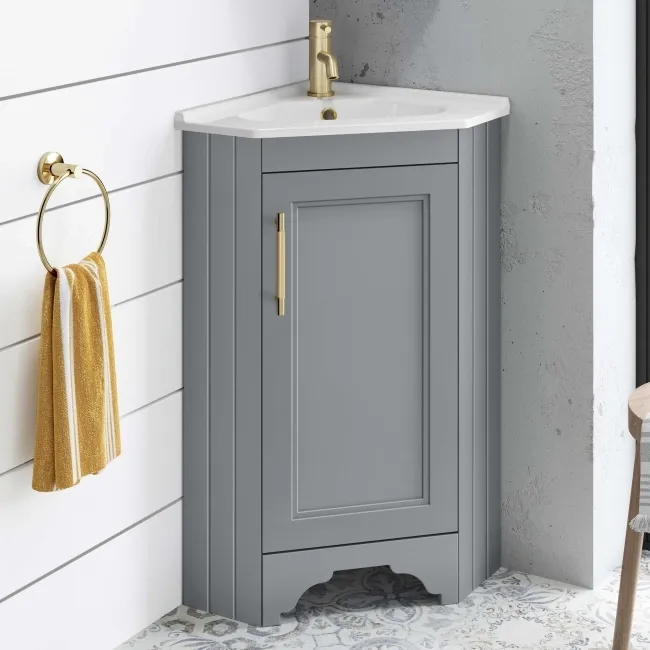
A corner basin activates unused angular zones and redirects circulation away from entry points. Concentrated placement improves spatial flow in narrow en-suite interiors.
Slimline Vanity Units
A slimline vanity unit compresses depth while retaining essential compartmental capacity. Reduced projection supports fixture alignment and maintains unobstructed movement routes in a small en-suite bathroom.
Wall-Hung Basins

A wall-hung basin elevates the structure to expose more visible floor area. Increased floor visibility enhances perceived openness and stabilises volumetric balance in restricted layouts.
Cloakroom-Depth Designs

A cloakroom-depth design employs shallow fronts to maintain clearances around doorways and circulation paths. Controlled depth preserves usability without overwhelming compact en-suite configurations.
Integrated Storage Vanities
An integrated storage vanity consolidates basin and storage functions into a single footprint. Combined structuring reduces clutter, increases organisation, and supports efficient zoning in a small en-suite bathroom.
How Do You Maximise Storage in a Small En-Suite Bathroom?
Storage maximisation in a small en-suite bathroom depends on vertical cabinetry, recessed niches, slimline vanity units, wall-mounted shelving, and corner-based systems because these structures expand capacity without reducing circulation. A small en-suite bathroom gains functional order from height-focused organisation and controlled projection.
Vertical Cabinetry
A vertical cabinet increases storage through height rather than footprint. Tall structures maintain floor clearance and stabilise spatial hierarchy in compact en-suite interiors.
Recessed Niches
A recessed niche embeds storage within the wall mass to remove external bulk. Flush surfaces strengthen visual continuity and protect movement zones in a small en-suite bathroom.
Slimline Vanity Units
A slimline vanity unit compresses depth while preserving essential compartmental space. Reduced projection enhances alignment with adjacent fixtures and maintains accessible entry geometry.
Wall-Mounted Shelving
A wall-mounted shelf elevates storage above circulation level. Raised positioning prevents obstruction and supports proportional balance in narrow en-suite layouts.
Corner-Based Storage Systems
A corner-based storage system activates angular geometry that standard cabinetry cannot utilise. Concentrated placement increases capacity while preserving central routes in a small en-suite bathroom.
How Do Colour, Tiles and Materials Affect a Small En-Suite Bathroom?
Colour, tiles and materials affect a small en-suite bathroom by controlling light behaviour, reducing visual segmentation, and strengthening proportional balance within compact dimensions. A small en-suite bathroom gains perceived volume through harmonised tones, continuous surfaces, and reflective textures.
Colour Influence
A light-reflective palette with soft neutrals, pale greys, and warm whites increases luminance and expands perceived width. Harmonised tones reduce boundary contrast and stabilise visual flow in restricted interiors.
Tile Impact
A large-format tile lowers grout density to create broader uninterrupted planes. Reduced segmentation enhances depth perception and minimises visual clutter in a small en-suite bathroom. Vertical tile orientation elongates height and strengthens proportional equilibrium.
Material Selection
A reflective material, including gloss ceramics, polished porcelain, or glass, amplifies available light and increases apparent volume. Matte finishes with subtle texture introduce depth without overwhelming compact areas. Continuous flooring materials reduce visual breaks and maintain cohesive sightlines in a small en-suite bathroom.
Combined Design Effect
A unified colour–tile–material strategy maintains consistent geometry across surfaces. Controlled variation prevents visual overload and reinforces spatial clarity in compact en-suite environments.
What Tile Ideas Work Best for Small En-Suite Bathrooms?
The tile ideas that work best for small en-suite bathrooms are large-format tiles, reflective finishes, vertical layouts, continuous floor-to-wall tiling, and subtle tonal schemes because these treatments expand visual volume and strengthen spatial coherence within compact dimensions. A small en-suite bathroom gains clarity through controlled pattern density and unified geometry.
Large-Format Tiles
A large-format tile reduces grout frequency and creates broad, uninterrupted planes. Lower line density improves depth perception and minimises visual fragmentation in restricted interiors.
Reflective Finishes
A reflective finish, including gloss ceramics or polished porcelains, amplifies available light and increases perceived width. Enhanced reflectance strengthens visual openness in a small en-suite bathroom.
Vertical Tile Layouts
A vertical layout elongates wall height through upright orientation. Increased vertical emphasis supports proportional balance and stabilises the height-to-width relationship in compact rooms.
Continuous Floor-to-Wall Tiling
A continuous floor-to-wall transition removes horizontal breaks. Unified surfaces maintain sightline flow and reduce segmentation in a small en-suite bathroom.
Subtle Tonal Schemes
A subtle tonal scheme with harmonised light shades prevents harsh visual boundaries. Balanced hues preserve compositional calm and expand apparent volume in narrow en-suite layouts.
Linear Mosaic Accents
A linear mosaic accent provides controlled detail without overwhelming the footprint. Concentrated placement enhances directional flow and complements the overall zoning of a small en-suite bathroom.
How Important Are Ventilation and Heating in a Small En-Suite Bathroom?
Ventilation and heating are important in a small en-suite bathroom because controlled airflow and consistent thermal regulation prevent moisture accumulation, protect materials, and stabilise comfort within compact dimensions. A small en-suite bathroom gains durability and functional balance through targeted environmental control. Check our complete guide on bathroom ventilation.
Ventilation Requirements
A mechanical extraction rate of 15 L/s removes moisture at source and prevents condensation on cold surfaces. Continuous airflow reduces mould risk and maintains structural integrity in restricted en-suite interiors with limited natural ventilation.
Humidity Management
A calibrated ventilation path lowers relative humidity after showering and protects grout, sealants, and cabinetry. Stable moisture levels preserve hygienic conditions and strengthen long-term performance in a small en-suite bathroom.
Heating Efficiency
A compact radiator or heated towel rail provides controlled warmth that prevents cold-surface condensation. Consistent heating supports comfortable circulation and enhances drying speed in small en-suite layouts.
Underfloor Heating Benefits
An underfloor heating system distributes heat evenly and removes the visual bulk associated with wall-mounted radiators. Uniform warmth increases comfort and maintains unobstructed zoning in a small en-suite bathroom.
Combined Environmental Strategy
A coordinated ventilation–heating approach stabilises ambient conditions throughout the day. Balanced environmental control strengthens material longevity, supports energy efficiency, and reinforces comfort in compact en-suite environments.
How Can You Improve Privacy and Noise Control in a Small En-Suite?
Privacy and noise control improve in a small en-suite through acoustic door structures, strategic fixture placement, soft-surface absorption, and controlled ventilation pathways because these measures reduce sound transfer and stabilise personal comfort within compact dimensions. A small en-suite bathroom gains functional discretion through targeted acoustic zoning.
Acoustic Door Structures
An acoustic door with solid-core construction increases mass and reduces sound transmission. Dense material composition strengthens privacy and supports controlled noise levels between the en-suite and adjoining bedroom.
Strategic Fixture Placement
A layout that positions the toilet and shower away from the shared bedroom wall decreases direct acoustic transfer. Offset placement stabilises sound dispersion and improves privacy in a small en-suite bathroom.
Soft-Surface Absorption
Soft-surface elements, including bath mats, fabric blinds, and upholstered panels, absorb reflective sound energy. Added absorption reduces echo intensity and enhances acoustic comfort in compact interiors.
High-Density Wall Materials
A high-density board or secondary internal lining increases structural mass and interrupts airborne sound pathways. Reinforced partitioning strengthens privacy in a small en-suite bathroom with thin wall constructions.
Controlled Ventilation Pathways
A ventilation system with backdraft dampers and insulated ducting prevents noise leakage through extraction routes. Stabilised airflow maintains acoustic containment and supports discreet usage.
Frosted or Textured Glazing
A frosted or textured glass panel in the door or partition provides visual privacy while maintaining light transfer. Diffused illumination preserves openness without compromising discretion in a small en-suite bathroom.
How Can You Design a Small En-Suite for Accessibility and Future-Proofing?
Accessibility and future-proofing in a small en-suite rely on level-access flooring, widened circulation routes, ergonomic fixture heights, reinforced fixing points, and adaptive storage because these measures support long-term usability within compact dimensions. A small en-suite bathroom gains functional resilience through inclusive spatial planning.
Level-Access Flooring
A level-access floor removes step-in thresholds and enables smooth movement across the room. Continuous surfaces improve safety and support mobility aids in restricted en-suite layouts.
Widened Circulation Routes
A widened circulation route of at least 750 mm strengthens manoeuvrability around sanitary fixtures. Increased clearance stabilises access patterns and enhances comfort in a small en-suite bathroom.
Ergonomic Fixture Heights
An ergonomic fixture height for basins, toilets, and controls reduces strain during daily use. Proportioned positioning supports long-term accessibility and maintains efficient zoning in compact interiors.
Reinforced Fixing Points
A reinforced wall structure around toilets, basins, and grab-bar locations provides future adaptability. Strengthened anchoring supports load-bearing fixtures as mobility needs change in a small en-suite bathroom.
Adaptive Storage Solutions
An adaptive storage system with adjustable shelves and accessible heights improves reachability. Flexible organisation accommodates evolving physical requirements while preserving circulation in tight spaces.
Sensor-Based Controls
A sensor-based control for lighting, taps, and extraction enhances hands-free operation. Reduced manual input increases safety and supports aging-in-place strategies in a small en-suite bathroom.
Future-Proof Layout Structuring
A future-proof layout positions major services—waste, water, ventilation, and electrics—within accessible zones for easy modification. Centralised service planning stabilises long-term maintenance and supports functional upgrades in compact en-suite environments.
How Much Does a Small En-Suite Typically Cost and Where Can You Save Money?
A small en-suite typically costs £2,500–£6,000 depending on labour, fixture quality, and structural alterations, and cost savings arise from controlled fixture selection, simplified layouts, and efficient material use. A small en-suite bathroom gains budget stability through proportioned planning and reduced mechanical complexity.
Core Cost Breakdown
A typical cost range of £2,500–£6,000 reflects labour, plumbing adjustments, electrical work, waterproofing, ventilation installation, tiling, and fixture supply. Concentrated pipe runs, minimal rewiring, and reduced wet-zone expansion stabilise overall expenditure in compact en-suite settings.
Savings Through Simplified Layouts
A simplified layout that aligns the toilet, basin, and shower along one wall reduces pipework length and installation time. Streamlined routing decreases labour intensity and strengthens budget predictability in a small en-suite bathroom.
Savings Through Fixture Selection
A controlled product selection using short-projection toilets, slim basins, and compact vanity units reduces material volume and installation complexity. Preassembled units lower fitting labour and preserve proportional clarity in restricted interiors.
Savings Through Material Efficiency
A large-format tile minimises grout use and accelerates installation. Continuous surfaces lower labour hours and reduce offcut waste in a small en-suite bathroom. Mid-range porcelain provides durability without premium cost inflation.
Savings Through Retained Services
A design that retains existing drainage locations avoids structural excavation and extensive subfloor modification. Preserved service routes stabilise cost levels and improve project efficiency.
Savings Through Modular Storage
A modular storage system with vertical cabinets and recessed niches reduces the need for bespoke carpentry. Pre-manufactured components deliver functional capacity while maintaining cost discipline in a small en-suite bathroom.
What Are the Most Common Mistakes to Avoid in a Small En-Suite Bathroom?
The most common mistakes to avoid in a small en-suite bathroom involve oversized fixtures, poor zoning, inadequate ventilation, excessive visual contrast, and inefficient storage because these errors reduce circulation, compress perceived volume, and weaken functional balance. A small en-suite bathroom performs best when spatial clarity and proportion control guide every decision.
Oversized Fixtures
An oversized toilet, basin, or shower enclosure removes essential movement space and disrupts zoning. Controlled projection stabilises circulation and preserves proportional order in compact interiors.
Poor Zoning and Layout Planning
A layout that misaligns the toilet, basin, and shower increases obstruction points and reduces functional flow. Linear fixture alignment and corner utilisation strengthen efficiency in a small en-suite bathroom.
Inadequate Ventilation
An insufficient extraction rate increases humidity and encourages condensation on cold surfaces. Controlled airflow protects materials, prevents mould formation, and maintains comfort in restricted environments.
Excessive Visual Contrast
A strong tonal jump between surfaces fragments sightlines and compresses perceived volume. Harmonised palettes create continuous visual flow and expand apparent space in a small en-suite bathroom.
Inefficient Storage Placement
A storage unit positioned within circulation paths narrows access and increases clutter. Vertical cabinetry and recessed niches preserve floor space and stabilise compositional balance.
Insufficient Lighting
A poorly structured lighting plan creates shadows and reduces depth perception. Layered illumination strengthens spatial clarity and supports the geometric structure of a small en-suite bathroom.
Ignoring Door-Swing Impact
A hinged door that obstructs fixtures or pathways constricts usable area. Sliding, pocket, or bi-fold systems preserve movement zones and optimise entry geometry.
What Are the Best En-Suite Design Ideas for Different Small-Space Scenarios?
The best en-suite design ideas for different small-space scenarios depend on linear rooms, square rooms, narrow rooms, loft rooms, low-light rooms, and irregular rooms because each spatial condition requires tailored zoning, controlled projection, and proportional circulation. A small en-suite bathroom gains functional precision when layout geometry directs every design decision.
Linear Rooms
A linear room benefits from a single-wall alignment that positions the toilet, basin, and shower along one axis. Consolidated routing strengthens circulation, reduces mechanical complexity, and preserves unobstructed access in elongated interiors.
Square Rooms
A square room achieves balance through a centralised shower or a corner shower with equal spacing on each wall. Symmetric zoning stabilises movement and reinforces proportional harmony in a small en-suite bathroom.
Narrow Rooms
A narrow room requires reduced-projection fixtures, wall-hung sanitaryware, and elongated tile layouts to emphasise length. Corner basins and short-projection toilets protect circulation paths and prevent spatial compression.
Loft Rooms with Sloping Ceilings
A loft room benefits from height-based zoning that places low-usage elements beneath the slope and reserves full standing height for the shower and basin. Strategic positioning strengthens ergonomic access and preserves openness within angled volumes.
Rooms with Limited Natural Light
A low-light room performs best with reflective materials, large-format tiles, and continuous surfaces. Unified textures reduce segmentation and increase perceived depth in a small en-suite bathroom.
Irregular Rooms
An irregular room benefits from bespoke corner utilisation, offset shower placement, and adaptive storage systems. Controlled geometry stabilises sightlines and maximises usable area in asymmetrical compact layouts.
What Are the Most Frequently Asked Questions About Small En-Suite Bathrooms?
What size qualifies as a small en-suite bathroom?
A small en-suite bathroom qualifies as a space under 3.5 m² because this footprint supports essential circulation and zoning within compact residential layouts. Controlled dimensions guide fixture placement and structural proportioning.
What is the minimum usable dimension for a functional layout?
The minimum usable dimension for a functional layout is 1.2 m × 2 m because this clearance accommodates a toilet, basin, and shower within a safe circulation path. Proportioned spacing stabilises movement flow in restricted interiors.
What layout works best in a narrow or awkward room?
The best layout in a narrow or awkward room is a linear or corner-based configuration because consolidated positioning reduces obstruction points. Controlled zoning strengthens efficiency in compact en-suite bathrooms.
Which fixtures save the most space?
The fixtures that save the most space include short-projection toilets, slimline basins, wall-hung sanitaryware, and corner showers because reduced projection preserves movement zones. Compact geometry enhances functional balance.
How important is ventilation in a compact en-suite?
Ventilation is important because a 15 L/s extraction rate prevents condensation and protects finishes in moisture-intensive areas. Controlled airflow stabilises hygienic conditions in small en-suite bathrooms.
What heating options work best?
The heating options that work best are heated towel rails, compact radiators, and underfloor systems because these choices regulate temperature without obstructing circulation. Even heat distribution improves comfort.
What colours and finishes make a small en-suite appear larger?
Light-reflective palettes, large-format tiles, and continuous surfaces make a small en-suite appear larger because these treatments expand sightlines and reduce segmentation. Harmonised tones strengthen perceived volume.
How much does a small en-suite typically cost?
A small en-suite typically costs £2,500–£6,000 because labour, fixture quality, and structural alteration drive overall expenditure. Simplified layouts and retained service routes reduce cost pressure.
How can accessibility be added to a compact en-suite?
Accessibility is added through level-access flooring, widened circulation, ergonomic fixture heights, and reinforced fixing points because these adjustments support long-term usability. Inclusive planning strengthens functional resilience.
Conclusion
A small en-suite bathroom delivers strong performance when design decisions focus on spatial clarity, compact fixture geometry, and controlled material selection.
The space achieves functional balance through proportioned layouts, reduced-projection products, and storage systems that preserve circulation. Comfort strengthens when ventilation, heating, and moisture control stabilise humidity and surface conditions. Visual expansion increases through light-reflective palettes, continuous surfaces, and unified tile treatments that reduce segmentation and enhance depth. Adaptability improves in narrow rooms, square rooms, lofts, and irregular structures through tailored zoning and ergonomic fixture positioning. Cost discipline remains consistent when simplified pipe routes, retained service points, and compact fixtures guide installation planning.


