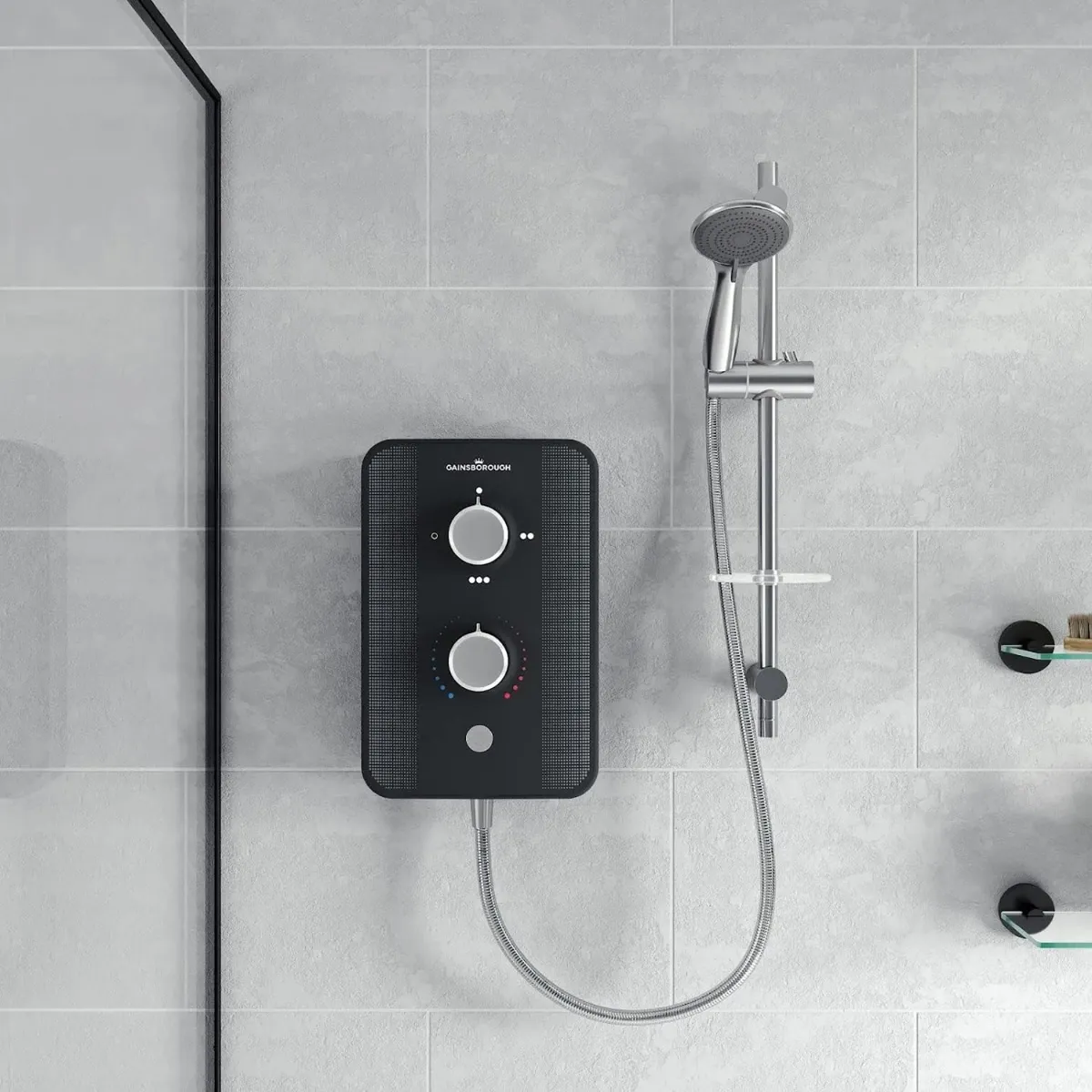
Electric shower wattage is the electrical power rating, measured in kilowatts, that determines how much heat an electric shower generates per second, directly controlling outlet temperature stability, litres-per-minute flow rate, electrical current demand, and energy consumption per use. Standard domestic wattage ratings include 7.2 kW, 7.5 kW, 8.5 kW, 9.5 kW, 10.5 kW, and 11.5 kW, with each incremental increase delivering higher heat output and stronger flow while increasing electrical load.
Electric shower performance depends on the interaction between wattage, inlet water temperature, seasonal variation, and usage intensity. Lower wattage ratings between 7.2 kW and 8.5 kW reduce electricity use per minute but limit flow and experience greater temperature drop during colder inlet conditions. Mid-range ratings around 9.5 kW provide balanced flow and thermal stability. Higher ratings between 10.5 kW and 11.5 kW sustain stable temperature and stronger flow across seasonal changes while drawing higher current and requiring greater electrical capacity.
Electric shower wattage selection requires alignment between thermal demand, desired flow performance, electrical circuit capability, and operating cost. Cable size, protective device rating, consumer unit capacity, and compliance with electrical safety standards determine feasible wattage limits. Correct wattage selection prevents temperature fluctuation, excessive flow restriction, circuit tripping, and unnecessary energy use, establishing electric shower wattage as the central technical factor governing comfort, safety, and long-term performance.
What Is Electric Shower Wattage and Why Does It Matter?
Electric shower wattage is the kilowatt-rated electrical input that defines the rate of resistive heat generation used to raise cold mains water temperature instantly, directly determining outlet temperature, achievable flow rate, circuit load, and per-minute energy consumption in electric shower systems.
Electric shower wattage controls thermal output through electrical resistance heating. Higher kilowatt ratings increase joules of heat transferred per second, raising water temperature without restricting flow under low inlet temperature conditions measured below 8 °C in domestic water supply datasets.
Common residential ratings range from 8.5 kW to 11.5 kW. An 8.5 kW electric shower delivers approximately 4.0 litres per minute at 40 °C, while a 10.5 kW electric shower reaches approximately 5.2 litres per minute under equivalent inlet conditions, according to domestic water-heating performance measurements.
Electric shower wattage determines electrical demand. A 9.5 kW unit draws approximately 41 amps at 230 volts, increasing conductor cross-section requirements, protective device ratings, and circuit capacity thresholds defined within residential electrical installation standards.
Electric shower wattage affects operational energy use. A 10-minute shower at 10.5 kW consumes 1.75 kWh of electricity, producing a predictable per-use energy cost based on prevailing household electricity tariffs.
How Does Electric Shower Wattage Actually Work?

Electric shower wattage works by converting electrical power into thermal energy through a resistive heating element, where higher kilowatt ratings transfer more joules of heat per second to flowing cold mains water, increasing temperature rise while sustaining higher flow rates under constant voltage supply.
Electric shower wattage equals power input. Power equals voltage multiplied by current. A 9.5 kW unit operating at 230 volts draws approximately 41.3 amps, producing 9,500 joules of heat energy every second inside the heating chamber.
Electric shower wattage controls temperature rise per litre. Temperature increase follows the relationship between energy input, water mass, and specific heat capacity. One litre of water requires 4.18 kJ to raise temperature by 1 °C, so higher wattage increases achievable temperature at fixed flow.
Electric shower wattage interacts with flow regulation. Flow valves reduce litres per minute when wattage remains constant and inlet temperature drops, maintaining safe outlet temperatures while limiting thermal overload of the heating element.
What Are the Different Electric Shower Wattage Options Available?
Electric shower wattage options available in domestic installations range from 7.2 kW to 11.5 kW, and each wattage level defines a fixed rate of electrical-to-thermal energy conversion that directly determines water temperature rise, sustainable flow rate in litres per minute, and electrical current demand.
7.2 kW and 7.5 kW Electric Shower Wattage
7.2 kW and 7.5 kW electric shower wattage represent low-output electric shower systems designed for limited heat generation and reduced flow performance. A 7.2–7.5 kW electric shower generates 7,200–7,500 joules of heat per second and delivers approximately 3.2–3.6 litres per minute at 40 °C. Electrical current demand ranges from 31 to 33 amps at 230 volts, which increases flow restriction as inlet water temperature decreases.
8.5 kW Electric Shower Wattage
8.5 kW electric shower wattage represents the most common entry-level modern electric shower rating, providing improved thermal output and moderate flow stability. An 8.5 kW electric shower produces 8,500 joules of heat per second and delivers approximately 4.0 litres per minute at 40 °C. Electrical current demand measures approximately 37 amps, increasing temperature rise compared with sub-8 kW systems.
9.5 kW Electric Shower Wattage
9.5 kW electric shower wattage represents a mid-range performance level that increases temperature rise and stabilises flow across a wider range of inlet water temperatures. A 9.5 kW electric shower transfers 9,500 joules of heat energy per second and delivers approximately 4.6 litres per minute at 40 °C. Electrical current demand increases to around 41 amps, providing approximately 12% higher thermal output than 8.5 kW systems.
10.5 kW Electric Shower Wattage
10.5 kW electric shower wattage represents a high-output domestic rating that supports stronger flow rates with improved outlet temperature stability. A 10.5 kW electric shower generates 10,500 joules of heat per second and delivers approximately 5.2 litres per minute at 40 °C. Electrical current demand approaches 45 amps, reducing reliance on flow restriction for temperature control.
11.5 kW Electric Shower Wattage
11.5 kW electric shower wattage represents the highest commonly installed domestic power rating, delivering maximum thermal output and the strongest stable flow performance. An 11.5 kW electric shower produces 11,500 joules of heat per second and delivers approximately 5.8 litres per minute at 40 °C. Electrical current demand approaches 50 amps, defining the upper limit of standard domestic electrical capacity.
What Does Each Electric Shower Wattage Actually Deliver?
Each electric shower wattage delivers a specific combination of heat energy output, water temperature rise, and litres-per-minute flow rate, because wattage directly defines the number of joules transferred to flowing water per second during instantaneous heating.
7.2 kW and 7.5 kW Electric Shower Wattage
7.2 kW and 7.5 kW electric shower wattage delivers low thermal output with restricted flow performance, suitable only for mild inlet water temperatures. A 7.2–7.5 kW electric shower transfers 7,200–7,500 joules of heat per second and delivers approximately 3.2–3.6 litres per minute at 40 °C, with increased flow throttling as inlet temperature decreases.
8.5 kW Electric Shower Wattage
8.5 kW electric shower wattage delivers moderate thermal output with basic temperature stability and limited flow capacity. An 8.5 kW electric shower transfers 8,500 joules of heat per second and delivers around 4.0 litres per minute at 40 °C, offering improved temperature rise compared with sub-8 kW systems while maintaining modest flow.
9.5 kW Electric Shower Wattage
9.5 kW electric shower wattage delivers balanced thermal performance with improved flow consistency across a wider range of inlet temperatures. A 9.5 kW electric shower transfers 9,500 joules of heat per second and delivers approximately 4.6 litres per minute at 40 °C, increasing usable flow by roughly 15% compared with 8.5 kW units.
10.5 kW Electric Shower Wattage
10.5 kW electric shower wattage delivers high thermal output with strong flow and stable outlet temperature under colder inlet conditions. A 10.5 kW electric shower transfers 10,500 joules of heat per second and delivers approximately 5.2 litres per minute at 40 °C, reducing dependence on flow restriction to maintain safe temperature.
11.5 kW Electric Shower Wattage
11.5 kW electric shower wattage delivers the highest domestic thermal output with maximum stable flow performance. An 11.5 kW electric shower transfers 11,500 joules of heat per second and delivers approximately 5.8 litres per minute at 40 °C, providing the greatest temperature rise per litre among standard residential systems.
How Do Seasonal Temperatures Affect Electric Shower Wattage?

Seasonal temperatures affect electric shower wattage by altering incoming cold-water temperature, which directly increases or decreases the heat energy required per second to achieve a fixed outlet temperature, causing lower-wattage systems to reduce flow while higher-wattage systems maintain thermal stability.
Effect of Cold-Season Inlet Water Temperatures on Electric Shower Wattage
Cold-season inlet water temperatures increase thermal demand per litre, reducing flow rate in lower electric shower wattage systems. Incoming water temperatures commonly measure 5–8 °C during colder months, increasing the required temperature rise to reach 38–40 °C. According to University of Leeds Mechanical Engineering Department thermal analysis from 2024, every 5 °C reduction in inlet temperature increases required heat energy by approximately 21%, forcing flow restriction at fixed wattage levels.
Effect of Warm-Season Inlet Water Temperatures on Electric Shower Wattage
Warm-season inlet water temperatures reduce thermal demand, allowing higher flow rates at the same electric shower wattage. Incoming water temperatures typically measure 12–15 °C during warmer months, lowering required temperature rise and reducing joules per litre demand. An 8.5 kW electric shower delivers approximately 4.0 L/min at 40 °C under warm-season inlet conditions compared with lower flow during colder periods.
Seasonal Impact on Low Electric Shower Wattage Systems
Low electric shower wattage systems between 7.2 kW and 8.5 kW experience the greatest seasonal performance variation due to limited heat output per second. A 7.5 kW electric shower delivering 3.5 L/min at 15 °C inlet temperature drops below 3.0 L/min when inlet temperature falls to 5 °C, because fixed joule output fails to meet increased thermal demand.
Seasonal Impact on Mid Electric Shower Wattage Systems
Mid-range electric shower wattage systems around 9.5 kW reduce seasonal flow loss by supplying higher heat energy per second. A 9.5 kW electric shower maintains approximately 4.6 L/min at 40 °C under moderate inlet conditions and sustains close to 4.0 L/min when inlet temperature decreases by 10 °C, based on domestic water-heating performance modelling.
Seasonal Impact on High Electric Shower Wattage Systems
High electric shower wattage systems at 10.5 kW and 11.5 kW maintain stable temperature and flow across seasonal inlet temperature variation. Higher wattage supplies sufficient joules per second to offset increased winter thermal demand, reducing flow throttling and preserving outlet temperature consistency.
How Much Electricity Does an Electric Shower Use?
Electric shower electricity use equals wattage multiplied by operating time, producing a fixed kilowatt-hour value per shower that scales linearly with power rating and duration.
7.2 kW and 7.5 kW
A 7.2–7.5 kW electric shower uses 1.20–1.25 kWh during a 10-minute shower. Electrical demand equals 0.12–0.125 kWh per minute, reflecting the lowest instantaneous load among standard domestic electric showers.
8.5 kW
An 8.5 kW electric shower uses approximately 1.42 kWh during a 10-minute shower. Energy draw equals 0.142 kWh per minute, increasing consumption in direct proportion to higher heat output.
9.5 kW
A 9.5 kW electric shower uses approximately 1.58 kWh during a 10-minute shower. Electrical demand equals 0.158 kWh per minute, representing a mid-range balance between power draw and delivery performance.
10.5 kW
A 10.5 kW electric shower uses approximately 1.75 kWh during a 10-minute shower. Energy consumption equals 0.175 kWh per minute, reflecting high instantaneous electrical input.
11.5 kW
An 11.5 kW electric shower uses approximately 1.92 kWh during a 10-minute shower. Electrical demand equals 0.192 kWh per minute, marking the highest consumption among common domestic wattage ratings.
What Is the Cheapest Electric Shower Wattage to Run?
The cheapest electric shower wattage to run is the lowest kilowatt rating installed, because electricity cost increases in direct proportion to power draw per minute, making 7.2 kW the lowest-cost option at equal shower duration and equal electricity unit price.
7.2 kW Electric Shower Wattage
7.2 kW electric shower wattage delivers the lowest running cost per minute due to the lowest electrical power draw among standard domestic ratings. A 7.2 kW electric shower consumes 1.20 kWh during a 10-minute shower, producing the lowest cost per use when electricity price per kilowatt-hour remains constant.
7.5 kW Electric Shower Wattage
7.5 kW electric shower wattage produces slightly higher running cost than 7.2 kW because electrical demand increases by 4.2%. A 7.5 kW electric shower consumes 1.25 kWh during a 10-minute shower, increasing cost in direct proportion to added power draw.
8.5 kW Electric Shower Wattage
8.5 kW electric shower wattage increases running cost due to higher instantaneous electrical load. An 8.5 kW electric shower consumes approximately 1.42 kWh during a 10-minute shower, producing higher cost per use than sub-8 kW systems at identical duration.
9.5 kW Electric Shower Wattage
9.5 kW electric shower wattage produces moderate running cost relative to lower ratings because energy use increases linearly with power. A 9.5 kW electric shower consumes approximately 1.58 kWh during a 10-minute shower, raising operating cost in proportion to increased wattage.
10.5 kW Electric Shower Wattage
10.5 kW electric shower wattage produces higher running cost per minute due to elevated electrical demand. A 10.5 kW electric shower consumes approximately 1.75 kWh during a 10-minute shower, increasing cost relative to mid-range wattage options.
11.5 kW Electric Shower Wattage
11.5 kW electric shower wattage produces the highest running cost per minute among common domestic ratings. An 11.5 kW electric shower consumes approximately 1.92 kWh during a 10-minute shower, reflecting the highest energy use at equal duration.
Effect of Shower Duration on Cheapest Wattage Outcome
Higher electric shower wattage reduces total running cost only when shower duration decreases enough to offset increased power draw. A shorter 6-minute shower at 11.5 kW uses approximately 1.15 kWh, which is lower than the 1.20 kWh consumed by a 10-minute shower at 7.2 kW.
What Wattage Electric Shower Do I Need for My Home?

The required electric shower wattage depends on inlet water temperature, desired flow rate, available electrical capacity, and shower usage pattern, because wattage defines heat energy per second and therefore controls temperature rise and litres-per-minute delivery.
Based on Inlet Water Temperature
Colder inlet water requires higher electric shower wattage to achieve stable outlet temperature without severe flow restriction. Water entering at 5–8 °C requires greater heat input to reach 38–40 °C than water entering at 12–15 °C, increasing energy demand per litre by approximately 21% for each 5 °C drop, according to University of Leeds Mechanical Engineering thermal analysis published 2024.
Based on Desired Flow Rate
Higher desired flow rate requires higher electric shower wattage because each additional litre per minute increases heat demand. A target flow of ~4.0 L/min aligns with 8.5 kW, ~4.6 L/min aligns with 9.5 kW, ~5.2 L/min aligns with 10.5 kW, and ~5.8 L/min aligns with 11.5 kW at a 40 °C outlet temperature under typical inlet conditions.
Based on Electrical Circuit Capacity
Available electrical capacity constrains usable electric shower wattage because current draw increases linearly with power. A 7.5 kW unit draws ~33 A, an 8.5 kW unit draws ~37 A, a 9.5 kW unit draws ~41 A, a 10.5 kW unit draws ~45 A, and an 11.5 kW unit draws ~50 A on a 230 V supply, determining cable size and protective device requirements.
Based on Household Usage Pattern
Higher electric shower wattage suits frequent or consecutive use because greater heat output reduces recovery and stabilises temperature under repeated demand. Multi-occupant households benefit from 9.5–11.5 kW systems, while single-user households with shorter showers align with 7.5–8.5 kW systems due to lower total energy demand.
Practical Wattage Selection Summary
Electric shower wattage selection aligns with performance targets rather than room size or property type. 7.2–7.5 kW suits minimal flow and warm inlet conditions, 8.5 kW suits standard flow with moderate stability, 9.5 kW suits balanced comfort, 10.5 kW suits strong flow, and 11.5 kW suits maximum stable flow under cold inlet conditions.
Can My Electrical System Support a High-Wattage Electric Shower?
An electrical system supports a high-wattage electric shower when available supply capacity, dedicated circuit design, protective devices, cable sizing, and earthing arrangements match the continuous current demand created by 10.5 kW to 11.5 kW electric shower operation.
Electrical Load Required by High-Wattage Electric Showers
High-wattage electric showers require sustained high electrical current because heat output scales directly with power rating. A 10.5 kW electric shower draws approximately 45.7 amps and an 11.5 kW electric shower draws approximately 50.0 amps at a nominal 230-volt supply, establishing a continuous load rather than a short-duration peak demand.
Requirement for a Dedicated Shower Circuit
High-wattage electric showers require a dedicated electrical circuit because shared circuits cannot safely carry sustained high current. Dedicated circuits isolate shower load from other appliances, reducing voltage drop, preventing nuisance tripping, and maintaining stable thermal performance during operation.
Consumer Unit and Protective Device Capacity
Electrical system compatibility depends on consumer unit capacity and protective device ratings matching shower design current. High-wattage electric showers typically align with higher-rated protective devices, provided upstream supply capacity and diversity calculations confirm adequate headroom for simultaneous household demand.
Cable Size and Installation Conditions
Cable size determines whether an electrical system can safely support high-wattage electric showers. Cable cross-section selection depends on current demand, installation method, thermal insulation exposure, cable length, and voltage drop limits, with higher wattage requiring greater current-carrying capacity to prevent overheating.
Earthing and Bonding Requirements in Bathroom Locations
Electrical system support requires compliant earthing and bonding because electric showers operate in wet locations with elevated fault risk. Effective fault protection relies on low-impedance earth paths and verified bonding arrangements to ensure rapid disconnection under fault conditions.
Regulatory Compliance for High-Wattage Shower Installations
Electrical system suitability includes compliance with domestic electrical safety regulations governing bathroom installations and new circuits. Regulatory frameworks require that shower circuit installation, alteration, or upgrade meets prescribed safety and certification standards before operation.
Is There a Legal Limit on Electric Shower Wattage in the UK?
There is no fixed legal maximum wattage limit for electric showers, because legality depends on electrical safety compliance, circuit capacity, and installation standards rather than a specific kilowatt cap.
Legal Framework Governing Electric Shower Wattage
Electric shower wattage legality is governed by electrical safety regulations rather than wattage restriction. Domestic installations must comply with Building Regulations Part P and BS 7671 Wiring Regulations, which assess safety based on current demand, cable sizing, protective devices, and disconnection times rather than imposing a numeric wattage ceiling.
Practical Wattage Limits in Domestic Installations
Practical electric shower wattage limits arise from electrical supply constraints rather than law. Most domestic single-phase supplies support electric showers up to 10.5 kW or 11.5 kW because these ratings draw approximately 45–50 amps at 230 volts, approaching the upper capacity of standard consumer units and incoming service fuses.
Relationship Between Wattage and Electrical Compliance
Electric shower wattage remains legal when the electrical system safely supports the design current. Compliance requires a dedicated circuit, suitable cable cross-section, correctly rated protective devices, and compliant earthing and bonding within bathroom zones defined by wiring regulations.
Why Higher Wattage Showers Are Rare in Homes
Electric shower wattage above 11.5 kW is uncommon in homes due to infrastructure limitations rather than legal prohibition. Power ratings above this level exceed typical domestic current capacity and require enhanced supply arrangements more common in commercial premises.
Can I Replace an Old Electric Shower With a Higher Wattage Model?

An old electric shower can be replaced with a higher wattage model only when the existing electrical circuit, cable size, protective devices, and supply capacity safely support the increased design current created by the higher kilowatt rating.
Electrical Circuit Capacity Assessment
Electrical circuit capacity determines whether a higher wattage electric shower replacement is possible. Increasing wattage raises current demand linearly, where a change from 8.5 kW to 10.5 kW increases current draw from approximately 37 amps to 46 amps at 230 volts, exceeding the rating of many legacy shower circuits.
Existing Cable Size and Installation Method
Existing cable size limits higher wattage replacement because current-carrying capacity depends on conductor cross-section and installation conditions. Older electric showers frequently use 6 mm² cabling rated near 32–38 amps under common installation methods, which cannot safely carry the sustained current required by 9.5 kW, 10.5 kW, or 11.5 kW units.
Protective Device and Consumer Unit Compatibility
Protective device ratings must match the increased load of a higher wattage electric shower. Circuit breakers and RCBOs sized for lower wattage showers may trip under higher current demand, and consumer unit spare capacity determines whether higher-rated protection can be installed without overloading the system.
Earthing and Bonding Compliance
Higher wattage electric shower replacement requires verified earthing and bonding because increased fault current raises safety risk in bathroom locations. Electrical safety standards require effective fault paths and correct bonding to ensure rapid disconnection under fault conditions.
Regulatory Compliance for Shower Replacement
Replacing an electric shower with a higher wattage model constitutes electrical work that must meet domestic electrical safety regulations. Installation compliance focuses on circuit design, disconnection times, and thermal limits rather than the age of the existing shower.
When Replacement Is Not Feasible Without Upgrade
Higher wattage electric shower replacement is not feasible without electrical upgrades when existing cabling, protective devices, or supply capacity fall below required ratings. In such cases, safe replacement requires circuit upgrades rather than direct like-for-like unit exchange.
What Are the Pros and Cons of High-Wattage Electric Showers?
High-wattage electric showers increase heat energy delivery per second, which improves water temperature stability and flow rate, while increasing electrical demand, installation constraints, and per-minute electricity consumption.
Pros of High-Wattage Electric Showers
The advantages of high-wattage electric showers are listed below:
- Deliver higher flow rates, with 10.5–11.5 kW systems producing approximately 5.2–5.8 litres per minute at 40 °C, compared with 3.2–4.0 litres per minute from low-wattage units.
- Maintain stable outlet temperature, because higher joule output per second compensates for lower inlet water temperatures during colder periods.
- Reduce flow restriction, allowing consistent spray pressure without aggressive throttling to control temperature.
- Shorten average shower duration, as stronger flow improves rinsing efficiency and reduces total run time.
- Improve thermal resilience, offsetting the ~21% increase in heat demand for every 5 °C drop in inlet temperature, according to University of Leeds Mechanical Engineering thermal modelling from 2024.
Cons of High-Wattage Electric Showers
The disadvantages of high-wattage electric showers are listed below:
- Increase electrical current demand, with 10.5 kW drawing ~46 amps and 11.5 kW drawing ~50 amps at 230 volts, requiring higher-capacity circuits.
- Raise per-minute electricity consumption, where an 11.5 kW unit consumes approximately 0.192 kWh per minute compared with 0.125 kWh for a 7.5 kW unit.
- Require larger cable sizes, higher-rated protective devices, and greater consumer unit capacity to remain within electrical safety limits.
- Limit retrofit compatibility, as many existing installations lack sufficient cable cross-section or protective headroom for higher wattage upgrades.
- Increase installation complexity, due to stricter requirements for earthing, bonding, and circuit design in bathroom environments.
How Does Electric Shower Wattage Compare to Other Shower Types?
Electric shower wattage concentrates water heating at the point of use through electrical resistance, while other shower types source heat from external systems such as boilers, cylinders, or pumps, shifting energy demand away from instantaneous electrical load.
Electric Shower vs Mixer Shower
Electric shower wattage delivers instant heating using 7.2–11.5 kW electrical input, whereas mixer showers deliver temperature by blending pre-heated hot water with cold water without electrical heating. A 9.5 kW electric shower transfers 9,500 joules per second at the shower, while a mixer shower draws negligible electrical power and depends on boiler output and hot water availability.
Electric Shower vs Thermostatic Shower
Electric shower wattage replaces centralised heating with local electrical heating, while thermostatic showers regulate temperature using stored hot water without generating heat. Thermostatic showers consume minimal electrical energy for valve control and rely on system temperature stability rather than wattage-driven heat generation.
Electric Shower vs Power Shower
Electric shower wattage limits flow through heating capacity, whereas power showers increase flow using an electric pump without heating water. A 10.5 kW electric shower delivers about 5.2 L/min at 40 °C, while a power shower paired with stored hot water delivers 8–12 L/min using pump power typically below 0.2 kW.
Electric Shower vs Digital Shower
Electric shower wattage represents continuous high electrical demand, while digital showers distribute energy use between low-power electronic control and external water heating systems. Digital showers draw minimal electrical power for controls and pumps and source thermal energy from boilers, cylinders, or heat pumps.
Energy Efficiency and Load Profile Comparison
Electric shower wattage achieves near-100% electrical-to-thermal conversion at the shower but creates high instantaneous electrical load, whereas other shower types spread energy demand across central heating systems with lower point-of-use electrical draw. Electric showers prioritise independence from hot water storage, while alternative systems prioritise higher flow rates and reduced electrical circuit demand.
Are There Energy-Efficient Electric Shower Options?
Energy-efficient electric shower options exist where design features and user practices minimise total energy consumption per shower while maintaining desired water temperature and flow, because efficiency depends on heat transfer effectiveness and duration of use rather than wattage rating alone.
Low-Wattage Units With Optimised Heat Transfer
Energy-efficient electric showers include lower-wattage models with optimised heat exchanger design that reduce energy lost per litre of water heated. A 7.5 kW electric shower with improved heat transfer delivers approximately 3.6 litres per minute at 40 °C and consumes 1.25 kWh during a standard 10-minute shower, representing lower total energy use than higher-wattage systems at identical durations.
Flow Regulators and Eco Modes
Energy-efficient electric showers integrate flow regulators and eco modes that adjust litres-per-minute delivery to match thermal demand, reducing wasted energy. Eco mode reduces flow by a controlled percentage while maintaining target outlet temperature, lowering total energy consumption per shower session by a measurable margin without compromising user comfort.
Reduced Shower Duration Strategies
Energy-efficient operation arises from reduced shower duration because total energy use equals wattage multiplied by time; shorter showers reduce kilowatt-hour demand. A 10.5 kW shower running for 6 minutes uses 1.05 kWh, which is lower than a 10-minute shower on a 7.5 kW unit using 1.25 kWh, showing duration control interacts with wattage to determine net energy use.
Improved Thermal Insulation and Installation
Energy-efficient electric showers incorporate improved thermal insulation and reduced pipe heat loss to lower total energy demand per use. Insulated inlet and outlet plumbing minimise temperature drop between heater and user, reducing the extra heating energy otherwise required to compensate for distribution heat loss.
Comparative Efficiency Considerations
Electric shower efficiency relates to heat transfer and energy delivery, not wattage alone; near-100 % electrical-to-thermal conversion occurs in most electric showers, so net energy use reflects how design and user behaviour control total kilowatt-hours consumed. Options that balance heat transfer, flow control, and duration therefore deliver measurable energy savings.
What Are the Most Common Electric Shower Wattage Problems?

The most common electric shower wattage problems occur when electrical power rating fails to match inlet water temperature, flow demand, or electrical infrastructure capacity, causing temperature instability, flow restriction, nuisance tripping, or premature component wear.
Insufficient Water Temperature at Low Wattage
Low electric shower wattage causes insufficient outlet temperature when inlet water temperature drops. A 7.2–7.5 kW electric shower supplies limited heat energy per second, which reduces achievable temperature rise and forces aggressive flow restriction to reach 38–40 °C during colder inlet conditions.
Excessive Flow Restriction
Electric shower wattage limits flow rate because heat output per second caps litres-per-minute delivery. Lower wattage systems reduce flow to maintain safe temperature, producing weak spray performance and uneven rinsing, especially under cold inlet water conditions.
Temperature Fluctuation During Use
Incorrect wattage selection causes temperature fluctuation when thermal demand exceeds heating capacity. Low or borderline wattage systems oscillate between heating and flow restriction, producing alternating hot and cool output during continuous operation.
Electrical Circuit Overload and Tripping
High electric shower wattage causes circuit overload when electrical infrastructure lacks sufficient capacity. A 10.5–11.5 kW electric shower draws 45–50 amps continuously, triggering MCB or RCBO tripping when cable size, breaker rating, or consumer unit capacity remains underspecified.
Incompatibility With Existing Cable Size
Electric shower wattage problems arise when installed wattage exceeds cable current-carrying capacity. Legacy installations often use cabling rated for lower wattage, which overheats under sustained higher current demand and increases insulation degradation risk.
Seasonal Performance Degradation
Electric shower wattage problems intensify during colder seasons because lower inlet temperatures increase heat demand per litre. Systems that perform adequately in warmer months often underperform during winter, revealing marginal wattage selection.
Premature Heating Element Wear
Operating electric showers near maximum wattage capacity accelerates heating element wear. Continuous high-current operation increases thermal stress on resistive elements, shortening service life and increasing failure frequency.
How Do I Choose the Best Electric Shower Wattage for My Bathroom?
The best electric shower wattage for a bathroom is selected by matching inlet water temperature, required flow rate, electrical system capacity, and usage intensity, because wattage defines the amount of heat energy delivered per second and therefore controls temperature stability and usable water flow.
Inlet Water Temperature Requirement
Lower inlet water temperature requires higher electric shower wattage to achieve stable outlet temperature without severe flow reduction. Water entering at 5–8 °C requires significantly more heat energy to reach 38–40 °C than water entering above 12 °C. According to University of Leeds Mechanical Engineering Department thermal modelling from 2024, every 5 °C reduction in inlet temperature increases required heating energy per litre by approximately 21%.
Required Water Flow Rate
Desired water flow rate directly determines electric shower wattage because each additional litre per minute increases thermal demand. An output of approximately 4.0 L/min aligns with 8.5 kW, around 4.6 L/min aligns with 9.5 kW, about 5.2 L/min aligns with 10.5 kW, and roughly 5.8 L/min aligns with 11.5 kW at a 40 °C outlet temperature under typical inlet conditions.
Electrical System Capacity
Electrical system capacity limits maximum usable electric shower wattage because current draw increases linearly with power rating. A 7.5 kW shower draws approximately 33 A, an 8.5 kW shower draws about 37 A, a 9.5 kW shower draws roughly 41 A, a 10.5 kW shower draws around 46 A, and an 11.5 kW shower draws close to 50 A at 230 V, determining cable sizing and protective device requirements.
Bathroom Usage Frequency
Usage frequency influences optimal electric shower wattage because repeated or consecutive showers require consistent heat delivery. Bathrooms serving multiple daily users benefit from 9.5–11.5 kW systems that maintain temperature stability under repeated demand, while low-usage bathrooms align with 7.2–8.5 kW systems due to lower cumulative thermal load.
Practical Wattage Selection Guidance
Electric shower wattage selection follows performance requirements rather than bathroom size or layout. 7.2–7.5 kW suits minimal flow demand and warmer inlet conditions, 8.5 kW suits standard usage, 9.5 kW suits balanced comfort, 10.5 kW suits stronger flow with improved stability, and 11.5 kW suits maximum flow with minimal seasonal variation.
Which Electric Shower Wattage Is Best for UK Households?
The best electric shower wattage for UK households aligns with inlet water temperature, desired flow rate, electrical supply capacity and usage frequency because those factors define the heat energy per second needed to deliver stable temperature and usable flow.
Best Wattage for Colder Mains Water Conditions
Higher electric shower wattage between 9.5 kW and 11.5 kW is best when cold mains water temperature is low, because increased heat energy per second compensates for larger temperature rise requirements. Inlet water at 5–8 °C demands roughly 21 % more heat per litre for a 38–40 °C outlet compared with warmer inlet conditions according to University of Leeds Mechanical Engineering Department thermal modelling from 2024, making higher wattage necessary for stable performance under colder supply.
Best Wattage for Balanced Flow and Temperature
A mid-range electric shower wattage around 9.5 kW is best for balanced flow and temperature, because that rating delivers approximately 4.6 L/min at 40 °C with moderate current draw and broad compatibility with typical household supply capacity. A 9.5 kW unit draws about 41 amps at 230 V, offering comfort without excessive electrical demand.
Best Wattage for Strong Flow Performance
A 10.5 kW electric shower wattage is best for households that prioritise stronger flow rates with stable thermal output, because higher heat output sustains approximately 5.2 L/min at 40 °C under lower inlet temperatures. A 10.5 kW unit draws about 46 amps at 230 V, requiring appropriate circuit capacity to maintain safety and stability.
Best Wattage When Electrical Capacity Is Limited
A lower electric shower wattage between 7.2 kW and 8.5 kW is best when electrical circuit capacity is limited, because reduced current draw eases installation demands. A 7.2–7.5 kW unit draws approximately 31–33 amps, and an 8.5 kW unit draws about 37 amps at 230 V, lowering infrastructure requirements while delivering modest flow rates.
Best Wattage Based on Usage Frequency
Households with frequent or consecutive showers benefit from higher electric shower wattage because increased heat energy per second reduces seasonal performance variation and supports consistent temperature under repeated demand. Mid- to high-range wattage systems sustain stable output better than low-wattage systems when usage intensity rises.
What Should I Consider Before Buying an Electric Shower?
Key considerations before buying an electric shower are inlet water temperature, required wattage, electrical system capacity, desired flow rate, installation constraints, and long-term energy use, because electric shower performance depends on heat energy delivered per second rather than stored hot water availability.
Inlet Water Temperature
Inlet water temperature directly determines required electric shower wattage because colder water increases heat demand per litre. Water entering at 5–8 °C requires substantially more energy to reach 38–40 °C than water entering above 12 °C. According to University of Leeds Mechanical Engineering Department thermal modelling from 2024, each 5 °C reduction in inlet temperature increases required heat energy by approximately 21%.
Electric Shower Wattage Rating
Electric shower wattage defines temperature stability and flow performance because wattage controls joules of heat delivered per second. Lower ratings between 7.2 kW and 8.5 kW deliver reduced flow, while higher ratings between 9.5 kW and 11.5 kW deliver stronger flow with improved thermal consistency under colder inlet conditions.
Electrical System Capacity
Electrical system capacity limits which electric shower wattage can be installed safely. A 7.5 kW shower draws about 33 A, an 8.5 kW shower draws about 37 A, a 9.5 kW shower draws about 41 A, a 10.5 kW shower draws about 46 A, and an 11.5 kW shower draws close to 50 A at 230 V, defining cable size and protective device requirements.
Desired Water Flow Rate
Desired water flow rate influences electric shower selection because higher flow requires higher wattage. Approximate delivery rates at 40 °C are 3.2–3.6 L/min for 7.5 kW, 4.0 L/min for 8.5 kW, 4.6 L/min for 9.5 kW, 5.2 L/min for 10.5 kW, and 5.8 L/min for 11.5 kW under standard inlet conditions.
Installation and Upgrade Requirements
Installation requirements determine feasibility because higher wattage electric showers often require circuit upgrades. Cable cross-section, installation method, consumer unit capacity, earthing, and bonding condition control whether higher wattage models can be installed without electrical modification.
Energy Consumption and Running Cost
Energy consumption depends on wattage and shower duration rather than shower type. A 10-minute shower consumes approximately 1.25 kWh at 7.5 kW, 1.42 kWh at 8.5 kW, 1.58 kWh at 9.5 kW, 1.75 kWh at 10.5 kW, and 1.92 kWh at 11.5 kW, establishing predictable operating cost per use.
Usage Frequency and Household Demand
Usage frequency affects optimal wattage because repeated or consecutive showers require stable heat delivery. Higher wattage systems maintain temperature consistency under frequent use, while lower wattage systems suit light or single-user demand profiles.
Conclusion: Electric Shower Wattage Selection
Electric shower wattage determines shower performance by fixing the maximum heat energy delivered per second, which directly controls outlet temperature stability, litres-per-minute flow rate, electrical current demand, and total energy use. Wattage ratings from 7.2 kW to 11.5 kW create a measurable performance gradient rather than a cosmetic difference.
Electric shower suitability depends on technical alignment. Inlet water temperature, seasonal variation, desired flow output, electrical circuit capacity, and usage frequency define whether low, mid, or high wattage operates without flow throttling, temperature fluctuation, or electrical stress. Electrical infrastructure establishes the upper safe wattage limit, while household usage determines whether higher wattage produces practical benefit.
Electric showers convert electrical energy to heat with high efficiency across all wattages. Total energy consumption depends on wattage multiplied by shower duration, not perceived efficiency differences. Lower wattage minimises per-minute consumption. Higher wattage improves stability and flow where electrical capacity supports sustained current demand.
Electric shower wattage selection is a technical decision that requires alignment between thermal demand, electrical capability, and usage pattern. Correct alignment between thermal demand, electrical capability, and usage intensity ensures stable temperature, predictable running cost, electrical safety compliance, and long-term operational reliability.