

In the realm of daily personal routines, individuals generally fall into one of two camps: those who relish the deep relaxation of soaking in a tub, and those who prioritize the speed, convenience, and invigorating sensation of a shower. In homes with heavy traffic or limited space, it can be challenging to satisfy everyone’s preference. This is where the Combination Bath—the shower-enabled tub—comes in.
This guide is designed to provide you with all the essential information needed to decide if this dual-purpose fixture is right for you. We’ll help you distinguish between different geometric shapes, such as the curved and angular versions, and much more.
What Defines a Combination Bath?
To start, let’s define the combination bath. The simplest description is a bathtub that is designed to accommodate a shower screen (or be fitted with one), featuring a specific shape at one end that allows for comfortable and spacious standing while showering.
By design, most combination baths are single-ended, meaning they are intended for one user for bathing at any time.
Because of their dual function, these tubs are typically installed with one end flush against a wall—the ideal placement for an overhead shower system, such as a riser rail kit. The other end is designated for bathing. They can be recessed entirely into an alcove or fitted with bath panels to conceal the underlying plumbing, support frame, and legs.

Is a Combination Bath a Separate Product Type, or Can Any Tub Work?
This is a nuanced point, as the answer depends heavily on the specific tub being purchased. Combination baths are often marketed as a distinct product category, though they do overlap with many other styles of tubs.
A true combination bath is usually manufactured with the inherent ability to fit a secure fixed or hinged shower screen. Some tubs simply lack the necessary ledge thickness or flat surface to safely and practically support a screen, failing the criteria for a proper shower-enabled tub.
In terms of aesthetics, combination baths are highly versatile. They can be built-in, inset, standard, or even feature a freestanding design, with options ranging from squared-off to smoothly curved. This variety ensures there’s a style to fit both modern and classic bathroom designs. The freestanding option offers an excellent middle ground for those seeking a stylish, prominent fixture but who may not have the budget for a fully freestanding soaking tub, or who don’t want to sacrifice the essential functionality of a shower.
The main counterpoint is that, theoretically, any tub could be paired with a shower handset and hose for rinsing. However, this poses a significant risk of water splashing onto surrounding walls and floors, which requires tedious clean-up after each use. Certain other tub types, like a back-to-wall tub or a corner/offset design, lend themselves better to being used with a handheld shower, but a true combination bath is characterized by its ability to support a robust, overhead system (like a rainfall, electric, or riser rail shower) and the requisite screen functionality.
Varieties of Combination Baths
Combination baths generally fall into two main categories: standard or freestanding. Your choice will depend on your personal preference and space requirements.

Standard Combination Baths
A standard combination bath is typically secured against a wall or nestled within a space, finished off with a bath panel to hide the frame, plumbing, and underbelly. Their design is often straightforward and clean, making them an excellent, universally affordable choice for any bathroom.
These are highly suitable for family bathrooms where budget is a primary consideration, and they are a safe, appealing choice for homes that may be sold in the future. However, if your goal is a bold, conversation-starting fixture, a simple standard combination tub might not meet your expectations.
| Pros | Cons |
| Universally appealing aesthetic design | Can sometimes appear basic or uninspired |
| Simple and easy to integrate | Limited material and color options |
| Modern and clean appearance | Style options can be restrictive |
| Accommodates a variety of layouts | Certain models require panels/screens from the same maker |
| Affordable pricing | |
| Suitable for smaller spaces |
Standard combination tubs come in shapes ranging from basic rectangular to gently curved. There are also space-saving models that are narrower at one end, perfect for compact rooms. They are usually white, made from acrylic, and ideal for contemporary settings, or a steel-finish for a sturdier option. For a more traditional look, customization is generally limited to the bath panel (and mainly suits straight tubs), allowing for a colored or styled panel, such as a shaker design.
Freestanding Combination Baths

A freestanding combination bath operates on the same principle as the standard version. The primary difference is its flexibility in placement, though it is still most effectively positioned against a wall.
Compared to standard models, freestanding combination baths offer more striking designs. Options can include painted exteriors, decorative bath legs, and luxurious features like roll-top edges paired with a flat rim to accommodate a shower screen. This variety provides more flexibility for different bathroom themes.
Consequently, they lean heavily towards a traditional style. If you are seeking period charm, ornate details, and graceful curves, this is the ideal choice. The use of legs can also lift the tub off the ground, creating the illusion of a larger room, which can counteract the space-reducing effect of standard tubs in small bathrooms.
| Pros | Cons |
| More visually arresting designs | Predominantly traditional styles with legs |
| Suitable for smaller spaces | Screen options can be rigid or fixed |
| Can visually expand the room size | Limits overall bathroom styling options |
| Available with painted exterior finishes |
If a modern freestanding combination bath is desired, options are scarce. You may be better off seeking a transitional design that blends both traditional and contemporary elements.

Defining Combination Bath Shapes
Combination baths are typically grouped into six main geometric categories:
Squared
Squared Combination Baths have four straight edges, usually rectangular. They can be installed in several ways:
- Fitted against two adjoining walls with a front and end panel.
- Recessed into a structural gap with only a front panel.
- Fully inset into a built structure without any panels.
They often do not have a defined “handing” because the tub can simply be rotated 180 degrees. While some straight tubs offer options for waste and filler placement, this is not the main consideration for handing.
L-Shaped
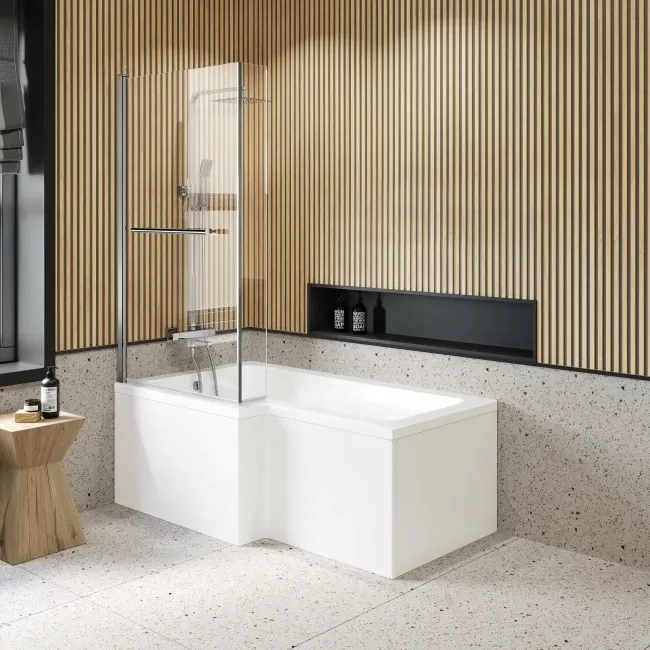
L-shaped tubs are characterized by straight, angular lines. The main body is straight or rectangular, but one end widens significantly in depth to create a generous area for showering. These baths are “handed,” depending on whether the enlarged showering area is preferred on the left or right side.
P-Shaped
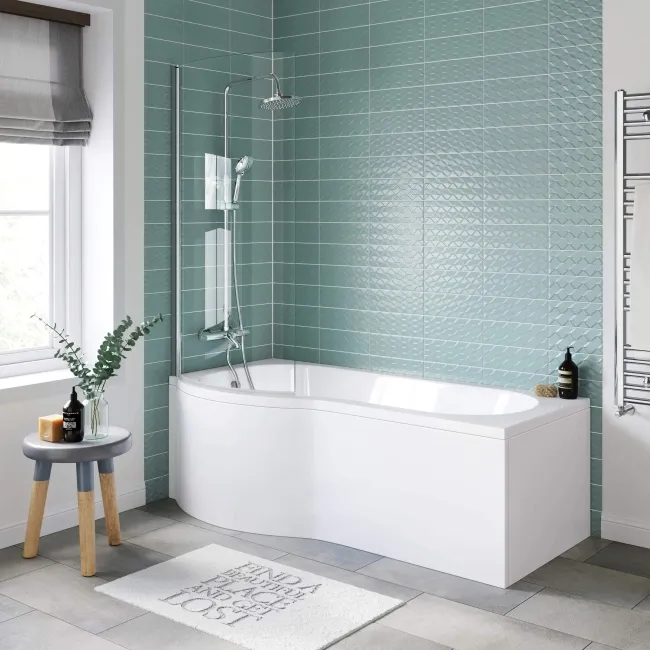
P-shaped tubs feature a squared end for bathing and an end that curves outward, providing a spacious showering area. This shape requires a matching curved glass panel and, if needed, a curved front bath panel and straight end panel. They are handed left or right; the right-handed version resembles a capital ‘P’, while the left-handed version is its mirror image.
B-Shaped
These can easily be mistaken for P-shaped tubs, but the b-shaped bath typically features a bulkier showering end. Some versions from certain makers also include a curved, thicker bathing end, making the overall shape resemble a capital ‘B’.
J-Shaped
J-shaped combination baths have a straight back and end, while the front begins straight and sweeps into a simple, quadrant-like curve. These are also available in left or right-handed designs.
D-Shaped
D-shaped baths come in two primary forms. The first has a straight back that sits flush against the wall, two straight sides, and a single, smooth curved front. The second design is a more elongated ‘D’ shape, featuring two longer straight edges (front and back) and a curved end. Like squared tubs, these don’t necessarily have handing, as they can often be rotated to fit.
Understanding Handing: Left or Right?
“Handing” refers to the intended installation orientation of the fixture. While the term usually relates to which hand is used to operate an item, for combination tubs, it simply denotes the side on which the showering end is positioned.
A left-handed combination bath is typically installed with the shower fixtures (brassware) and the showering space positioned to the left-hand side. Right-handed combination baths are the opposite.
There is no practical advantage to choosing one over the other. The decision is purely dictated by the layout of your space, the optimal placement for plumbing and waste systems, and your personal preference if both orientations are viable.
Typical Dimensions and Sizing
Combination tubs come in a wide range of sizes, making them highly adaptable to almost any space.
| Typical Dimension | Range |
| Length | 1400mm – 1800mm |
| Width/Depth | 600mm – 900mm* |
| Height (Depth of Tub) | 350mm – 700mm* |
*Note: The Length is the smallest or largest your space can accommodate. Remember to allow for tolerance for tiling, boxing, and sealing.
*The Width (or outward depth) is key for shaped tubs. Straight and D-shaped tubs will have a consistent width (popularly 600-800mm). Shaped tubs (L- or P-shaped) will have two width dimensions: one for the narrower bathing end, and one for the wider showering end. Your layout and preference will determine which dimension is prioritized, which can affect floor space or the neatness of the finish against a measured recess.
*The Height dimension refers to the depth of the tub itself, not the installed height. Most standard combination tubs fall into the 350-500mm range. Freestanding versions with legs, however, are taller and can reach 650-700mm once installed.
Material and Thickness Considerations
The thickness refers to the material used and can vary by manufacturer. Most combination tubs are made from acrylic, a standard, plastic-like industry material. Some producers offer a choice between standard acrylic and a reinforced acrylic, which includes an extra layer of resin or fiberglass to create a stronger, more resilient material. This slightly increases the thickness, though it may not be visually noticeable. The acrylic layer itself is generally between 4mm and 6mm deep, regardless of whether it’s reinforced.
Another common material is steel enamel, used by certain high-quality brands. This material is generally between 2mm and 4mm thick, but its metallic composition is excellent at retaining heat.
Benefits of a Combination Bath
Combination baths offer numerous advantages:
- Affordable – Often priced more economically than a fully freestanding tub, making them a great choice for everyday family bathrooms.
- Best of Both Worlds – They successfully merge the features of a tub and a shower, satisfying both bathers and shower-lovers.
- Harmony – By catering to all preferences, they help eliminate household friction over morning routines.
- Durability – Many models are built with longevity in mind, offering a long service life.
- Adaptable – The wide variety of shapes and sizes ensures they can be integrated into nearly any bathroom layout.
- Easy Maintenance – They require no special care; simple soap and water are usually sufficient for the tub, and standard glass cleaner keeps the screen sparkling.
- Universal Aesthetic – Their standard white color allows them to blend seamlessly with any chosen color palette or theme.
- Customizable – You can personalize the look by choosing specific brassware (style and color), bath panels, shower screen (or curtain), and accompanying accessories.
- Family-Friendly – Ideal for families, especially for parents bathing young children, or even for washing pets.
Positioning a Combination Bath Under a Window
It is possible to place a tub under a window, but there are practical points to consider. A bathroom window is an emergency exit point, and you need to ensure easy access for ventilation to prevent the buildup of moisture, mold, and mildew. As long as the window remains accessible for opening, positioning the tub there shouldn’t be a problem and can actually help with faster ventilation. Privacy is also a factor, requiring a solution like waterproof blinds or shutters.
In some spaces, placing the tub under the window is the only practical way to fit it in, and it can create an attractive focal point. It is always recommended to consult a professional installer first to confirm feasibility.
Tap Holes and Faucets

The availability of pre-drilled tap holes depends on the specific combination bath model and your choice of faucet. Many tubs come undrilled, requiring the installer to drill the necessary holes to accommodate your preferred number and type of taps.
When drilling into the tub deck, this typically involves two holes or more for separate hot and cold faucets, a bridge mixer, or a standard bath mixer tap (with or without a shower handset). Another option is a three-tap-hole set, which includes two levers for the hot/cold water and an accompanying spout or bath filler.
For a cleaner aesthetic, and provided the plumbing allows, you can opt for wall-mounted bath taps. These come in both modern and traditional styles and can be mounted on the back or side wall, offering a tidy, aesthetically-pleasing finish.
Inspiration and Styles
Images throughout this guide illustrate various styles and designs. For further inspiration, consider viewing lifestyle images that showcase how combination baths fit into broader bathroom themes.
Manufacturing and Cost
Many companies that supply tubs offer a full range of standard, combination, and freestanding baths. Costs vary by retailer and maker. Entry-level models may start around £250-£300, while the upper range can approximate £500-£1,200, depending on features like material reinforcement and whether it is a freestanding design.
Selecting the Right Combination Bath
Is there a single “best” combination bath? Each design and manufacturer offers unique benefits and selling points. The ideal choice ultimately depends on your personal taste, preferred style, and finding the perfect fit for your space.


